
A large OSPF campus with 800 routers sees CPU spikes when access-layer links flap, flooding many transit LSAs and triggering repeated full SPF runs. The design must dampen churn while keeping loop-free convergence. Which OSPF scaling tuning with LSA throttling, SPF timers, and prefix suppression fits?
Select an answer to reveal the explanation.
Short Explanation
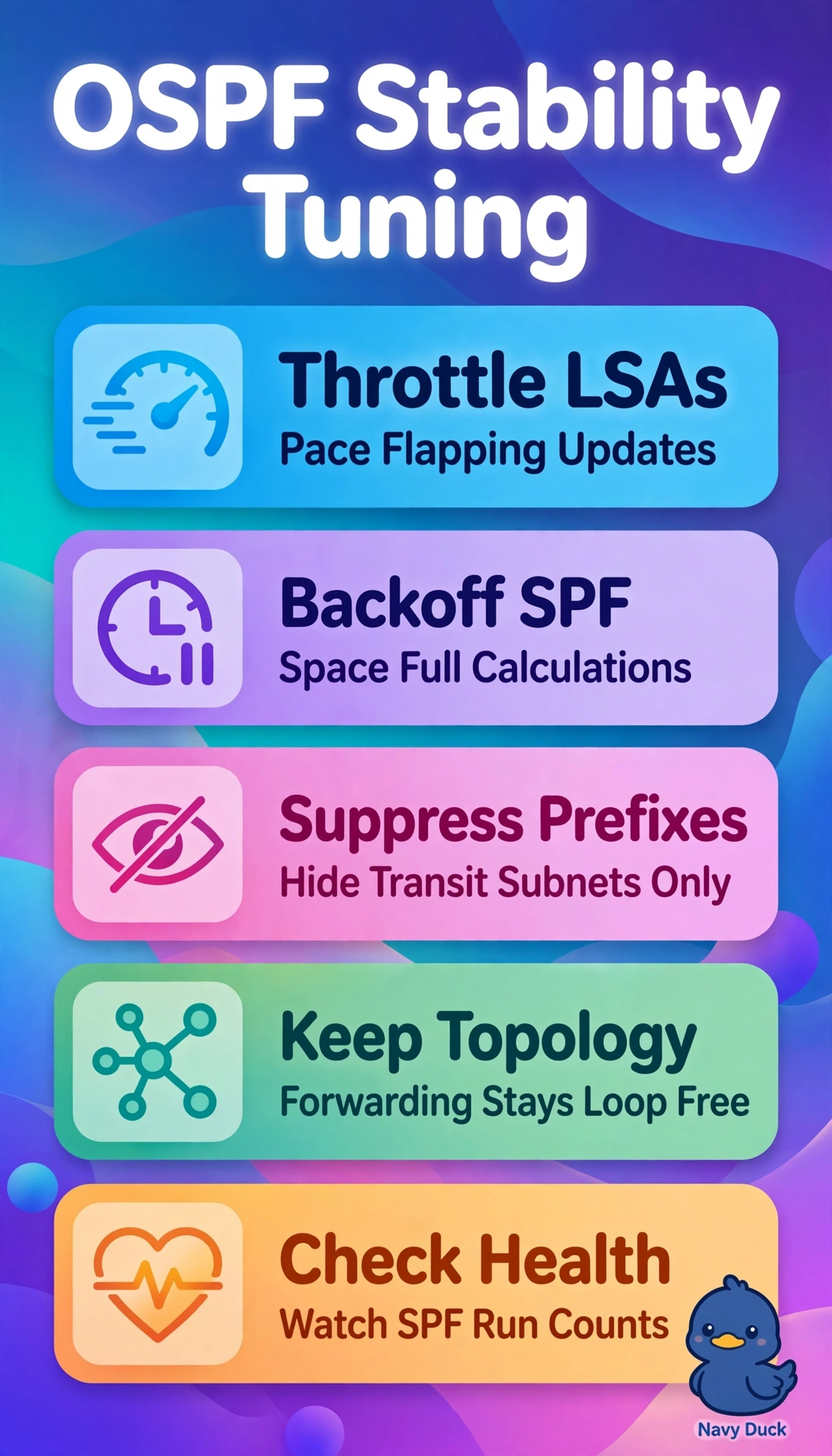
You can keep access-link flaps from making the whole campus recalculate immediately. LSA throttling and exponential SPF backoff pace the work, while prefix suppression quiets unnecessary transit advertisements. These shock absorbers protect CPU while preserving loop-free convergence.
Full Explanation
The effective tuning dampens access churn without sacrificing loop-free convergence by pacing both LSA origination and SPF computation while pruning unnecessary detail. LSA throttling spaces repeated advertisements, and exponential SPF backoff reacts quickly to an initial event but waits progressively longer before repeated full SPF runs, protecting CPU while still computing correct loop-free paths. Suppressing transit prefixes on access interfaces removes unstable prefixes from advertisements while retaining link topology for forwarding. LSA throttling with incremental SPF optimization but openly advertised access transit prefixes may speed computation per run, but leaves flooding volume unchanged. LSA throttling and prefix suppression with fixed rapid SPF timers may help a single failure, but do not penalize sustained flaps and can recreate CPU spikes. LSA throttling with exponential backoff and totally stubby access areas without redundancy contains LSAs, but removes alternate paths and resilience needed for campus convergence. Exam caveat: distinguish LSA generation pacing, SPF execution pacing, and computation optimization; incremental SPF does not replace backoff. Practically, check show ip ospf timers rate-limit and show ip ospf statistics after flapping a test access link to verify paced LSAs, deferred SPF, stable CPU, and preserved failover.