
A hospital campus suffers STP reconvergence delays and blocked redundant links between access and core, requiring active-active uplinks, sub-second failover for imaging traffic, and no spanning-tree loops across buildings. Which loop-free campus topology should the designer specify to remove STP blocking while keeping redundancy?
Select an answer to reveal the explanation.
Short Explanation
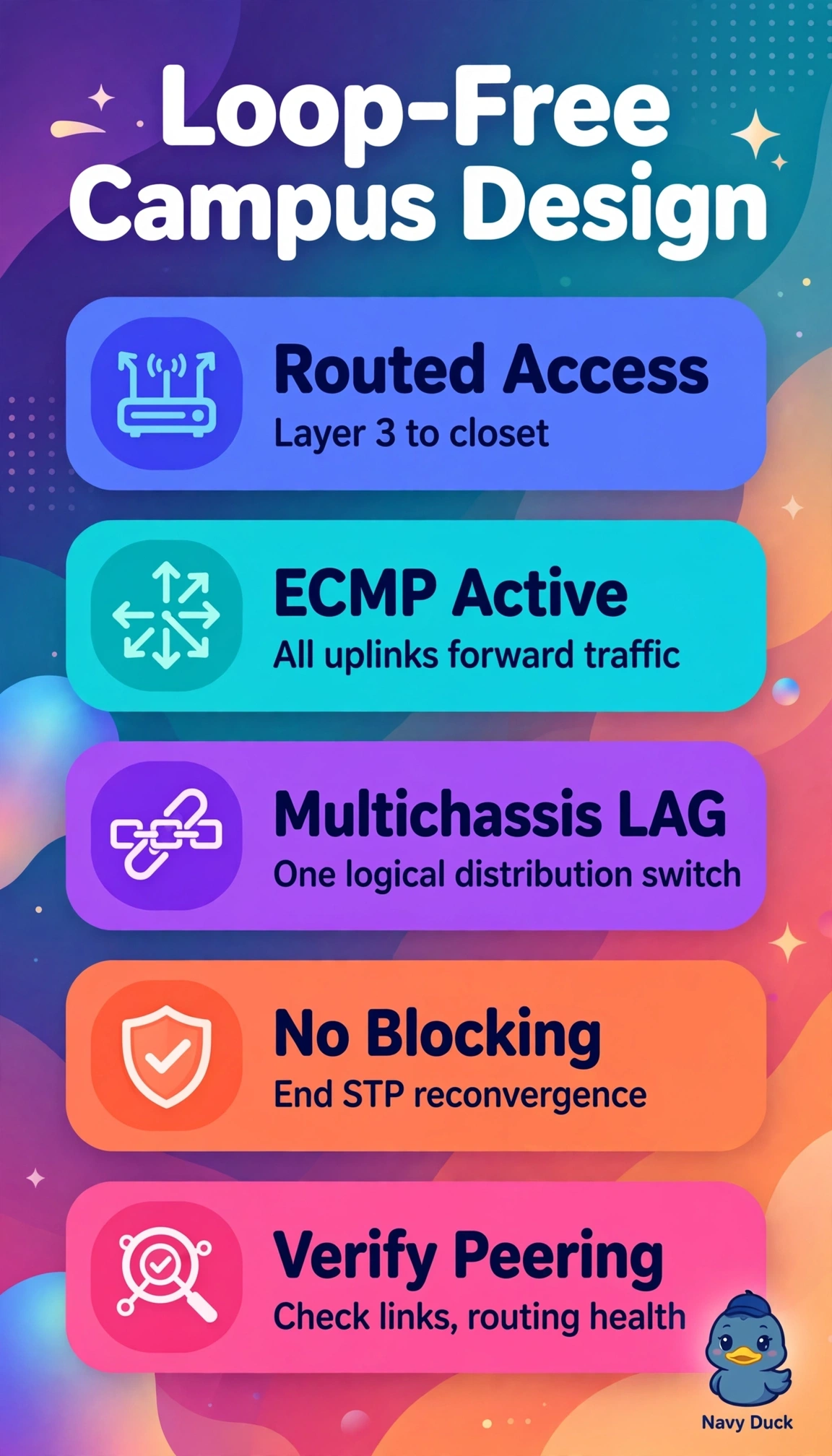
You are done letting half your links nap in blocking mode. Routed access turns every uplink into a forwarding path with fast routing failover. No blocked ports, no spanning-tree drama.
Full Explanation
Routed access moves Layer 3 boundaries to the access or distribution layer so each closet has equal-cost routed uplinks with fast IGP convergence instead of STP blocking, while multichassis EtherChannel such as StackWise Virtual or Virtual Switching System lets two physical chassis appear as one logical switch so access switches can dual-home with all links forwarding without spanning-tree loops. A large tuned Layer 2 domain still depends on spanning tree and flood scope grows with size, so blocked links and reconvergence risk remain for imaging traffic. Single-homed access with isolated VLANs removes redundancy entirely and per-VLAN rapid spanning tree still blocks redundant paths where they exist. Hub-and-spoke Layer 2 trunks with BackboneFast on access ports misapplies a backbone convergence aid and preserves a single large failure domain with blocked or single paths. For the exam, remember routed access or multichassis EtherChannel equals loop-free by design rather than by blocking, and in practice verify ECMP paths, peer-link health, and that no VLAN spans beyond its intended boundary.