
A manufacturer operates a headquarters plus three distant plants connected over private WAN. Each plant has local IT, unique security policy, 2,500 endpoints, and must survive WAN outages with local forwarding while sharing select services. Which SD-Access fabric site design handles autonomous sites with shared transit?
Select an answer to reveal the explanation.
Short Explanation
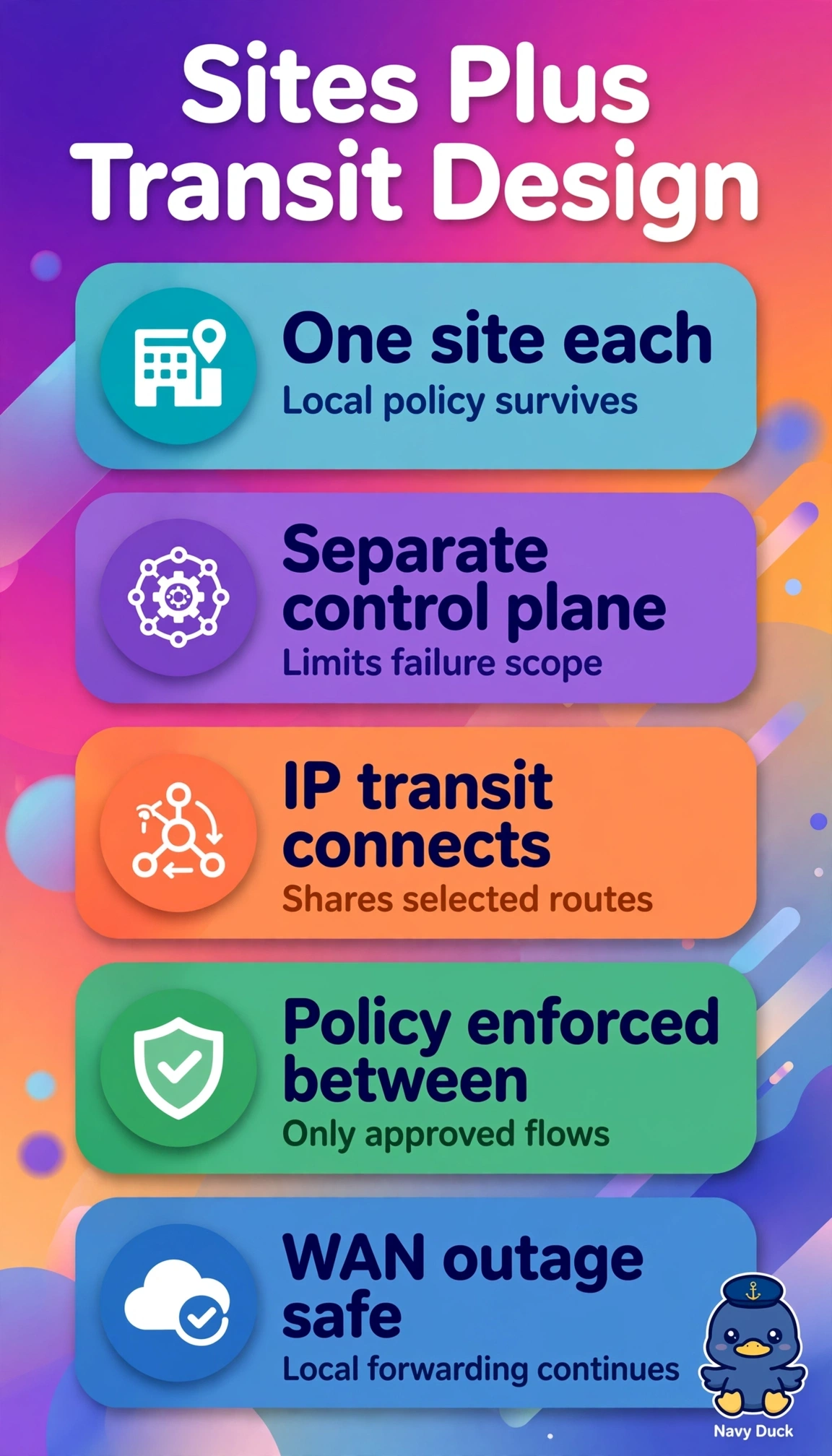
You've got four busy kitchens that need to cook on their own when the road's out, so you'll give each site its own fabric and link them like neighborhoods sharing a highway. Your IP transit then lets you swap only the routes you've approved.
Full Explanation
The distributed model with IP-based transit fits because each headquarters and plant operates as an independent fabric site with local control-plane nodes, borders, and edge nodes maintaining its own virtual networks and group-based policy, allowing forwarding, authentication, and authorization to continue during WAN outages while preserving unique policy for 2,500 endpoints under local IT, with IP transit interconnecting sites and fusing only approved virtual networks at borders for controlled access to shared services. Connecting sites with SD-Access transit fails as policy-stretch design because it extends end-to-end segmentation with common control-plane semantics for seamless roaming, contradicting required autonomy and selective fusion. Centralizing the control-plane cluster at headquarters fails as centralized-control design because LISP map-server/resolver dependence for registration and policy resolution leaves plants isolated if the private WAN fails, violating local-forwarding survivability. Using Fabric-in-a-Box with fully duplicated services fails as isolated-box design because eliminating transit forces independent hosting of every shared service per site, breaking selective sharing and misapplying a small-branch embedded-control design to large plants needing scale. For exams, distinguish IP transit for autonomous different-policy sites with selective fusion from SD-Access transit for unified-policy domains with stretched segmentation, and practically verify redundant local control-plane nodes, border-to-transit peering, and the explicit extended-versus-fused virtual-network list.