
A global manufacturer has headquarters in Chicago, regional hubs in London and Singapore, and 150 branches needing direct branch-to-branch collaboration, including between branches in different regions. Leadership wants resilient control, localized breakouts, and efficient overlay paths without hairpinning everything. Which SD-WAN control-plane and overlay design best fits these considerations?
Select an answer to reveal the explanation.
Short Explanation
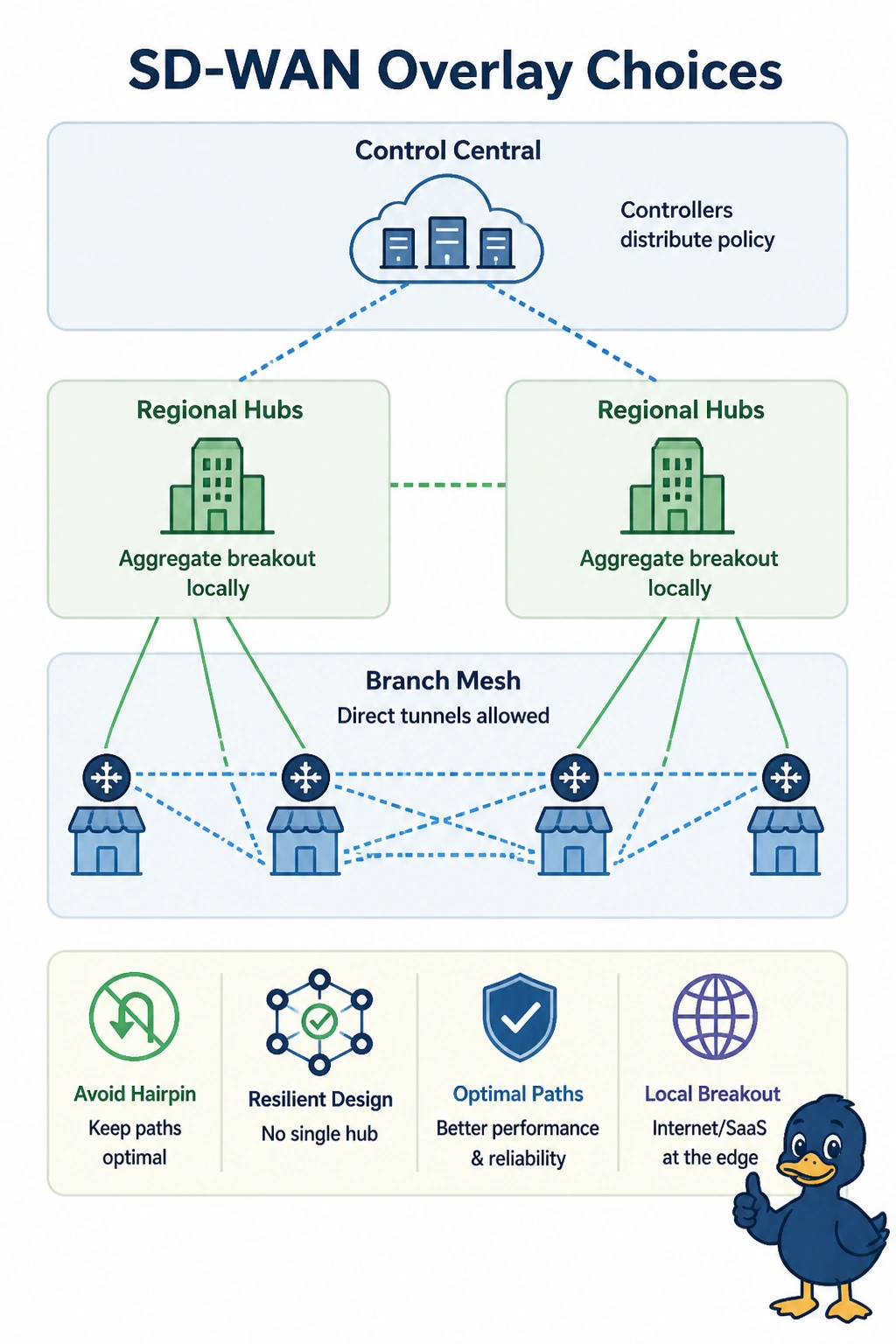
You’re building regional hubs with direct shortcuts between branches, including across regions. That hierarchy gives you resilient control and efficient paths without forcing traffic through a hub.
Full Explanation
Regional hub-and-spoke hierarchies with full-mesh data-plane tunnels best fit the requirements: regional hubs support resilient, scalable control while preserving centralized policy intent, and localized breakouts keep internet and cloud egress close to users for performance and compliance. Allowing direct tunnels between branches, including across regions, gives voice, video, and collaboration traffic efficient overlay paths without forced hairpinning. A design that requires all branch traffic to pass through regional hubs fails on path efficiency: mandatory hub transit increases latency and hub load even with localized breakouts. A design that permits direct tunnels only within each region fails the global collaboration requirement, since it prevents efficient direct paths between branches in different regions. A design that backhauls all internet breakouts through Chicago fails the localized-breakout goal, adding latency and undermining regional resiliency and sovereignty for London and Singapore. Exam caveat: control-plane hierarchy does not necessarily mean mandatory data-plane transit; distinguish the two. Practical check: validate controller affinity and quorum, regional DIA and DNS egress, and on-demand tunnel establishment with SLA-based steering between representative branches before cutover.