
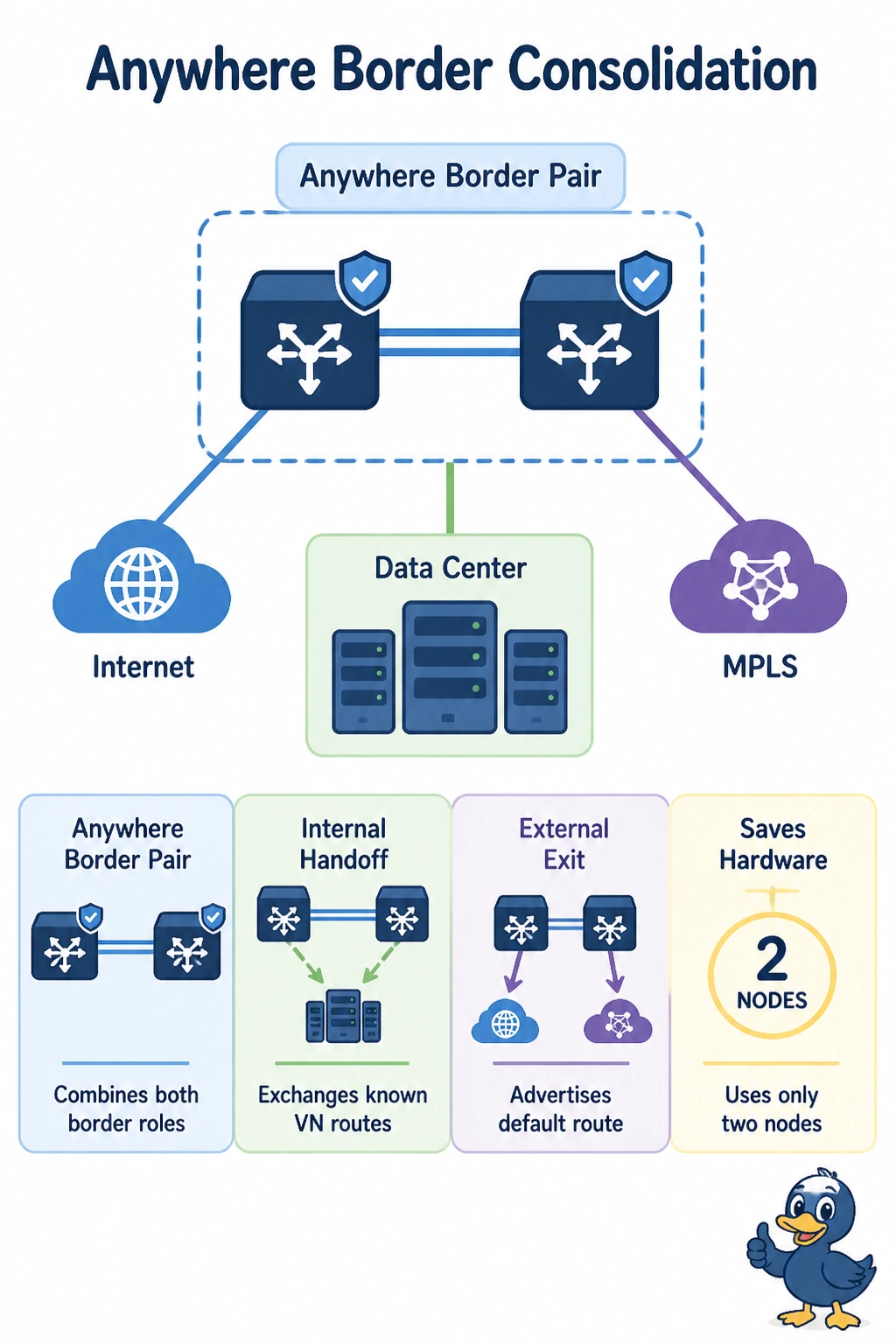
A logistics company builds one SD-Access fabric in its headquarters with only two border routers, needing to hand off corporate VNs to its data center, provide Internet and MPLS exits, and advertise a default route into the fabric. Which border node design fits this consolidated edge requirement?
Select an answer to reveal the explanation.
Short Explanation
You’re short on doors but still need staff and visitors to use the right one. Consolidation with an anywhere border handles both internal handoff and outside exits on one pair.
Full Explanation
The scenario requires a single headquarters fabric with only two border routers to perform both internal virtual network extension to the data center and external connectivity to Internet and MPLS while advertising default into the fabric, which is the role of an anywhere border (internal plus external) where internal and external functions are combined on the same pair to conserve hardware without sacrificing policy or reachability. The external-only design is operationally sound for Internet and MPLS peering with default origination, yet it fails by concept because it does not extend corporate virtual networks to the data center and therefore leaves internal handoff unaddressed. The internal-only design is commonly used to extend virtual networks and preserve segmentation to the data center while sourcing reachability internally, yet it fails by concept because it lacks peering to outside domains and cannot provide true Internet and MPLS exits. The dedicated-pair design with separate internal and external pairs is a valid large-scale best practice for fault isolation and policy scaling with full default handling, yet it fails on the stated fact of limited hardware because it requires four routers instead of the available two. For exam purposes, remember that only an external or anywhere border should originate the fabric default from outside, an internal border alone never satisfies an Internet exit requirement. As a practical check, verify the fusion configuration, virtual routing and forwarding imports, handoff subnets, and that fabric endpoints actually receive the default before declaring the consolidated edge complete.