
A hospital will keep patient-record VMs on its own hypervisors, build care-coordination apps on a managed database and app platform, and adopt cloud email with no server patching. Which SaaS, PaaS and IaaS responsibility mapping best informs the network design?
Select an answer to reveal the explanation.
Short Explanation
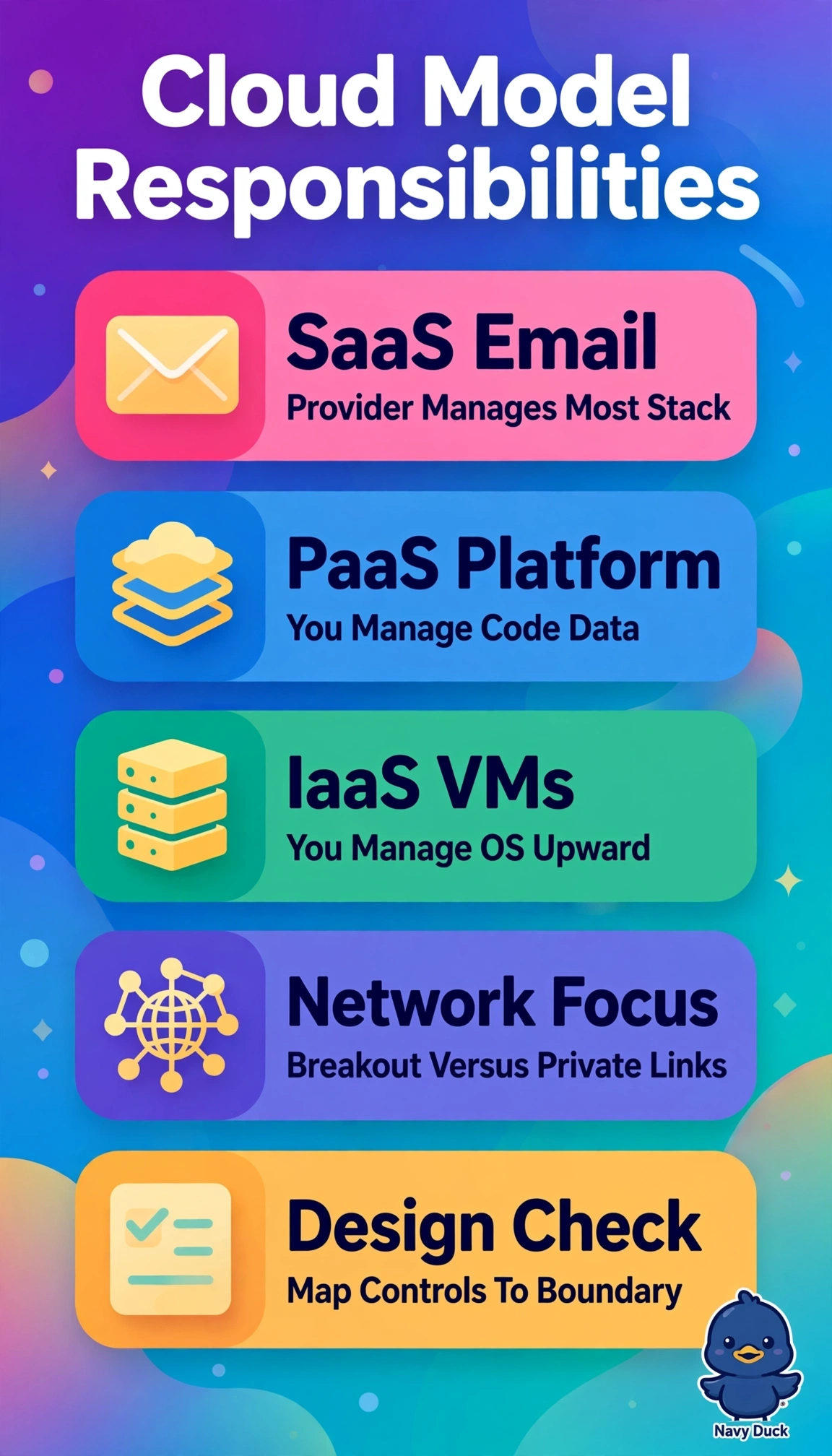
Sorting these services correctly saves you from building the wrong roads. SaaS shifts most stack to the provider, PaaS shares app control, IaaS leaves you holding the OS upward. Nail that boundary and your breakout and VPN choices fall into place.
Full Explanation
Cloud responsibility scales with abstraction: SaaS leaves the provider managing application through infrastructure so enterprise networking centers on Internet access, identity, and CASB or secure web gateway policy; PaaS leaves the customer managing code and data while the provider manages runtime and middleware so networking centers on API access, private endpoints, and developer connectivity; IaaS leaves the customer managing OS, apps, and data while the provider manages virtualization and physical fabric so networking centers on virtual networks, hybrid VPN or interconnect, and segmentation. Inverting the mapping misplaces controls by treating email as infrastructure needing virtual networks, treating VMs as provider-managed apps needing no patching access, or treating platforms as fully outsourced. Exam caveat is to classify by who manages OS and application rather than by brand name, and practically check data ownership, private connectivity needs, and where TLS inspection and identity enforcement should sit for each model.