
A 2,000-seat contact center runs voice, agent video, and bulk data backups over a congested 1-Gbps WAN edge. Voice needs strict latency bounds, video needs guaranteed bandwidth, and backups must not starve during bursts. Which queuing and congestion-avoidance design meets the end-to-end QoS policy goal?
Select an answer to reveal the explanation.
Short Explanation
You're giving voice a fast lane without letting it hog the highway. Low-latency queuing plus fair shares and early drops delivers that prioritization balance beautifully.
Full Explanation
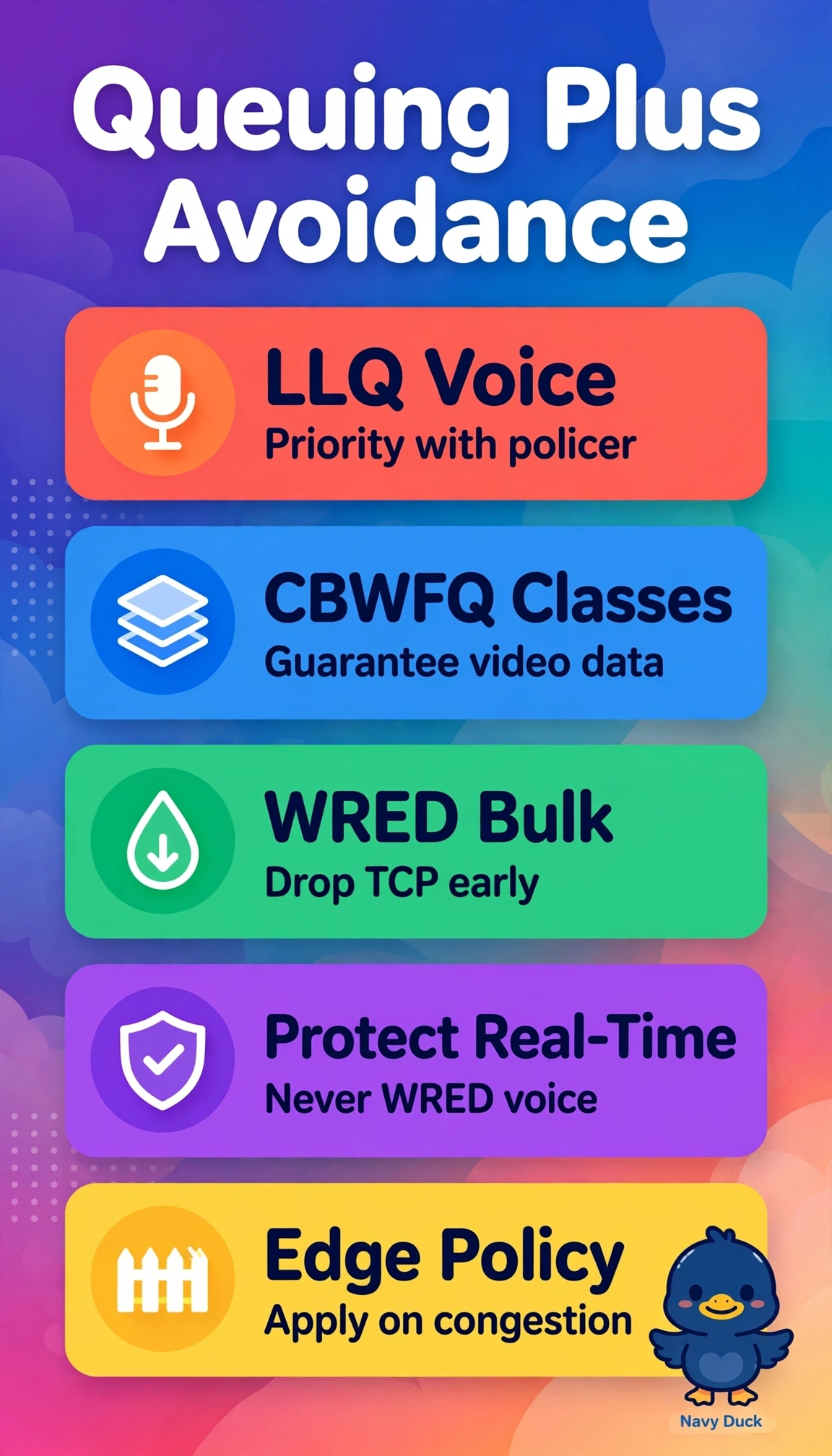
Low-latency queuing provides a strict-priority queue with an implicit policer for voice to bound delay and jitter while preventing starvation, Class-Based Weighted Fair Queuing guarantees minimum bandwidth to video and data classes, and Weighted Random Early Detection proactively drops bulk TCP before queues fill to avoid global synchronization. Placing voice in CBWFQ without a priority queue cannot provide delay guarantees because fair scheduling still queues voice behind other packets, and enabling WRED on voice harms real-time media that should be policed rather than randomly dropped. Single FIFO with tail drop provides no differentiation or protection during congestion, and trusting all markings invites abuse, while giving strict priority to every class collapses to FIFO behavior and lets bursty video or backups starve other traffic without policing. For the exam, link LLQ to voice, CBWFQ to bandwidth guarantees, and WRED to TCP-based bulk classes, and in practice verify priority policer rates and queue thresholds under load testing.