
A retailer has a headquarters data center, 30 branch stores needing direct cloud SaaS access, and a new AWS-hosted inventory app that must scale for holiday bursts. Branches suffer backhaul delay, the data center needs stable high capacity, and cloud workloads must burst without new circuits. Which WAN connectivity mix should the designer recommend for on-premises, hybrid and cloud needs?
Select an answer to reveal the explanation.
Short Explanation
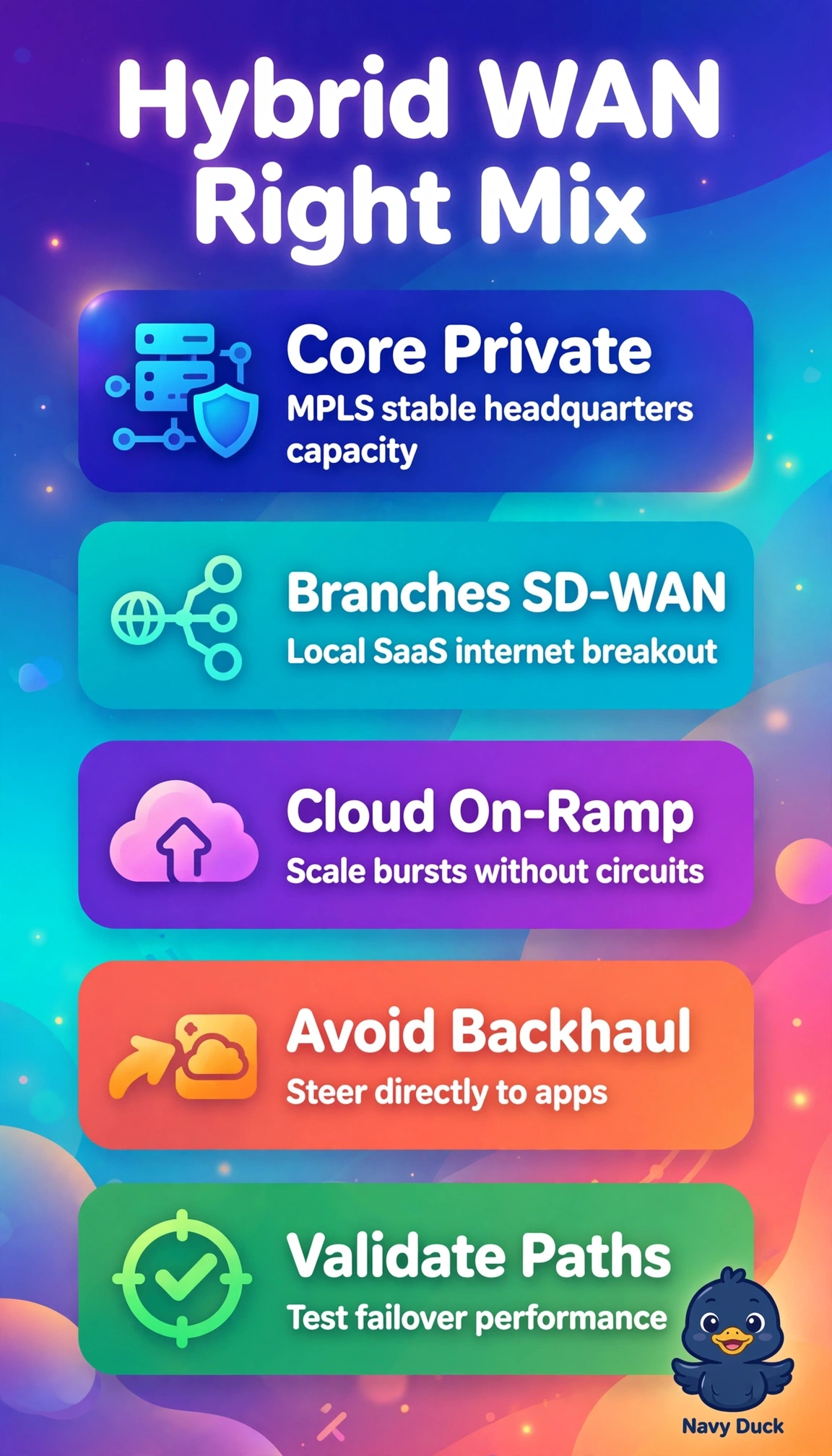
You are matching each site to its appetite for control and agility. Hybrid WAN keeps the data center steady while SD-WAN steers branches smartly to SaaS and cloud. Stable core, flexible edge — that is the sweet spot.
Full Explanation
The correct mix maps technology to requirement: private MPLS or leased line gives headquarters deterministic high capacity with SLA-backed throughput for centralized systems, internet-based SD-WAN gives branches local breakout for SaaS to eliminate trombone backhaul delay, and a cloud on-ramp provides elastic on-demand connectivity so the AWS inventory app scales for holiday bursts without provisioning new circuits. The centralized MPLS backhaul design fails on branch optimization because hubbing all store traffic through headquarters preserves congestion and latency for SaaS even while it delivers headquarters stability and scalable cloud interconnect. The fixed MPLS extension into AWS fails on elasticity because static circuits require lead time and fixed bandwidth, so holiday bursting would demand new provisioning despite correct headquarters transport and correct branch breakout. The all-internet SD-WAN design fails on headquarters assurance because broadband without private transport lacks guaranteed capacity and strict jitter loss bounds, even while it correctly enables direct SaaS access and cloud elasticity. An exam caveat is to separate stable predictable capacity from burstable elastic demand rather than treating private as always superior, since the test rewards fit to constraint. As a practical check validate headquarters committed rate and SLA, test per-store SD-WAN path selection with secure local egress, and confirm the on-ramp supports burstable virtual interfaces to the inventory VPC before peak season.