
A multinational enterprise has a registered global prefix, five large campuses, and plans for hundreds of VLANs, point-to-point links, and loopbacks with easy summarization and future growth. The team wants consistent subnetting without address scarcity. Which IPv6 prefix hierarchy with site and subnet sizing should the addressing plan adopt?
Select an answer to reveal the explanation.
Short Explanation
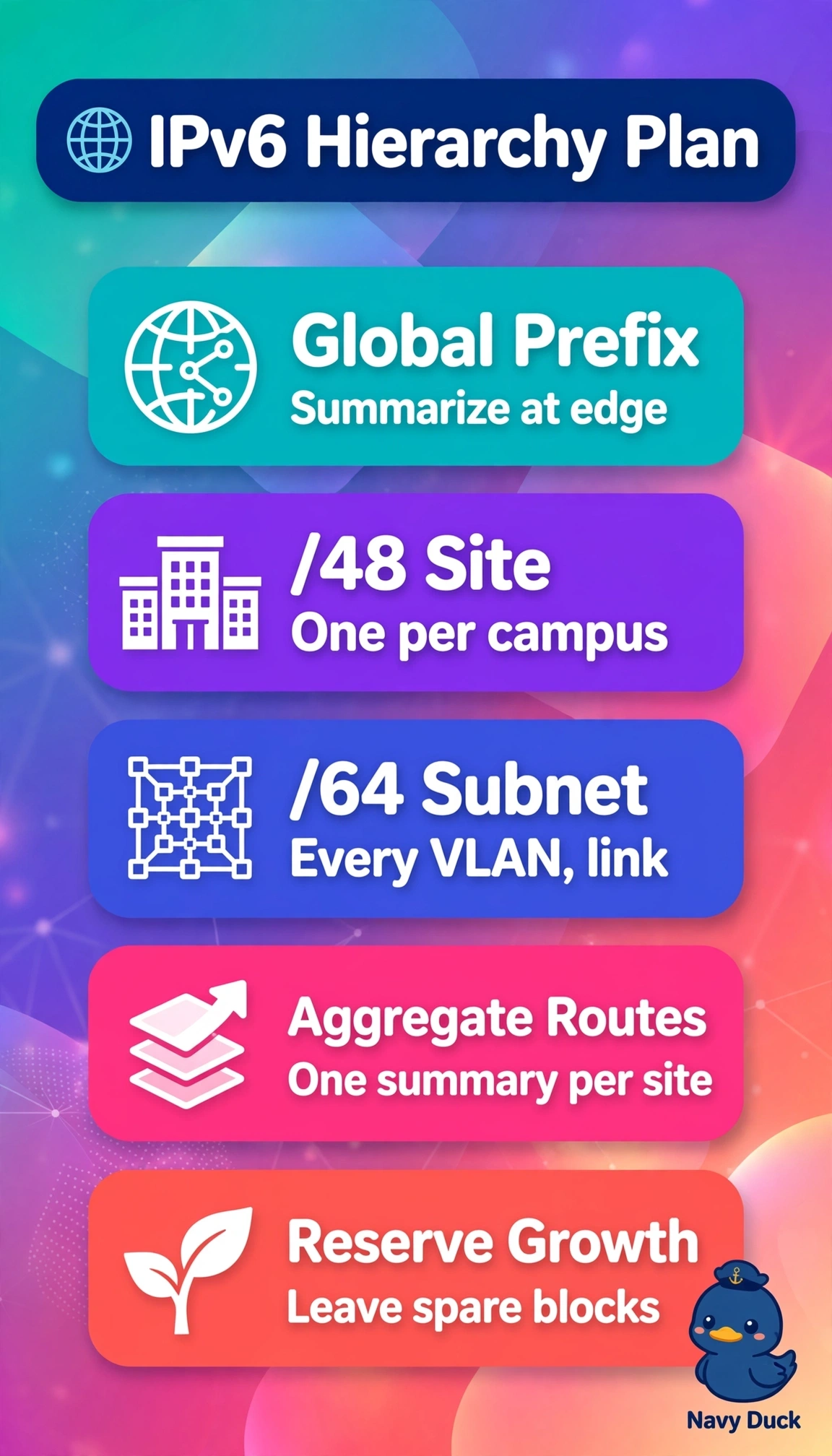
You're set for life on space, so be generous and orderly. A tidy hierarchy of /48 sites carved into /64 subnets keeps routing clean and growth painless, like giving each campus its own zip code and every street its own name.
Full Explanation
The long-established IPv6 design practice assigns a /48 to each site to provide ample 16 bits of subnet space, with a /64 per subnet to support stateless autoconfiguration, neighbor discovery, and uniform operations, allowing aggregation of each site to a single summary route toward the core. Assigning only a /64 per site leaves no subnet bits and breaks summarization and growth, using sub-/64 variable lengths for LANs violates the /64 boundary assumed by SLAAC and many host stacks, and sharing a single enterprise /64 with IPv4 secondaries defeats hierarchical routing and IPv6 autoconfiguration benefits. For the exam, remember /48 for site, /64 for subnet, and /127 or /126 only for carefully scoped point-to-point links where you consciously forgo SLAAC, and in practice document the nibble-aligned allocation, reserve space for future sites, and validate that firewalls and ACLs are built around summarized prefixes.