
An enterprise video team streams quarterly town halls from one data-center source to 400 branch receivers, with sparse participation between events and a need for efficient paths during streams. PIM sparse mode with a rendezvous point is deployed. Which PIM sparse mode operation with source and shared trees should the designer describe to meet efficient delivery?
Select an answer to reveal the explanation.
Short Explanation
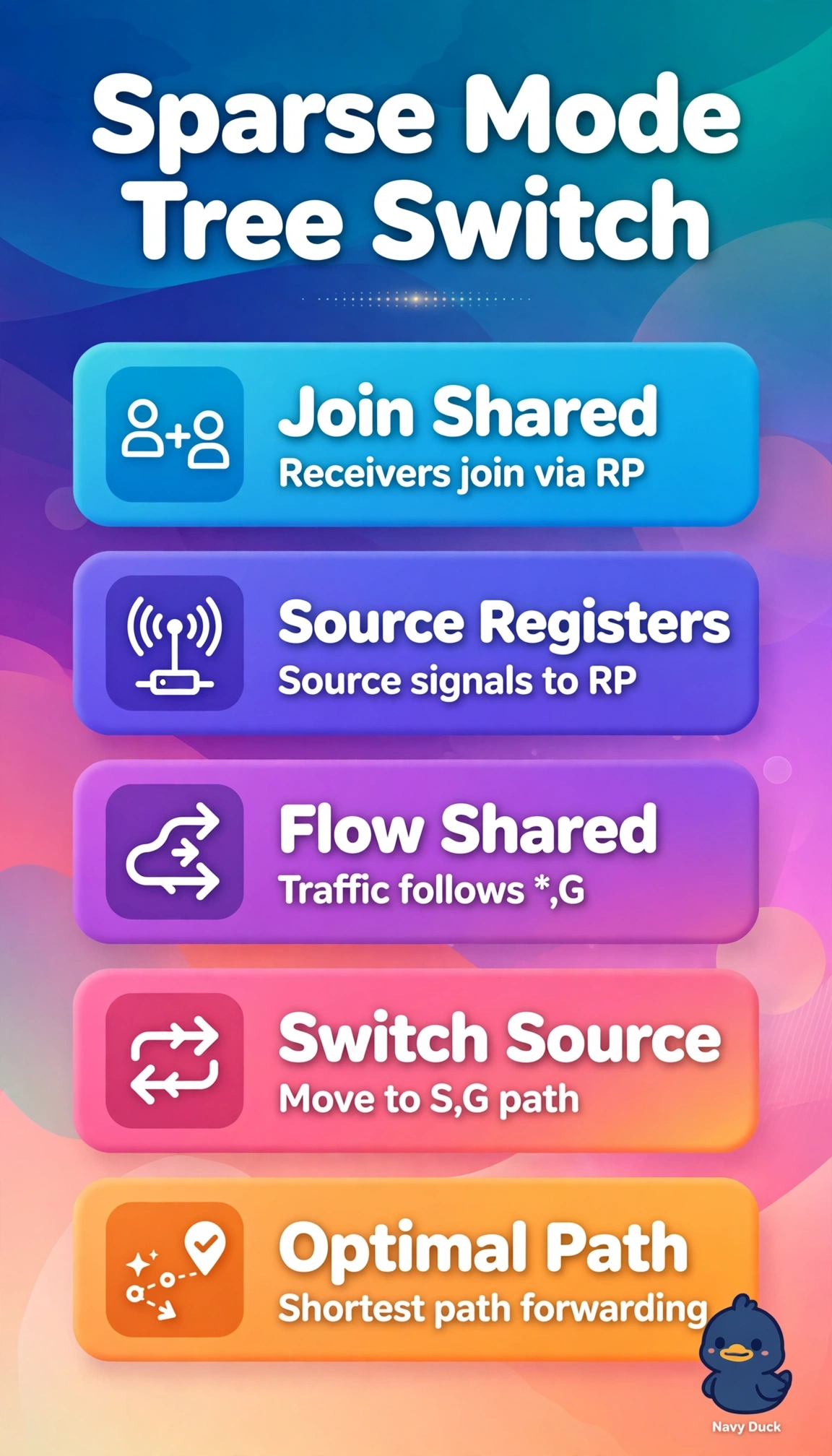
You're handling occasional big audiences efficiently, so start shared then go direct. That RP-to-source switchover is the switchover magic that keeps sparse mode both scalable and optimal, like meeting in a lobby then walking straight to offices.
Full Explanation
PIM sparse mode uses an RP-rooted shared tree denoted *,G to allow receivers to signal interest without flooding, with sources registering to the RP, and then last-hop or intermediate routers can trigger a shift to a source-rooted shortest-path tree denoted S,G for lower latency and better link utilization once traffic flows. Staying permanently on the shared tree sacrifices path optimality and concentrates load on the RP, building source trees immediately without an RP reverts to flood-and-learn or dense behavior that wastes bandwidth when receivers are sparse, and flood-then-prune describes PIM dense mode rather than the explicit join mechanics of sparse mode. For the exam, associate sparse mode with explicit joins, RP discovery, and SPT switchover thresholds, and in practice confirm RP placement and redundancy, SPT threshold policy, and that the underlying unicast routing supports reverse-path forwarding toward both RP and source.