
A 500-seat contact center runs voice, video meetings, and bulk CRM sync over a 200-Mbps WAN that congests at quarter-end. Voice needs strict low delay, video needs guaranteed bandwidth without starving data, and TCP bulk traffic needs early drops before queues fill. Which queuing and congestion-avoidance combination should the designer specify for the WAN edge?
Select an answer to reveal the explanation.
Short Explanation
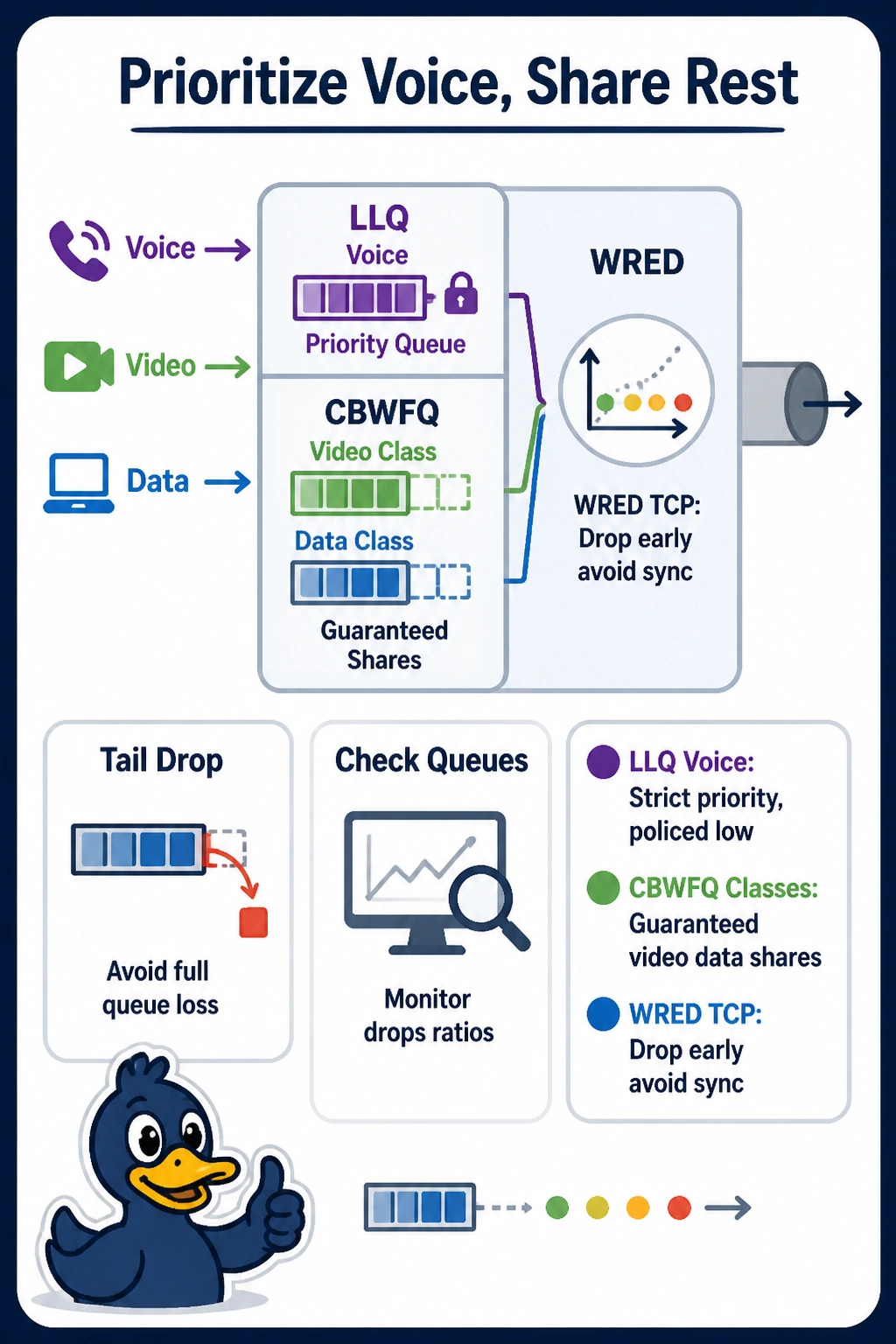
You have got three different appetites sharing one pipe here. LLQ gives voice the express lane while CBWFQ shares the rest fairly and WRED taps the brakes early. Strict where it counts, fair everywhere else.
Full Explanation
Low-latency queuing provides a strict-priority queue policed for voice delay and jitter while class-based weighted fair queuing guarantees minimum bandwidth shares to video and data classes during congestion so bulk TCP cannot starve interactive traffic, and weighted random early detection avoids global TCP synchronization by probabilistically dropping lower-priority TCP packets before the queue fills while leaving the priority voice queue untouched. Using CBWFQ alone with tail drop and FIFO treats voice the same as bulk data and tail drop causes full-queue drops and synchronized retransmissions that increase delay for voice. Placing voice, video, and bulk data all in priority queues defeats policing because LLQ priority traffic can starve CBWFQ classes and bulk data should never receive strict priority. Shaping voice instead of prioritizing it adds delay and buffering to delay-sensitive traffic, which violates voice requirements, and tail drop for TCP repeats congestion-collapse behavior. For the exam, remember LLQ is priority plus CBWFQ plus policer and WRED is for TCP avoidance, and in practice verify priority policer drops, class bandwidth ratios, and WRED thresholds during peak load.