
A service provider automation team needs sub-second streaming telemetry plus programmatic configuration on IOS XE with strongly typed data models and efficient binary transport. They are comparing SNMP polling, REST APIs, and model-driven telemetry. Which description correctly captures gRPC and gNMI roles and benefits for this telemetry and configuration need?
Select an answer to reveal the explanation.
Short Explanation
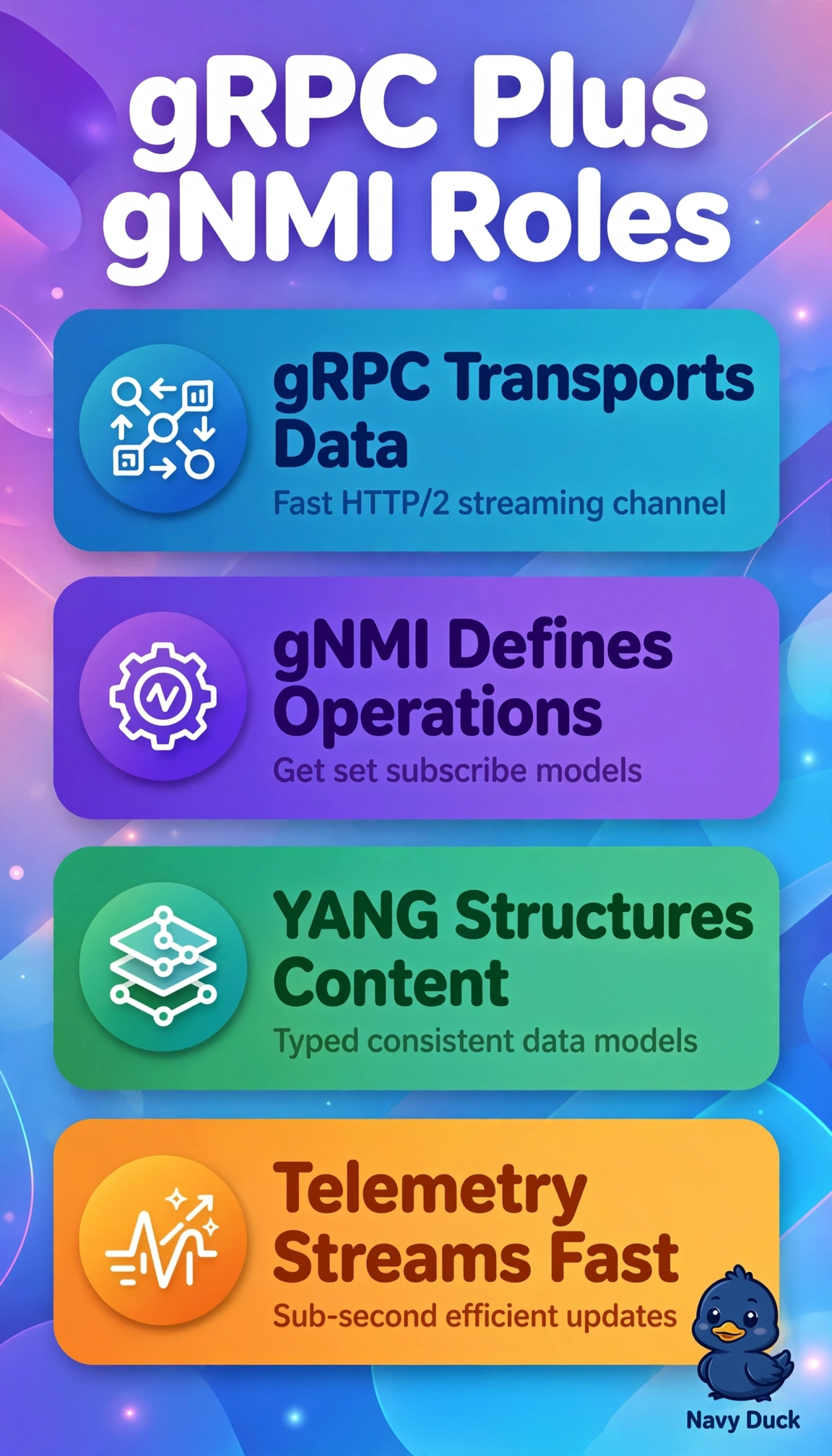
Polling old counters can't keep pace with your streaming dream. gNMI defines what to send or set while gRPC swiftly carries it, like a menu plus fast delivery.
Full Explanation
The correct description fits because gRPC provides HTTP/2-based efficient binary transport using Protocol Buffers that supports persistent streaming and low overhead, while gNMI layered on top provides model-driven operations defined by YANG with strongly typed paths for dial-in streaming telemetry through Subscribe plus Get and Set configuration on IOS XE, alongside Cisco's gRPC dial-out for device-initiated streams, directly meeting both sub-second streaming and programmatic configuration needs. RESTCONF with YANG over HTTPS is valid for programmatic configuration and model-driven polling but fails the efficient binary streaming requirement because it uses JSON or XML over request-response HTTPS without persistent sub-second push. Streaming SNMP MIB counters with gRPC transport is efficient and fast but fails the strongly typed model-driven requirement because MIB and OID structures lack YANG-based semantics and gNMI service operations for configuration. NETCONF with YANG over SSH is valid for strongly typed configuration and event handling but fails the efficient transport and true streaming requirement because XML over SSH sessions is verbose and not optimized for high-frequency binary telemetry. Exam caveat is to distinguish management protocol from transport since RESTCONF, NETCONF, and gNMI can all use YANG yet differ in encoding and push capability. Practical check is to verify IOS XE gNMI dial-in subscriptions or gRPC dial-out destinations, YANG model support, and protobuf encoding with on-change or sample cadence under one second.