
A regional bank runs EIGRP named mode with dual MPLS paths where the backup path has higher delay, wants loop-free unequal-cost sharing from feasible successors, and must keep metric calculation consistent. Which EIGRP metric and unequal-cost design achieves this load-sharing goal?
Select an answer to reveal the explanation.
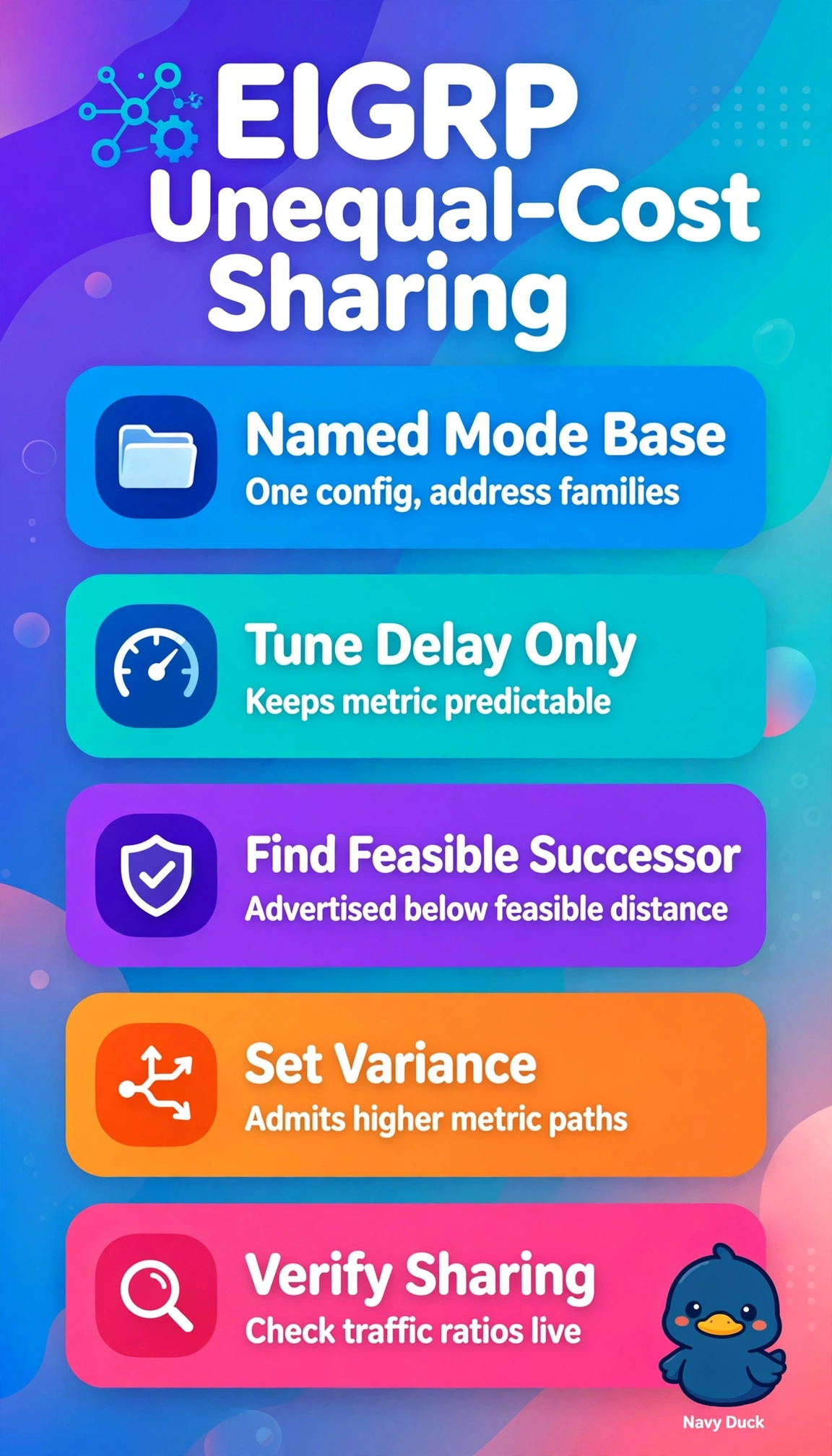
Short Explanation
You're trying to unlock that second-best loop-free path without breaking math. Variance is your gatekeeper that admits feasible successors for unequal-cost sharing when delay is tuned consistently.
Full Explanation
In EIGRP named mode, delay is the manipulable component of the composite metric alongside bandwidth, and variance defines a multiplier of the successor feasible distance that permits feasible successors with a higher metric to enter the routing table for unequal-cost load sharing while DUAL feasibility condition preserves loop freedom. Tuning bandwidth with maximum-paths fails because maximum-paths controls only equal-cost paths and bandwidth influences the metric in a way that rarely creates the desired ratio, so unequal-cost paths remain unused. Tuning delay with maximum-paths similarly improves the metric design but leaves variance at default, meaning feasible successors stay out of the table and only equal-cost paths share. Tuning reliability with variance fails because reliability is not used in classic metric computation by default and cannot be tuned for traffic engineering, so the design would have no effect. For the exam, remember variance enables unequal-cost while maximum-paths enables equal-cost, and feasible successor status is mandatory; in practice verify with topology table that candidates meet the feasibility condition before raising variance.