
A regional bank has OSPF Area 0 at headquarters, Area 10/20 at branches with 200 LAN prefixes, and a data-center router redistributing 300 acquired-company routes. Leadership wants smaller branch tables, faster convergence, and contained redistribution faults. Which OSPF summarization placement best meets the requirements?
Select an answer to reveal the explanation.
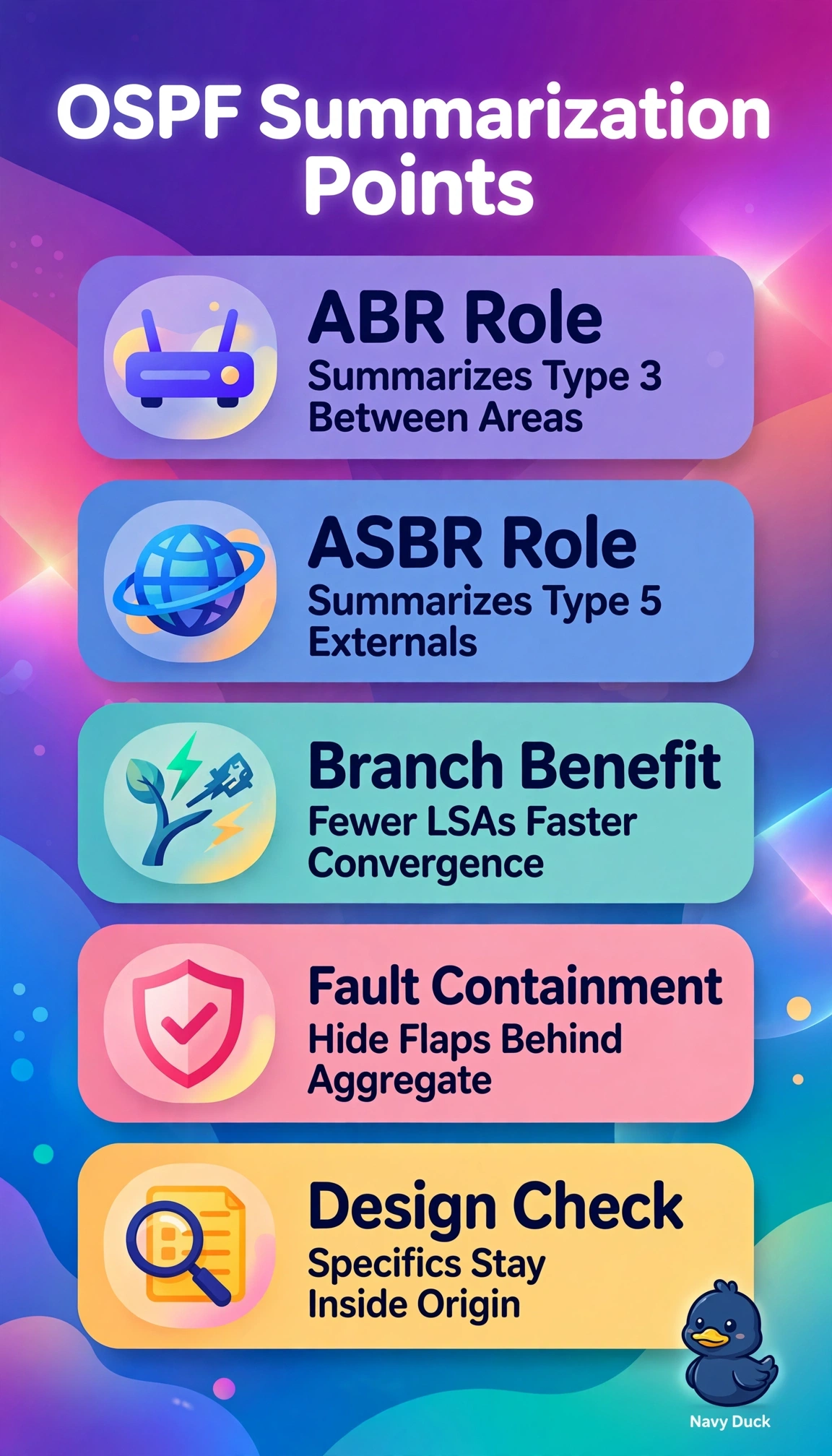
Short Explanation
You have got two summarization knobs here, and location is everything. ABRs tame Type 3s while ASBRs tame Type 5s, so placing each correctly shrinks tables without breaking reachability. That split keeps faults contained like watertight bulkheads in a ship.
Full Explanation
OSPF summarization is hierarchical by role: an ABR summarizes inter-area Type 3 LSAs when advertising one area prefixes into another, which hides branch flaps and reduces LSDB and routing table size in other areas, while an ASBR summarizes external Type 5 LSAs at the redistribution point, which contains instability from acquired-company routes and limits flooding scope. Summarizing branch LANs at the ASBR fails because the ASBR does not generate Type 3s for those areas and redistribution of all externals everywhere maximizes flooding; summarizing backbone prefixes at branch ABRs inverts the hierarchy and filtering Type 1 LSAs is architecturally impossible since router LSAs never leave their area; summarizing externals at ABRs confuses LSA scope because Type 5 summarization can only occur where redistribution happens, and leaking all branch specifics defeats scalability. Exam caveat is to associate inter-area summarization strictly with ABRs and external summarization strictly with ASBRs, and practically verify with the link-state database that only aggregates cross boundaries while specifics remain inside their origin area.