
An automotive supplier has a 4000-endpoint headquarters campus plus two factories that must keep switching locally if the WAN fails, keep OT and IT policies independent, and share only select VNs between locations while preserving SGT-based policy end to end. Which SD-Access fabric site design addresses multisite scale and transit needs?
Select an answer to reveal the explanation.
Short Explanation
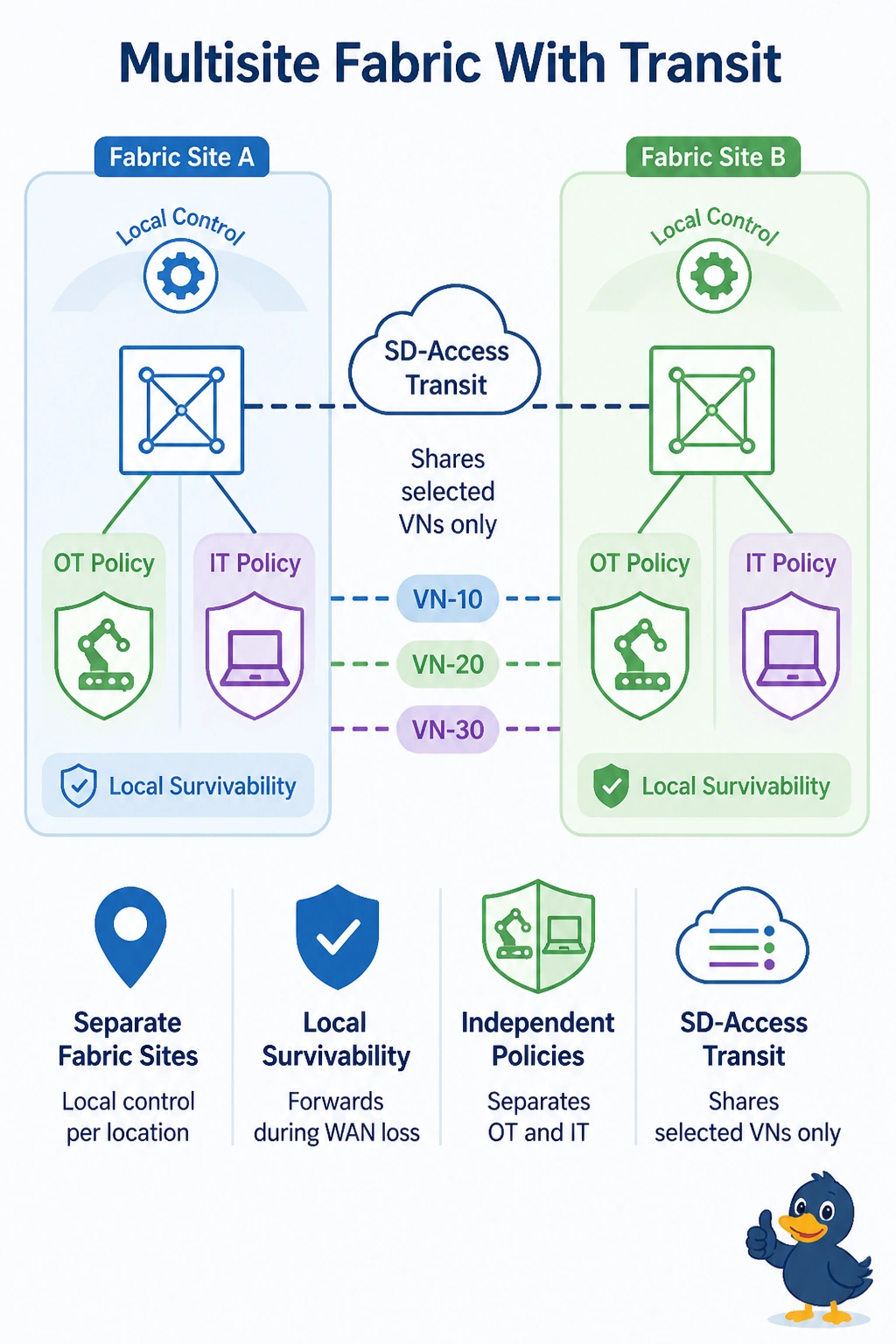
You want each location to keep switching locally, with OT and IT policies independent and only selected VNs shared. Autonomy through separate fabric sites and selective SD-Access transit gives you that resilience without stretching one policy domain across all three locations.
Full Explanation
Independent fabric sites with separate OT and IT policy scopes, linked by SD-Access transit carrying only select VNs, are correct: each location keeps its own control plane and policy scope, supporting local switching during WAN failure and independent OT/IT policies. SD-Access transit extends required VNs while containing broadcast, database size, and policy complexity for the 4,000-endpoint campus. Advertising every VN over IP transit can preserve local forwarding, but IP transit hands traffic off per VN as plain IP, so VXLAN and SGT metadata do not remain end to end, and it lacks the required selectivity. Centralizing all forwarding decisions at headquarters creates WAN fate-sharing: isolated factories cannot make autonomous forwarding and authorization decisions, undermining manufacturing continuity. Coordinated fabric sites with shared OT and IT policies fail the requirement for independent policy scopes, preventing distinct access, segmentation, and change control for industrial systems and enterprise IT despite selective transit. Exam caveat: distinguish SD-Access transit from generic IP transit and coordinated sites; the required design combines independent control planes with selective VN extension. Practical check: verify site boundaries and the transit VN leaking table in Catalyst Center, then simulate WAN isolation and confirm each factory retains local border, control-plane, and authentication continuity.