
A national retailer runs a single AS with 60 iBGP routers across four regions and full-mesh peering is becoming unmanageable. Leadership requires keeping one AS number, centralizing routing policy, and minimizing reconfiguration on every router. Which iBGP scaling approach should the designer select to meet these scaling goals?
Select an answer to reveal the explanation.
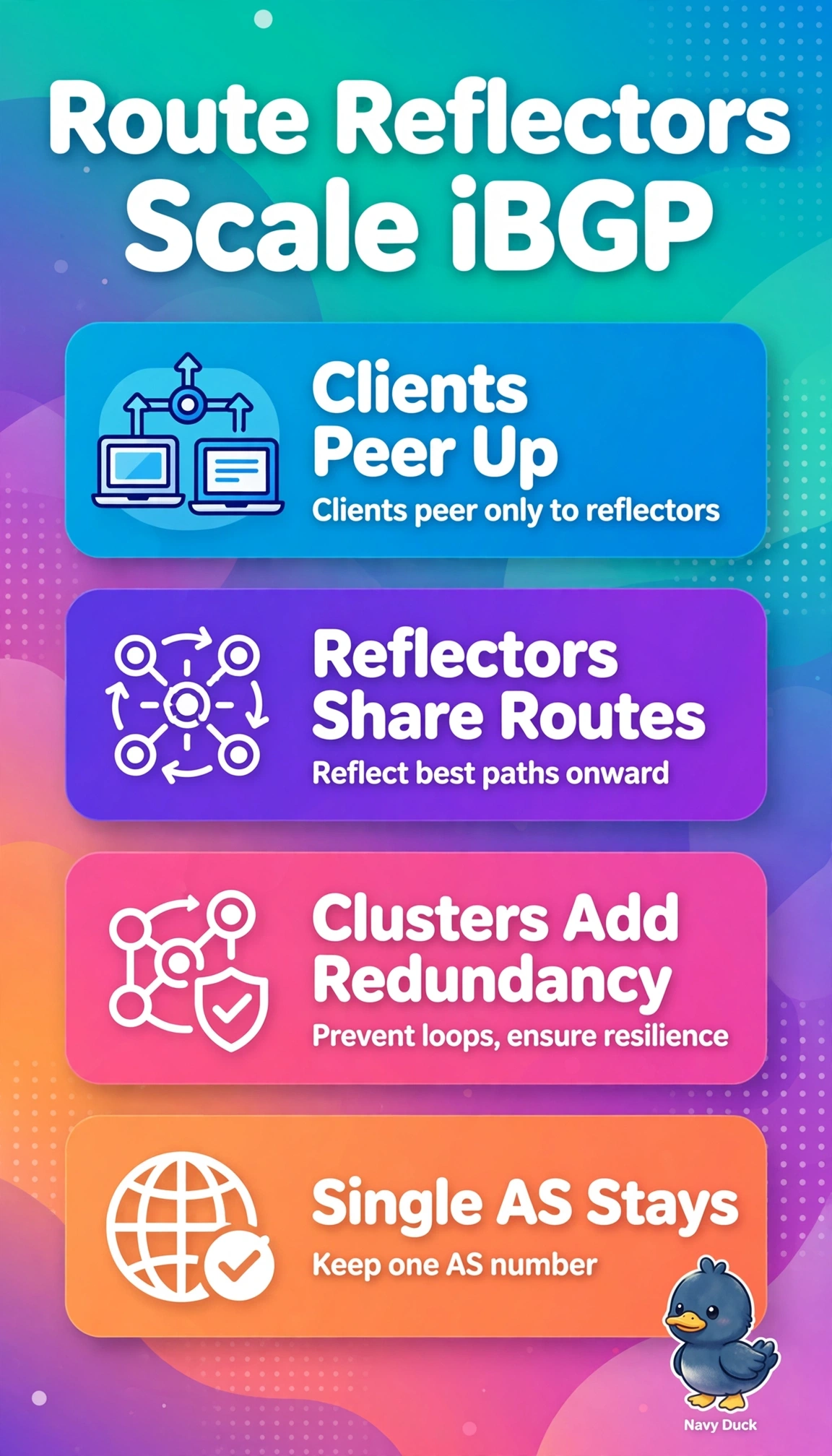
Short Explanation
You've got one AS and a tangled mesh crying out for simplification. Route reflectors act like designated messengers that share routes so others don't all talk at once.
Full Explanation
Hierarchical route reflectors with redundant clusters are correct because they keep one AS number while removing the n(n-1)/2 iBGP full mesh by having clients peer only to reflectors, centralizing best-path and policy on few nodes with mainly client-to-reflector configuration. Confederations with regional sub-ASs scale peering and present one AS externally, yet they split the interior into sub-AS policy domains and require migrating every router to new sub-AS membership with confederation eBGP rules, violating minimal reconfiguration and single-AS operation. Peer groups with optimized updates centralize policy templates and reduce CPU and replication, yet they leave full-mesh TCP sessions intact, so burden keeps growing. A single centralized reflector cluster removes mesh and consolidates policy with minimal client change, yet it creates a WAN-sensitive choke point and failure domain that poorly serves 60 routers in four regions, where hierarchy localizes reflection and redundancy adds resilience. For exams, peer-group efficiency and reflection solve different problems and confederation versus reflection both relax mesh but differ in AS model and impact, so watch for single-AS, central-policy, and minimal-touch cues. Practically, verify cluster IDs, redundant per-region placement, client inheritance, and full routing and policy parity before removing mesh sessions.