
A school district must address 40 new point-to-point WAN links and 10 server farm subnets expecting up to 50 hosts each, public space is limited, and future growth must be supported without renumbering. Which VLSM planning choice avoids waste while preserving usability?
Select an answer to reveal the explanation.
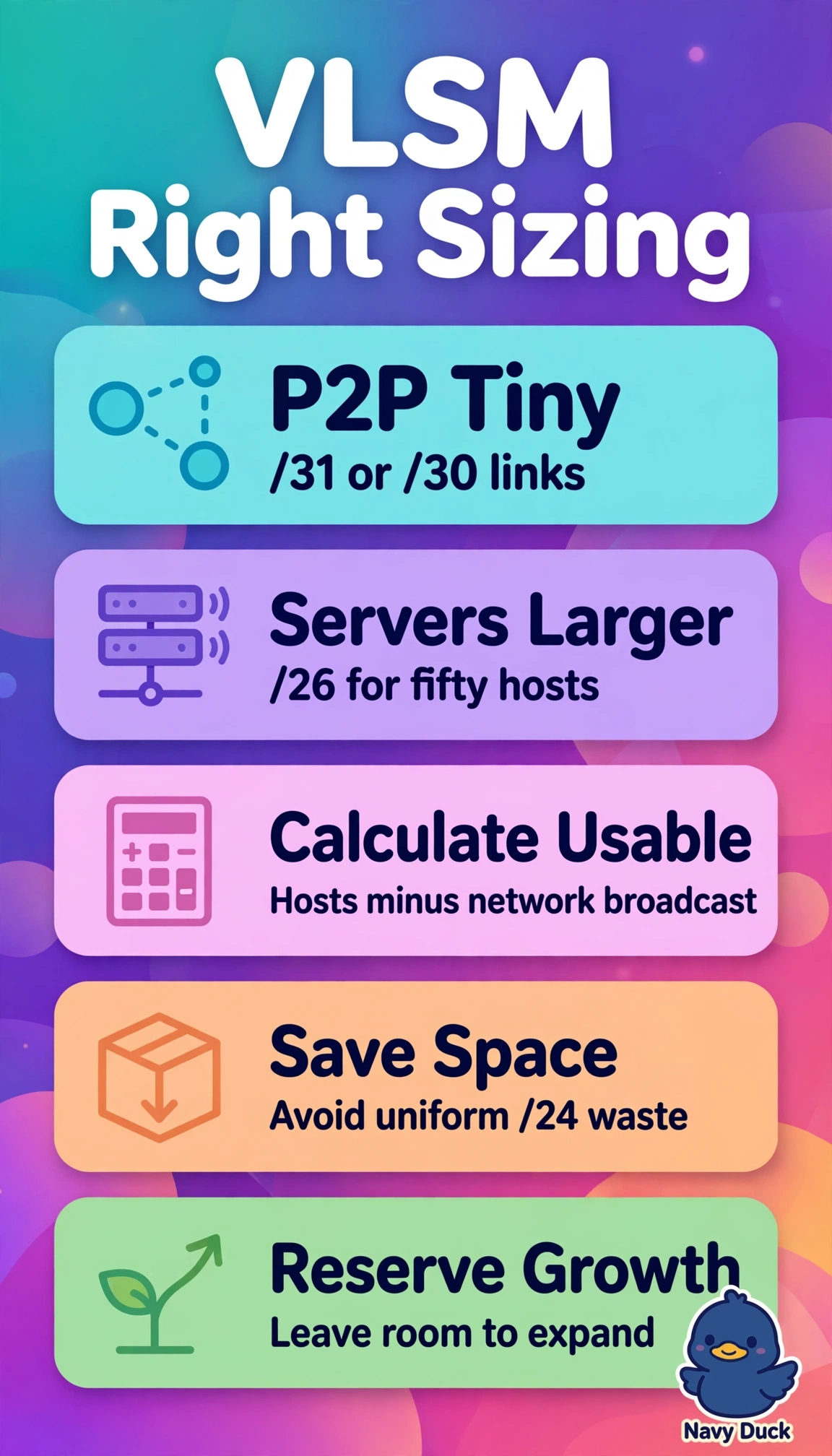
Short Explanation
You wouldn't rent a stadium for a phone call. Right-sizing masks gives tiny links just two addresses and servers room to grow, like ordering shoes by size. Uniform blocks waste space fast.
Full Explanation
VLSM matches mask length to host count, so /31 or /30 efficiently covers point-to-point links with minimal waste while /26 provides 62 usable hosts to support 50 server hosts plus growth, preserving limited space without renumbering. Uniform /24 everywhere fails by concept because using 254-host blocks for two-host links wastes scarce addresses across 40 links. Uniform /16 fails by concept because massive blocks per link exhaust address space and break summarization discipline despite avoiding per-link exhaustion. Using /29 for 50-host farms fails by concept because /29 supports only six usable hosts and cannot accommodate the stated requirement, causing immediate shortfall. For the exam, calculate usable hosts as two to the host bits minus two, except /31 special case. In practice document mask standards per link type and reserve adjacent space for server growth.