
A retail enterprise has OSPF Area 0 at headquarters, 80 small stores with only a default route need, and one acquisition site redistributing external routes that must reach headquarters without leaking everywhere. Which OSPF multi-area design contains LSAs while preserving required external reachability?
Select an answer to reveal the explanation.
Short Explanation
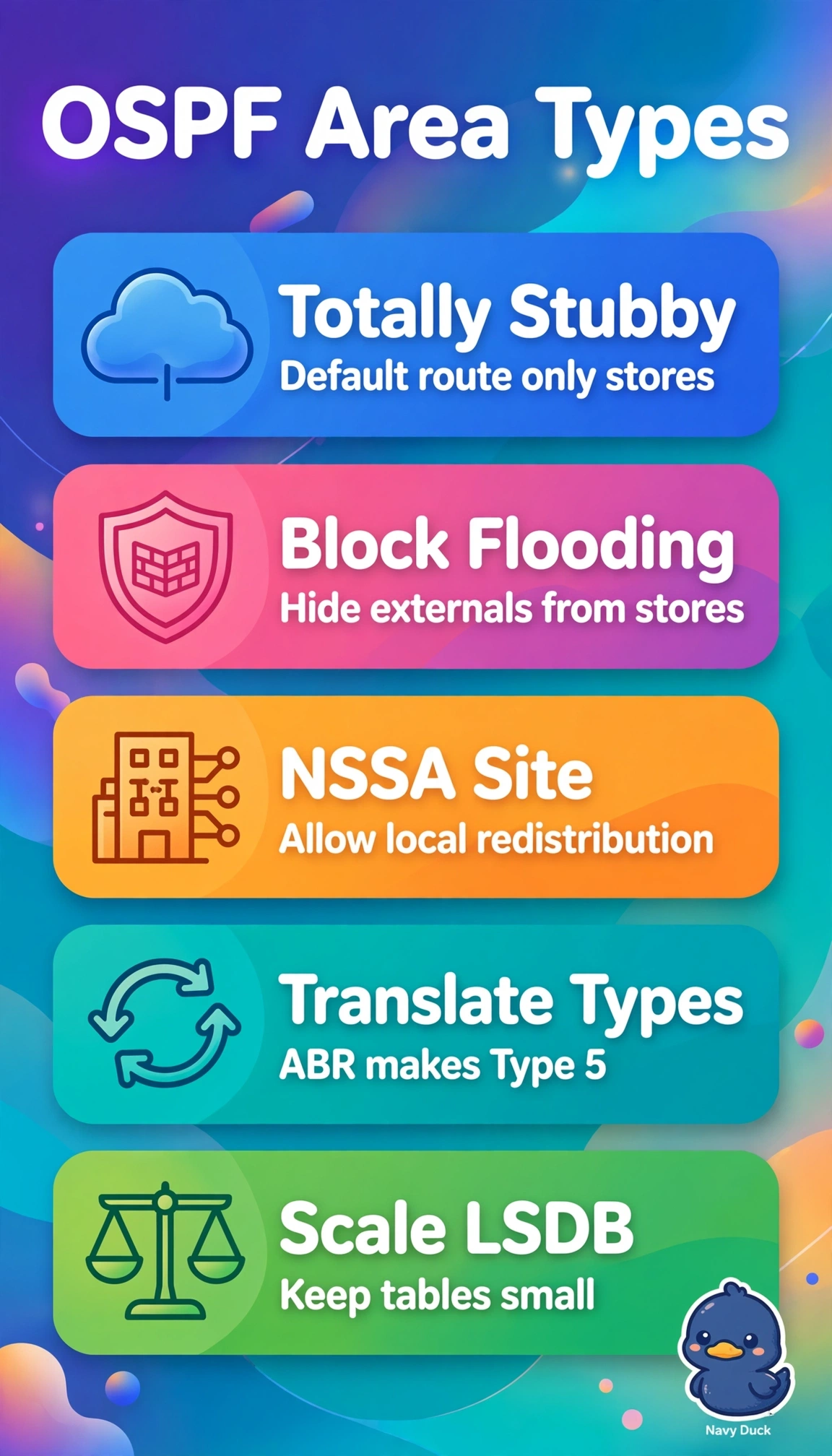
You've got quiet shops and one chatty newcomer, so you'll want different rules for each, like giving most kids headphones but one a hall pass. Make the stores totally stubby to keep them on just a default route while the acquisition stays NSSA to send its externals up safely.
Full Explanation
A totally stubby area replaces inter-area and external LSAs with a default route, ideal for small stores needing only exit routing, while an NSSA permits local redistribution as Type 7 LSAs that the ABR translates to Type 5 for the backbone, satisfying acquisition external reachability without flooding externals into stub branches. A single stub area blocking all Type 5 would prevent acquisition externals from entering OSPF at all, breaking headquarters reachability. Making every site standard preserves full LSDBs everywhere, sacrificing scalability and flooding externals to resource-constrained store routers. Configuring stores as NSSA and headquarters as stub inverts the hierarchy, since the backbone cannot be stub and NSSA at small stores adds unnecessary redistribution complexity. For the exam, remember totally stubby uses default only and NSSA is the sole stub variant allowing redistribution; in practice verify area flags match and check Type 7 to Type 5 translation on the ABR.