
A logistics firm must connect isolated IPv6 sensor islands across a large IPv4-only core that cannot be upgraded this year, with deterministic endpoints managed by the network team. Which overlay tunneling approach carries IPv6 across the IPv4 infrastructure in this environment?
Select an answer to reveal the explanation.
Short Explanation
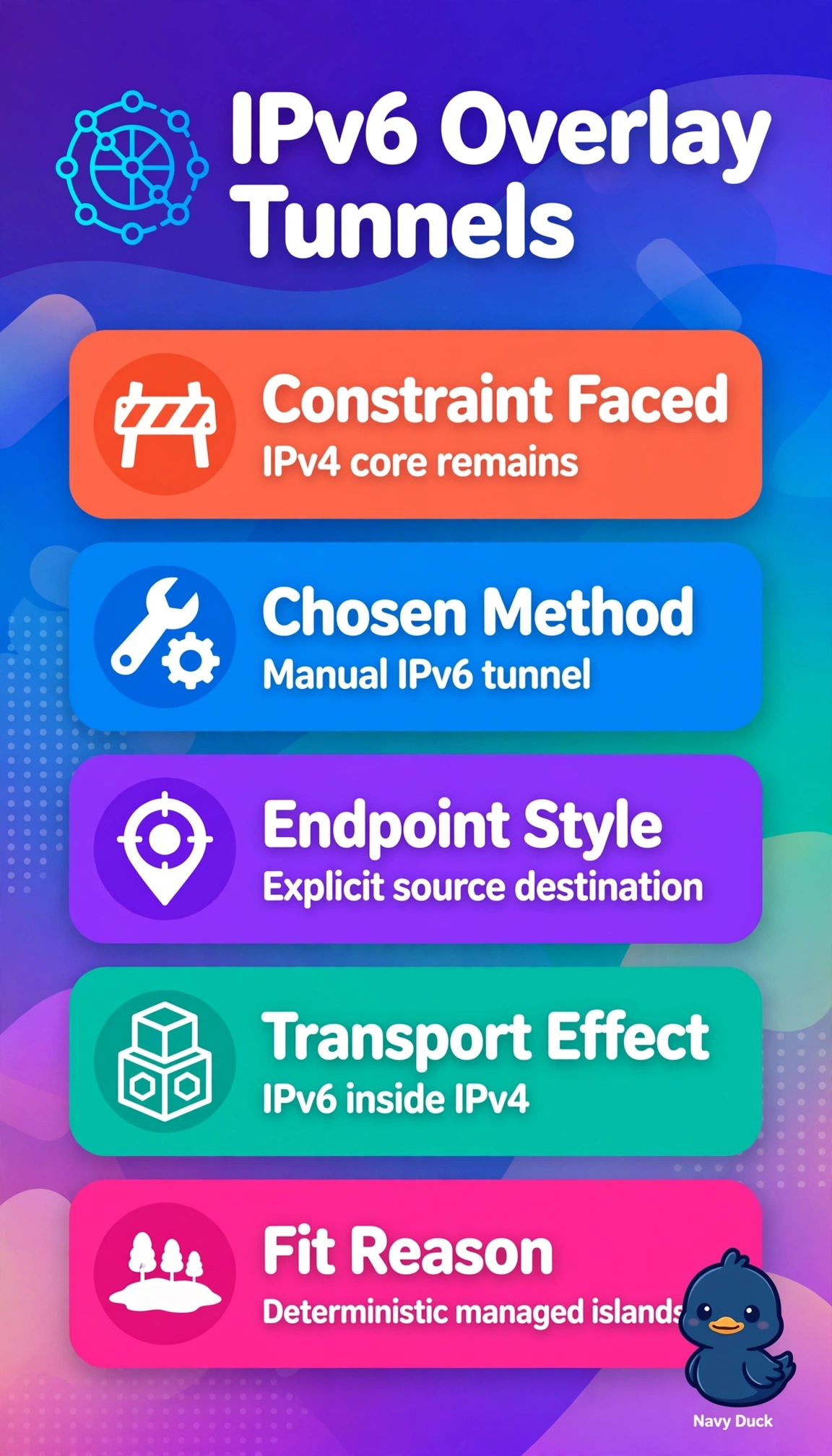
You can't rebuild the highway yet, so you'll build a dedicated tunnel through it. Manually defined endpoints give you predictable tunneling the team controls, perfect for fixed sensor sites.
Full Explanation
The correct approach works because manually configured IPv6-in-IPv4 tunnels encapsulate IPv6 packets inside IPv4 between explicitly defined source and destination addresses, creating a deterministic overlay path across an IPv4-only core without requiring core upgrades, which suits fixed managed sites. Automatic 6to4 tunnels fail by concept because they derive IPv6 prefixes from embedded public IPv4 addresses and suit automatic Internet connectivity rather than deterministic enterprise islands with managed endpoints and private addressing. ISATAP fails by concept because it is designed for automatic host-to-router tunneling within a site using NBMA-style operation, not for managed router-to-router transport between fixed IPv6 islands. Enabling native dual-stack forwarding fails by concept because it requires upgrading the core to forward IPv6 natively, which directly violates the constraint that the IPv4 core cannot be upgraded this year. For the exam, remember manual tunnels mean explicit endpoints for stable site interconnection while automatic methods trade determinism for convenience; in practice verify tunnel source reachability and MTU for encapsulated sensor traffic.