
A financial firm must keep trading databases on premises for compliance, use public cloud for elastic web front ends, share identity between sites, and manage both environments under unified policy. Which cloud-based service model description guides the private, public and hybrid deployment choice?
Select an answer to reveal the explanation.
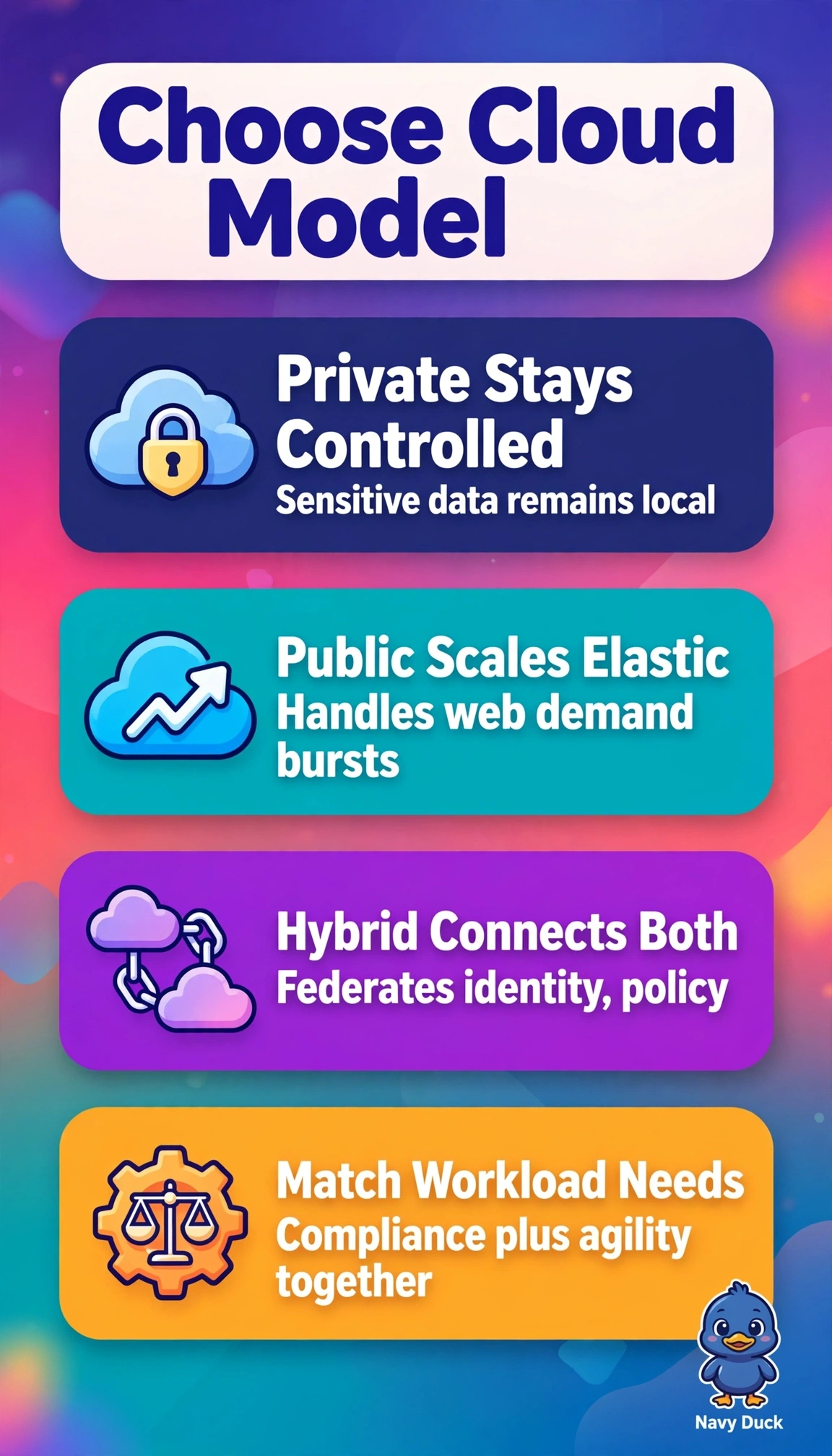
Short Explanation
You are keeping the safe at home while renting extra storefront space downtown. A hybrid blend respects compliance without giving up elastic scale when demand surges.
Full Explanation
The correct description is right because hybrid cloud is defined as integration of private and public environments under coordinated governance, which directly maps to keeping regulated trading databases on premises for control and compliance while bursting web front ends to public cloud for elasticity, with federated identity enabling single sign-on across sites and unified policy ensuring consistent security and management, thus answering the deployment choice question rather than a single-environment implementation. The private-cloud-only description fails by deployment scope because it preserves on-premises control, identity federation, and unified policy but omits public elasticity, so elastic demand must be met by overprovisioning local capacity. The public-cloud-only description fails by compliance placement because it achieves elasticity, federation, and unified policy but places regulated trading data off premises, violating the explicit on-premises constraint. The split-policy hybrid description fails by governance because it places workloads correctly and federates identity but replaces unified management with divided control, losing consistent enforcement and auditability across environments. Exam caveat: do not confuse virtual private cloud or private cloud with hybrid cloud; virtual private cloud remains a partitioned segment of public cloud and does not satisfy an on-premises requirement, and private cloud alone does not provide public elasticity. Practical check: validate the design by confirming data residency for trading records, autoscaling metrics for web tiers, a tested federated login spanning both sites, and a single policy console showing compliant status in both environments.