
A data-center operations team polls 800 switches with SNMP every five minutes but misses microbursts and high CPU during polling gaps. They need continuous streaming of interface counters, sub-minute visibility, and push-based delivery to multiple tools. Which telemetry approach delivers streaming visibility beyond periodic SNMP polling?
Select an answer to reveal the explanation.
Short Explanation
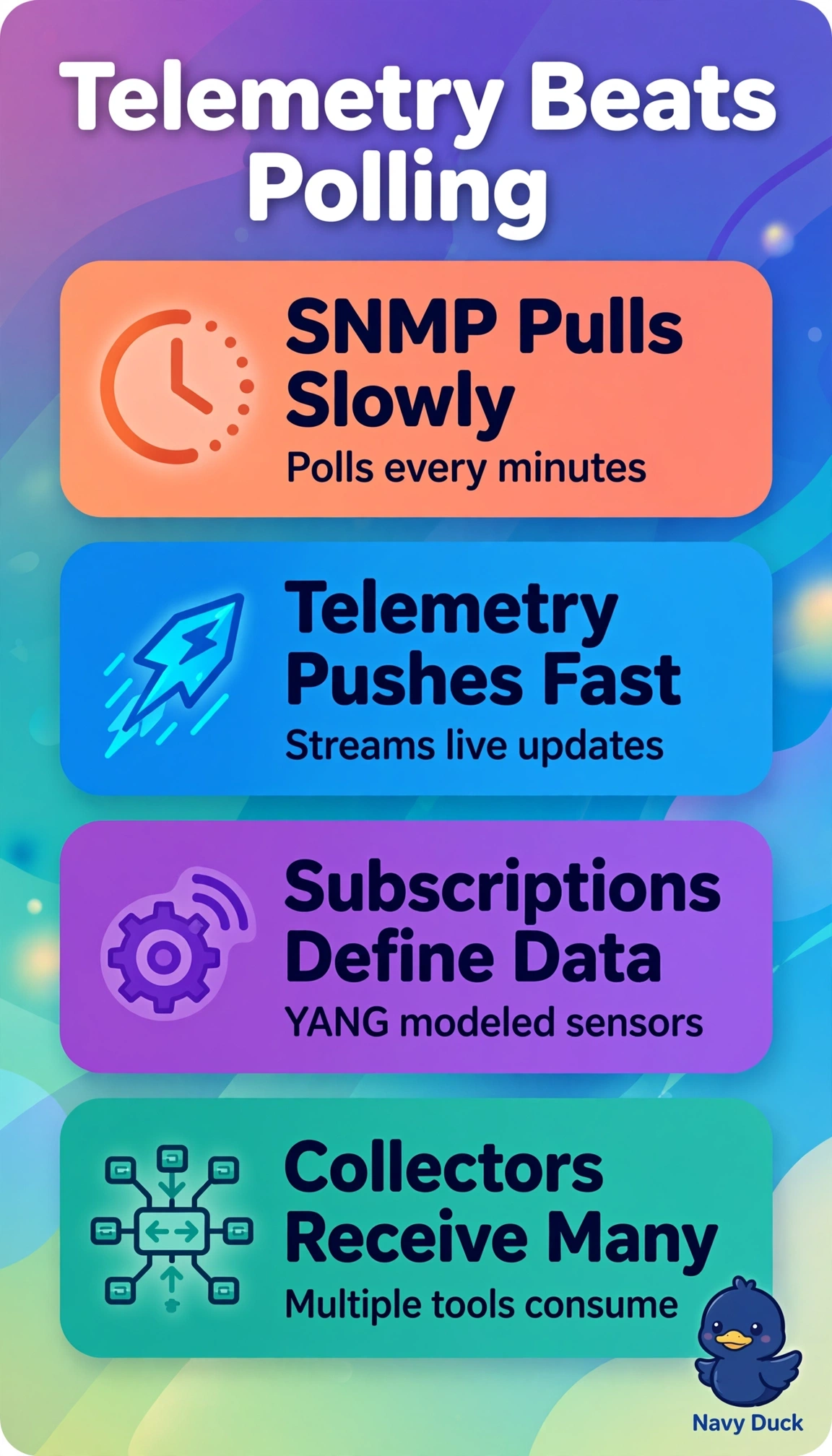
You're checking the scoreboard every five minutes while missing all the big plays in between. Streaming telemetry pushes live stats to you continuously so microbursts can't hide between polls.
Full Explanation
Model-driven telemetry lets network devices publish YANG-modeled operational data via dial-in or dial-out subscriptions to collectors at high cadence or on change, providing push-based, structured, multi-consumer visibility compared to SNMP pull-based polling that is interval-limited, CPU-heavy, and coarse-grained. Extended SNMP polling fails because lengthening intervals worsens gap blindness and SNMP remains pull-based and unstructured for high-frequency streaming. Syslog messaging fails because syslog carries event messages rather than periodic structured counters and lacks subscription-based YANG data models for interface statistics. NetFlow export fails because flow records describe traffic conversations rather than device health counters and do not provide general model-driven sensor subscriptions. Exam caveat is to map subscriptions and collectors to telemetry push and polling managers to SNMP pull. Practical check is to identify key sensors, cadence, and collector capacity before enabling streaming on core devices.