
A financial firm streams market data from a single well-known source to hundreds of trading desks that must explicitly request that source, with minimal RP setup and no shared-tree overhead. Receivers run modern stacks supporting source filtering. Which multicast design serves this source-specific multicast use case with IGMPv3?
Select an answer to reveal the explanation.
Short Explanation
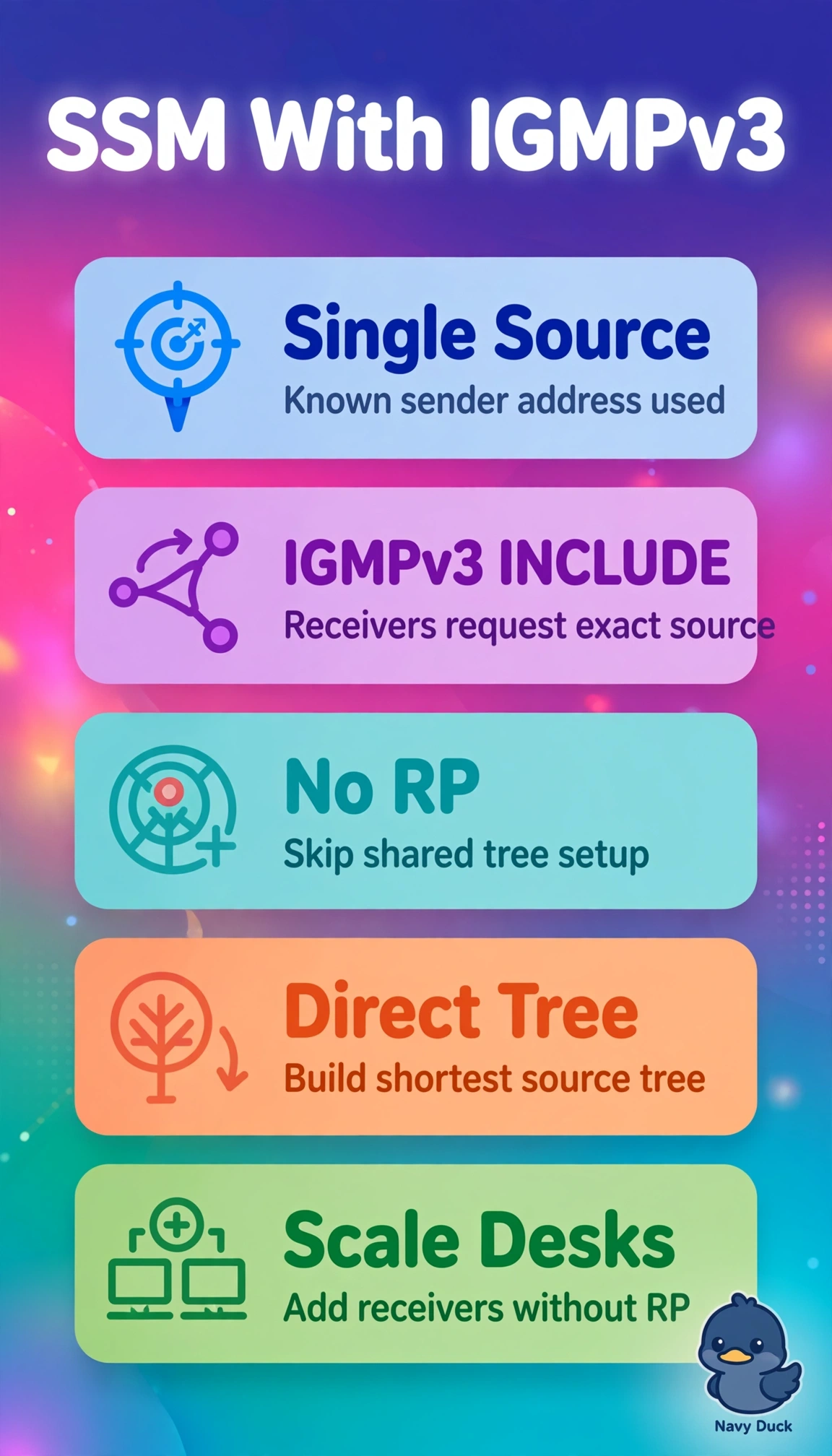
When you've got one superstar feed your desks all want, you don't need a middleman to find it. You can tune straight to that channel like your favorite radio preset with SSM, using IGMPv3 INCLUDE joins and skipping the RP altogether.
Full Explanation
The correct design fits because source-specific multicast is engineered for one known publisher where receivers explicitly signal (S,G) with IGMPv3 INCLUDE, allowing PIM-SSM to build shortest-path trees directly to that source with no RP, no shared tree and no discovery, which minimizes state and latency for market-data fanout and matches modern source-filtering stacks and the 232.0.0.0/8 SSM convention. The resilient sparse-mode design with Anycast-RP fails on architecture because it still requires (,G) joins to an RP and forwarding down a shared tree before switchover, preserving RP configuration, state and rendezvous delay that the scenario explicitly excludes. The SSM with fallback RP design fails on PIM mechanics because the SSM range must have no RP mapping, so retaining one adds needless configuration and risks (,G) handling while adding no useful redundancy since resilience should come from routing and source redundancy. The MSDP-based Any-Source design fails on scope because MSDP plus domain-wide flooding and discovery solves unknown-source reachability across domains, which is wasteful when every desk already knows the single feed and can join it directly. For exams, remember IGMPv3 alone does not make forwarding SSM; the join type and absence of RP shared-tree behavior decide, and Anycast-RP high availability is still RP-based operation. In practice, confirm the SSM range covers the group, verify snooping and host tables show (S,G) INCLUDE rather than (*,G), and check multicast routing shows SPT entries toward the source with RPF succeeding and no RP involved.