
A logistics company has four regions with 25 branches each, each branch needs three subnets, the WAN must stay stable as sites are added, and the design must minimize routing table size. Which hierarchical IPv4 addressing method enables clean route summarization at distribution boundaries?
Select an answer to reveal the explanation.
Short Explanation
You're sorting packages by zip code so border routers only read the big label. Contiguous supernets let each region advertise one summary, like filing branches under one folder. Growth stays tidy and tables stay small.
Full Explanation
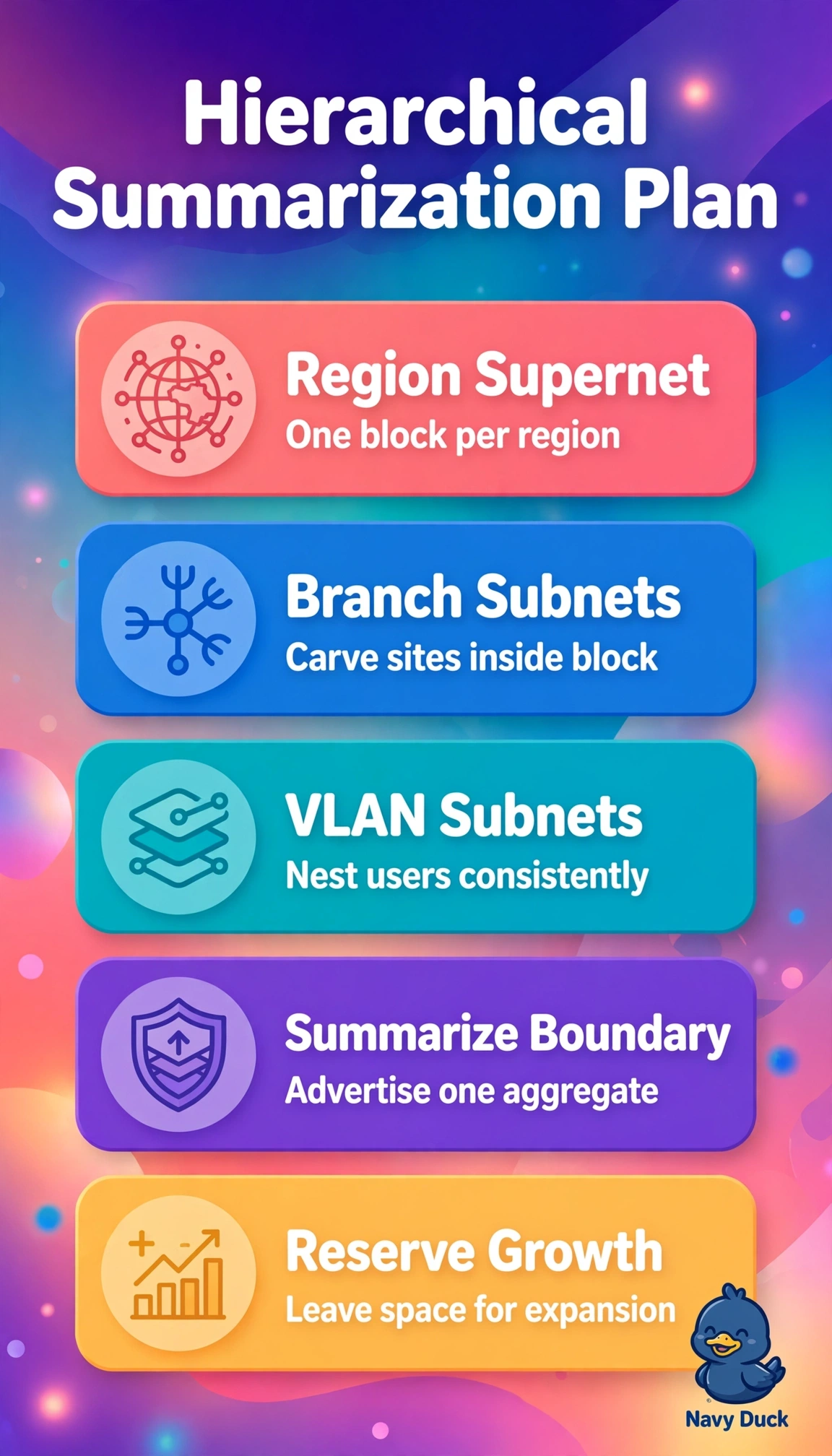
The correct design works because aligning address hierarchy to physical topology gives each of the four regions a single contiguous supernet that is further subnetted for its 25 branches and their three VLANs, so distribution routers can advertise only one summary toward the core, which keeps tables small, hides branch-level churn, and preserves WAN stability as sites are added. Sequential enterprise-wide /24 assignment in deployment order satisfies inventory simplicity and provides unique addressing, yet it scatters each region's prefixes randomly across the range, so no clean boundary aggregate exists and every new branch injects another core route. Branch-focused VLSM for the three VLANs satisfies efficient utilization and sound local design, yet advertising each branch prefix independently without a covering regional summary still leaves about 100 branch routes plus VLAN churn in the WAN, directly violating minimization and stability. Reusing the identical private block everywhere with local NAT satisfies conservation and template standardization widely used in retail, yet overlapping addresses lack enterprise-wide uniqueness and cannot be summarized meaningfully by region, while adding NAT state, translation troubleshooting, and broken end-to-end reachability. Exam caveat is to distinguish address conservation from routability, since a method can save space yet fail summarization if it ignores topology. Practical check is to sketch the four regional supernets, list branch subnets beneath each, and verify that hiding all but the regional summary still leaves every VLAN reachable.