
A multihomed enterprise has two equally capable eBGP transit links and needs both links active for the same prefixes, plus consideration of unequal provider capacities on future links. Which BGP load-sharing design provides active-active use with support for weighted distribution?
Select an answer to reveal the explanation.
Short Explanation
You want both pipes working today and a smart way to weight fatter pipes tomorrow. Multipath plus bandwidth-aware sharing gives you balanced load sharing without forcing an active-standby design.
Full Explanation
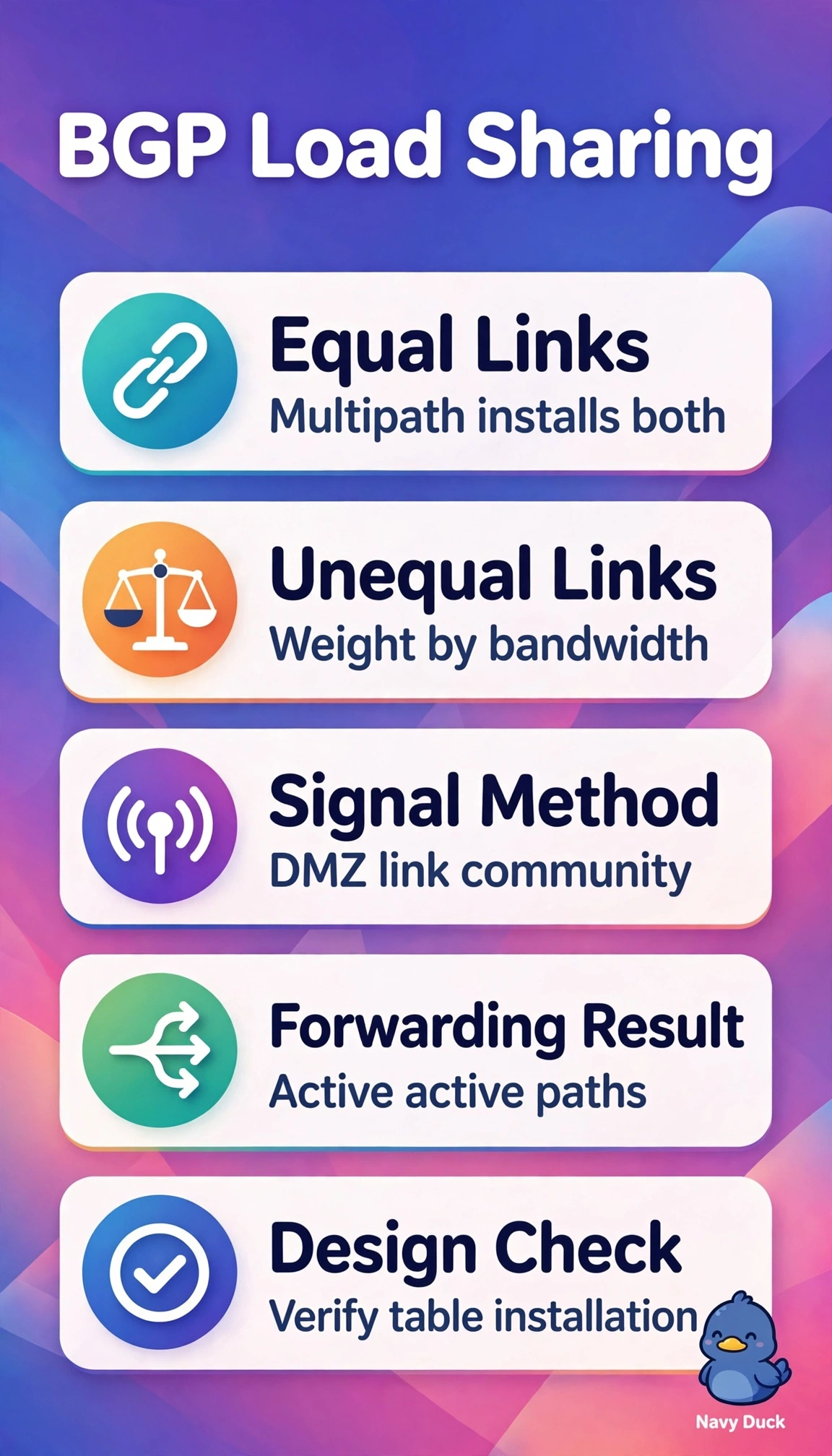
The correct approach works because BGP multipath installs multiple equal-cost eBGP paths for the same prefix to enable active-active forwarding, while the DMZ link-bandwidth extended community propagates the bandwidth of the incoming link so interior routers can perform weighted unequal-cost load sharing proportional to provider capacity. Tuning local preference to prefer one link fails by concept because it creates an active-standby policy that explicitly defeats the requirement for both links to carry the same prefixes simultaneously. Using maximum-paths alone fails by concept because multipath without bandwidth awareness shares only across equal-cost paths and cannot weight distribution for unequal provider links, so future capacity differences would remain unused. Advertising different prefix halves per link fails by concept because prefix splitting provides coarse balancing dependent on traffic per prefix rather than true per-prefix multipath, and failure shifts behavior unpredictably. For the exam, remember multipath handles equal cost and DMZ link bandwidth enables weighted unequal cost with IGP propagation; in practice verify multipath installation in the routing table and confirm the link-bandwidth extended community is sent to iBGP peers (it is non-transitive across eBGP).