
A large campus uses routed access with dual EIGRP uplinks from each access switch to distribution, and video conferencing drops for seconds when a fiber fails because hello timers detect loss slowly. The links are point-to-point fiber with sub-second convergence required. Which BFD design for fast failure detection in routed access best meets the convergence goal?
Select an answer to reveal the explanation.
Short Explanation
You need a faster heartbeat on those uplinks. BFD plus routing gives rapid detection of fiber loss, like a nurse monitor alarming instantly instead of waiting for rounds.
Full Explanation
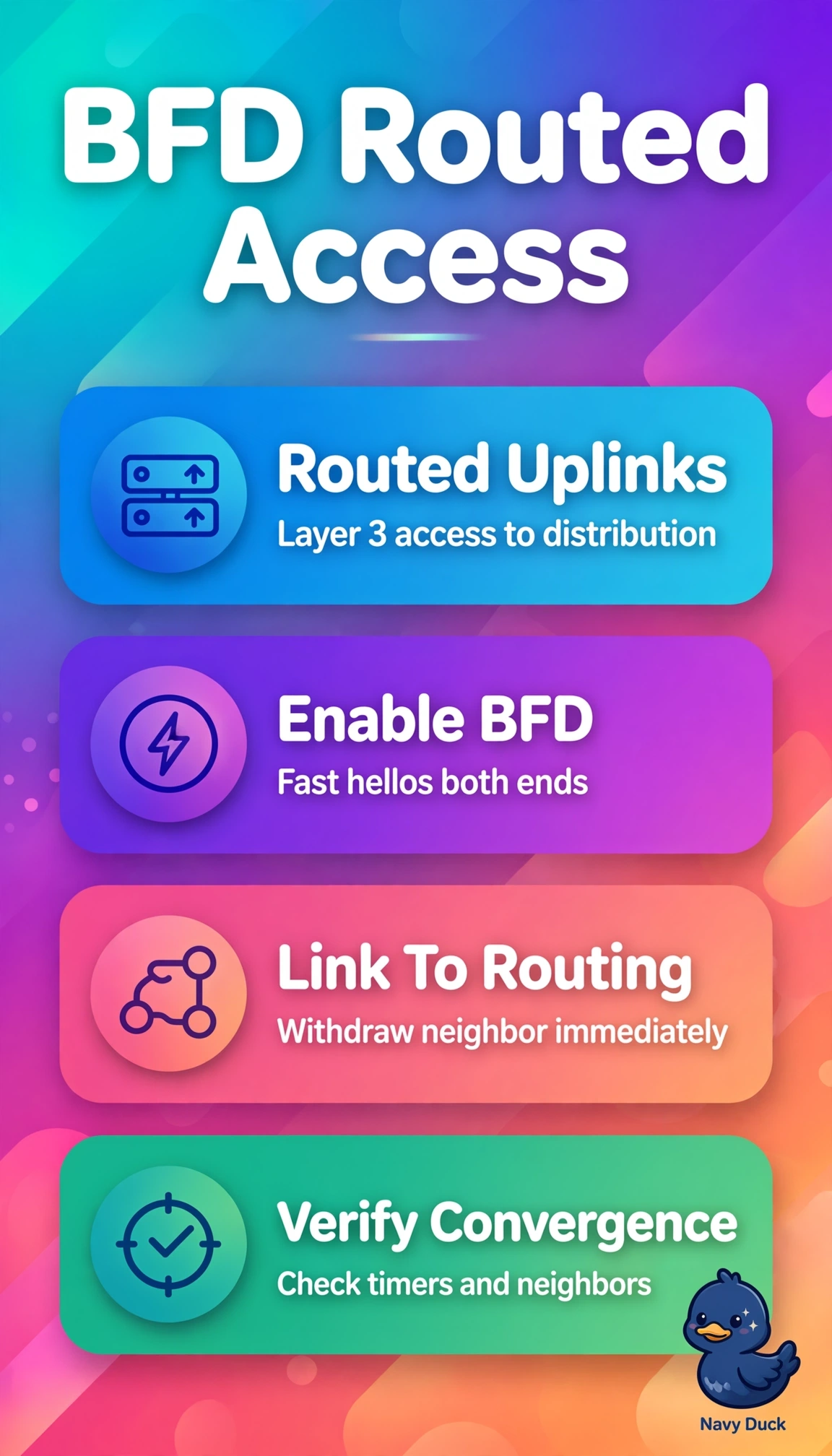
The correct design works because single-hop BFD on point-to-point fiber provides millisecond hello and dead detection directly on the forwarding path, and registering EIGRP as a client lets a BFD session down immediately withdraw the neighbor and trigger DUAL reconvergence across the remaining uplink, which meets sub-second voice and video needs where EIGRP hellos alone are too slow. Deploying BFD only on the primary uplink fails by coverage because the unprotected secondary still depends on slow EIGRP hold-time expiry, so a failure there reintroduces seconds-long blackholing despite redundancy. Using multihop BFD to distribution loopbacks fails by path semantics because multihop traverses IP hops and often uses less aggressive timers and fate-sharing with alternate paths, so it cannot reliably signal the specific point-to-point uplink failure as quickly as single-hop. Running BFD on both uplinks without EIGRP client integration fails by signaling because detection occurs but the routing protocol never receives the fast down event and continues forwarding until its own timers expire, negating the convergence benefit. For exams, remember BFD itself does not reroute traffic; it only accelerates detection and requires protocol integration and appropriate single-hop versus multihop scope to be effective. In practice, verify with show bfd neighbors, show eigrp neighbors, and controlled uplink shutdowns while measuring packet loss to confirm timers are aggressive enough for sub-second failover without flapping on stable fiber.