
A university access layer has frequent student moves, unmanaged hubs causing unidirectional link issues, and edge ports taking 30 seconds to forward after reboots. Uplinks need sub-second failover without Layer 2 loops. Which fast-convergence design stabilizes edge access while preserving loop protection?
Select an answer to reveal the explanation.
Short Explanation
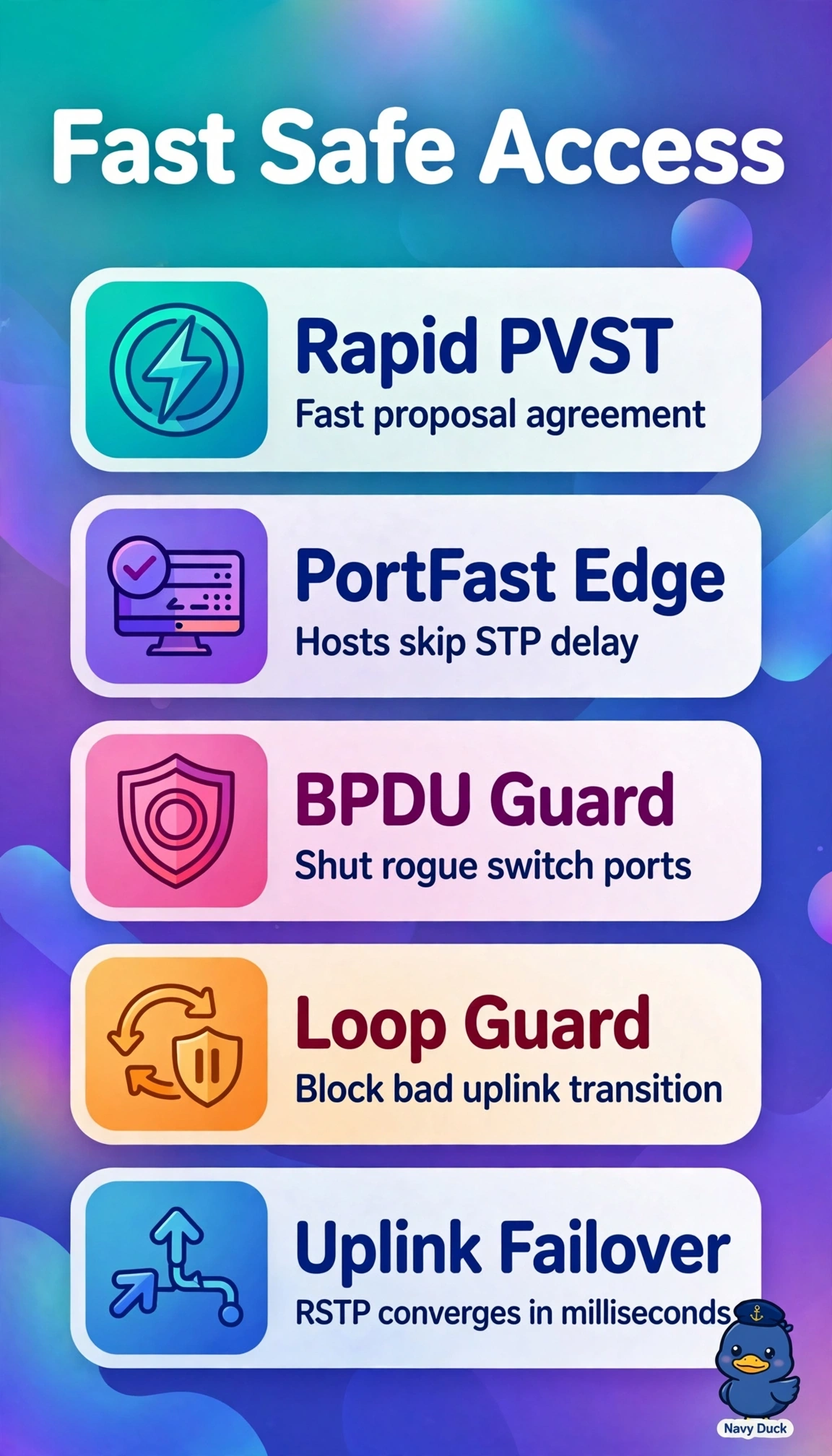
You'll get your edge ports forwarding in seconds when you pair Rapid PVST with PortFast and BPDU Guard, like giving dorm rooms express doors that still lock out intruders. Your uplinks stay loop-free because Loop Guard blocks them if BPDUs go missing, so you've got speed without the risk.
Full Explanation
Rapid PVST provides sub-second convergence through proposal-agreement, PortFast bypasses listening-learning on true host ports, BPDU Guard disables ports that unexpectedly receive BPDUs from rogue switches, and Loop Guard blocks alternate or root ports from transitioning on loss of BPDUs due to unidirectional failures, preserving loop freedom while accelerating edge bring-up. Traditional 802.1D with PortFast on uplinks is dangerous because PortFast must never face another switch and 802.1D lacks rapid transition, inviting loops. UDLD with Root Guard on edge ports misplaces tools since Root Guard enforces root placement on uplinks, not hosts, and neither provides PortFast forwarding acceleration alone. Enabling BackboneFast and UplinkFast assumes legacy 802.1D enhancements that are obsolete and incompatible with RSTP native rapid mechanisms, so the design would not converge as intended. For the exam, pair PortFast only with host ports plus BPDU Guard and Loop Guard with inconsistent BPDU handling; in practice audit port types and test with BPDU injection and fiber pull.