
A logistics company runs a multi-area IS-IS backbone, sees neighbor flaps after congestion, faces spoofed hello risk on a metro link, and needs faster failure detection without creating instability. Which IS-IS authentication and stability tuning design provides secure and stable adjacencies?
Select an answer to reveal the explanation.
Short Explanation
You are adding both good locks and good shock absorbers to the same door. Consistent authentication plus measured timers with BFD catches real failures quickly without shaking the whole backbone.
Full Explanation
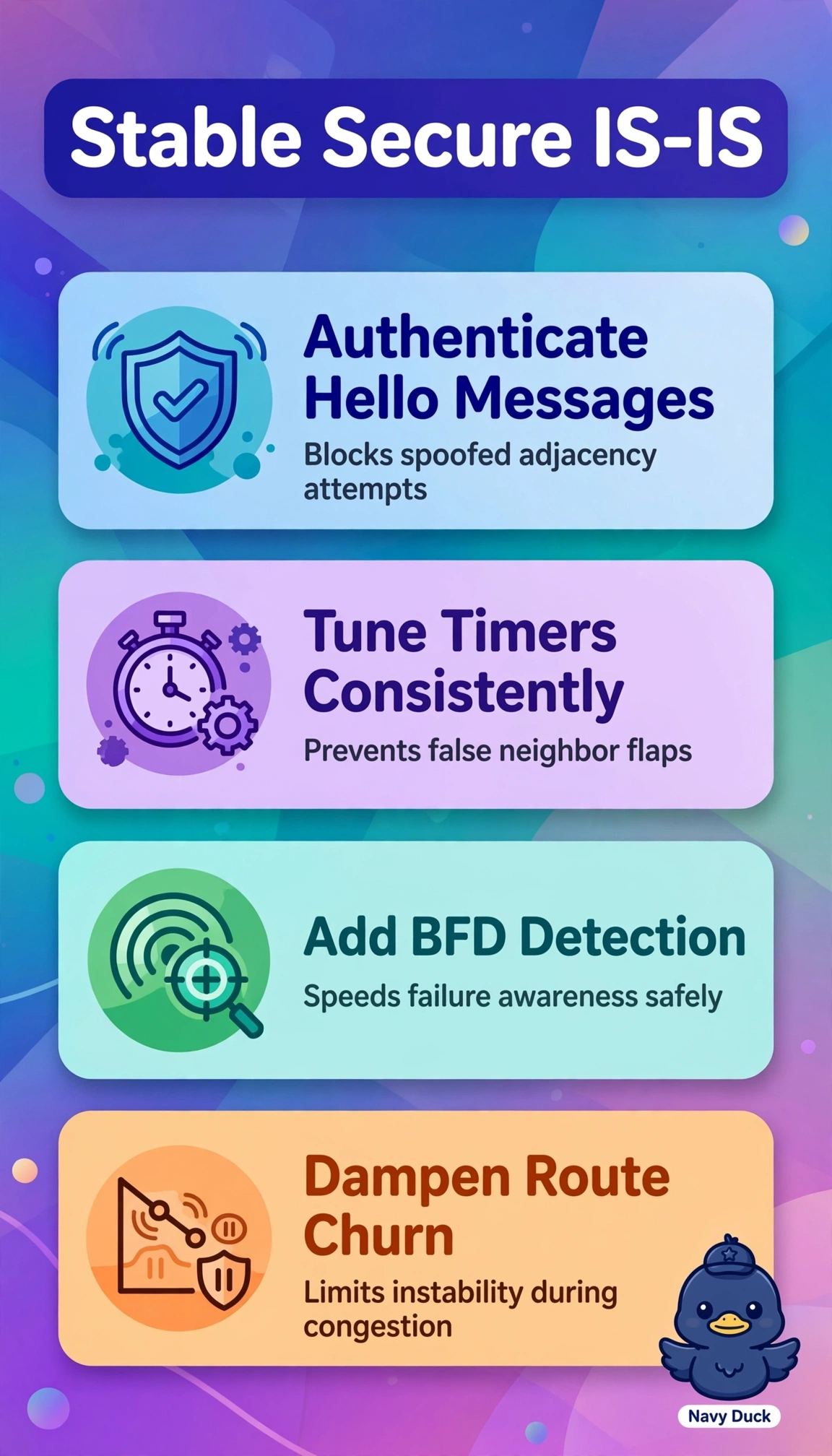
The correct design succeeds because it maps each mechanism to a distinct stated problem: hello authentication authenticates IIHs on the vulnerable metro link so spoofed hellos cannot establish or hijack an adjacency, consistently tuned hello and hold timers prevent asymmetric expiry and flapping in the multi-area backbone, BFD provides fast lightweight failure detection decoupled from IS-IS hello processing during congestion, while damping suppresses transient flaps from triggering LSP churn and repeated SPF. The design using LSP and database authentication with consistent timers and BFD is best practice for flooding integrity, but scope matters conceptually because it leaves IIHs unauthenticated so the spoofed-hello risk remains despite stability and speed. The design keeping hello authentication and damping but relying on hellos without BFD is secure and stable, yet it fails the explicit faster detection requirement because IS-IS hellos remain slower and more CPU-dependent than BFD. The design using hello authentication with aggressive BFD but no damping is secure and fast, yet it fails stability because every congestion-induced loss causes BFD and adjacency flaps that amplify control-plane load. Exam caveat: distinguish IS-IS authentication levels since hello, area and domain protect different PDUs and are not interchangeable. Practical check: verify matching keys and timers with show isis adjacency plus show bfd neighbors, confirm unauthenticated hellos are rejected, then test under load that real failures are detected quickly without uncontrolled flapping.