
A hospital campus expands to 12 buildings with 180 VLANs where a single spanning-tree instance causes large failure domains and suboptimal roots. Uplinks need deterministic forwarding and faster recovery. Which STP scalability and root placement design using RSTP versus MST best optimizes convergence?
Select an answer to reveal the explanation.
Short Explanation
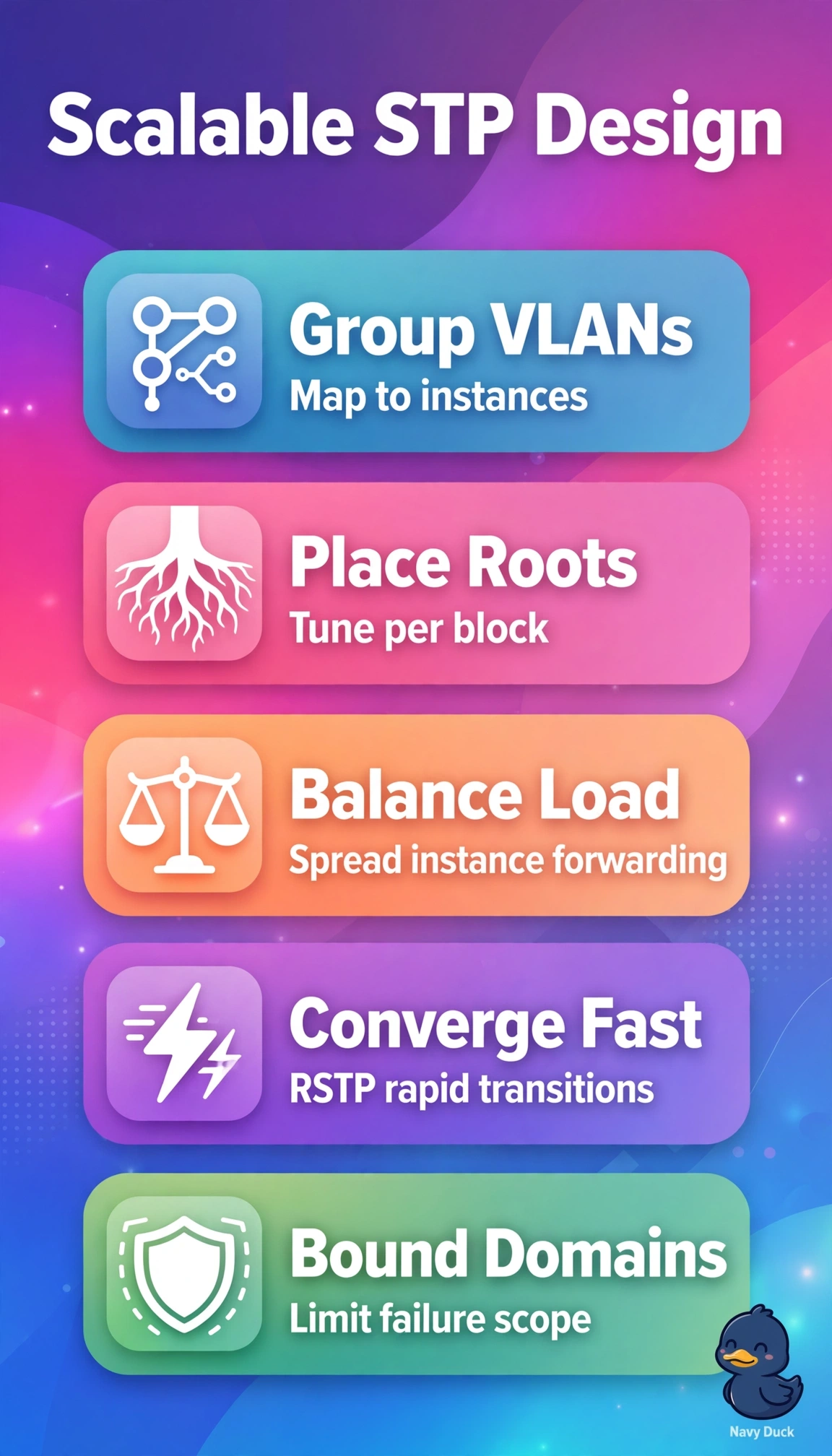
You've outgrown one tree for 180 VLANs. MST groups VLANs into lean instances with well-placed roots. It's like dividing a huge school into zones with local principals.
Full Explanation
MST is optimal here because it aggregates 180 VLANs into a few RSTP-driven instances, limiting failure domains while enabling distinct building-block roots to steer VLAN groups deterministically across diverse uplinks. The RSTP-only design with tuned roots provides rapid recovery and predictable roots but keeps one topology for all VLANs, so any event affects every VLAN and load sharing by VLAN group remains impossible. The per-VLAN rapid design with tuned roots also gives deterministic forwarding and fast recovery, yet running 180 topologies across 12 buildings creates excessive BPDU, CPU and memory load that MST aggregation was designed to prevent. The MST design retaining default election achieves instance separation but leaves root selection to chance, risking suboptimal paths, inconsistent blocking and poor capacity planning. For exams, rapid does not mean scalable: RSTP provides speed, MST provides scalable load sharing using rapid transitions, and a region requires identical name, revision and VLAN-to-instance mapping or switches split into different regions. In practice verify with show spanning-tree mst configuration and show spanning-tree mst instance-id, confirming primary and secondary roots per instance and consistent mapping on all switches.