
A healthcare system is choosing an SD-Access underlay for a new hospital with 1,500 ports, tight timelines, and a small operations team. The underlay must provide routed reachability for the fabric overlay with minimal manual tuning. Which underlay choice best balances automation and control?
Select an answer to reveal the explanation.
Short Explanation
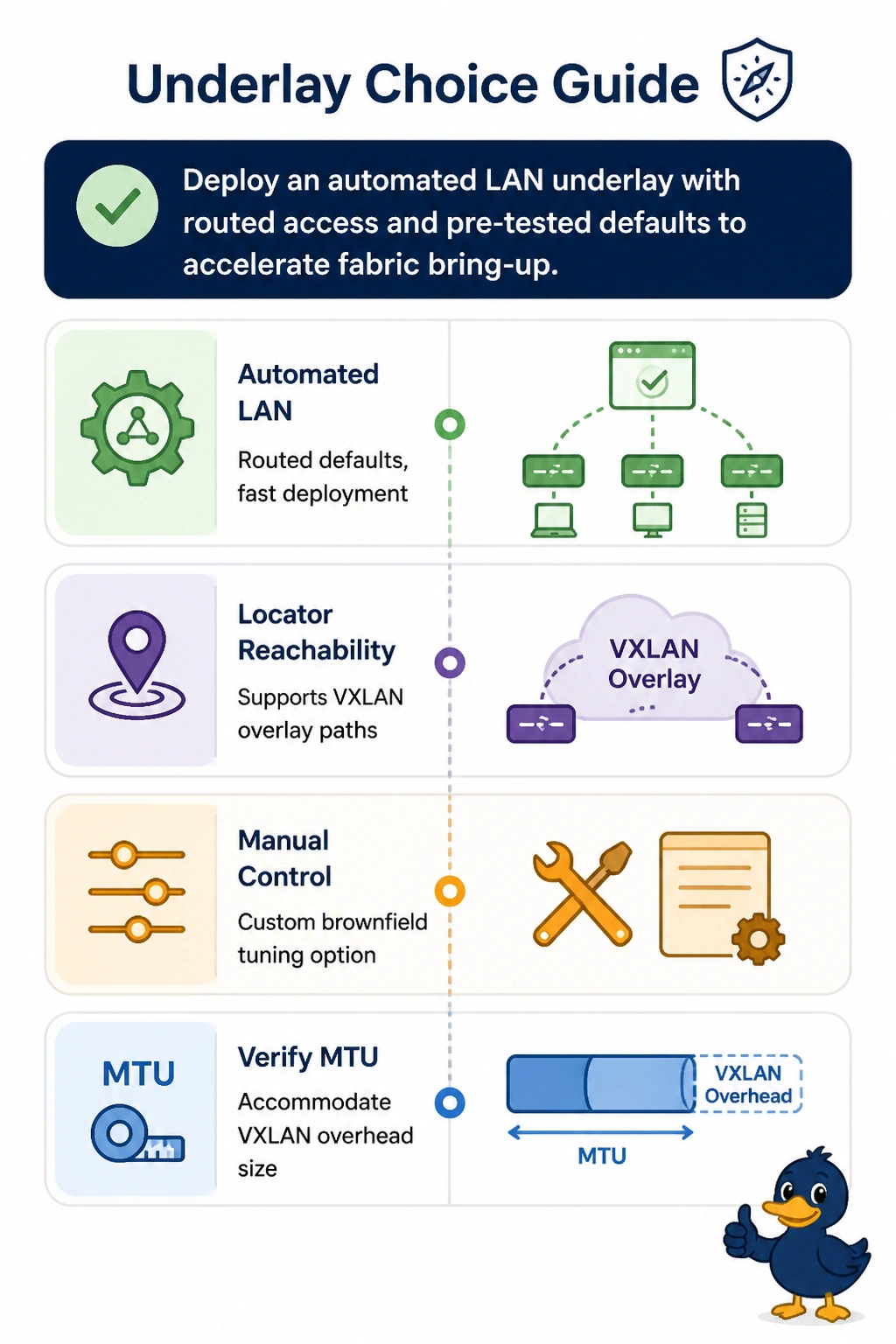
Speed matters, but so does sleep. Let proven automation lay the foundation so your team can focus on fabric services above it.
Full Explanation
The automated LAN underlay with routed access and pre-tested defaults is ideal because SD-Access requires a Layer 3 routed underlay for loop-free transport of VXLAN overlay tunnels, and automation with validated IS-IS, MTU, and routing defaults lets a small team bring up 1,500 ports quickly with consistent configuration and minimal troubleshooting. By contrast, a Layer 2 switched access design remains common for traditional campuses but fails the routed-reachability requirement because spanning-tree domains complicate fabric edge scaling and cannot provide the equal-cost multipath foundation the overlay expects. A manually tuned OSPF routed access design is also operationally proven and offers fine-grained control, yet it directly violates the minimal-manual-tuning constraint by demanding per-interface design, metric planning, and extended validation that tight timelines and lean staffing cannot absorb. A large-scale data center Clos underlay is widely deployed for east-west workloads and delivers excellent ECMP, but it misaligns with campus distribution needs for a hospital, adding unnecessary cabling, platforms, and operational complexity beyond 1,500-port access distribution. For exams, remember that SD-Access presumes a routed campus underlay, not Layer 2 extension or data center spine-leaf, when automation is prioritized. In practice, verify IS-IS adjacency, IP MTU support for VXLAN overhead, and controller-based inventory discovery before provisioning the overlay.