
A large campus core has dual supervisors per chassis and cannot tolerate multi-second outages or routing reconvergence during a supervisor switch, yet maintenance windows are shrinking. The design must keep forwarding and neighbor adjacencies intact across failover. Which high-availability mechanism should the designer select for hitless supervisor failover?
Select an answer to reveal the explanation.
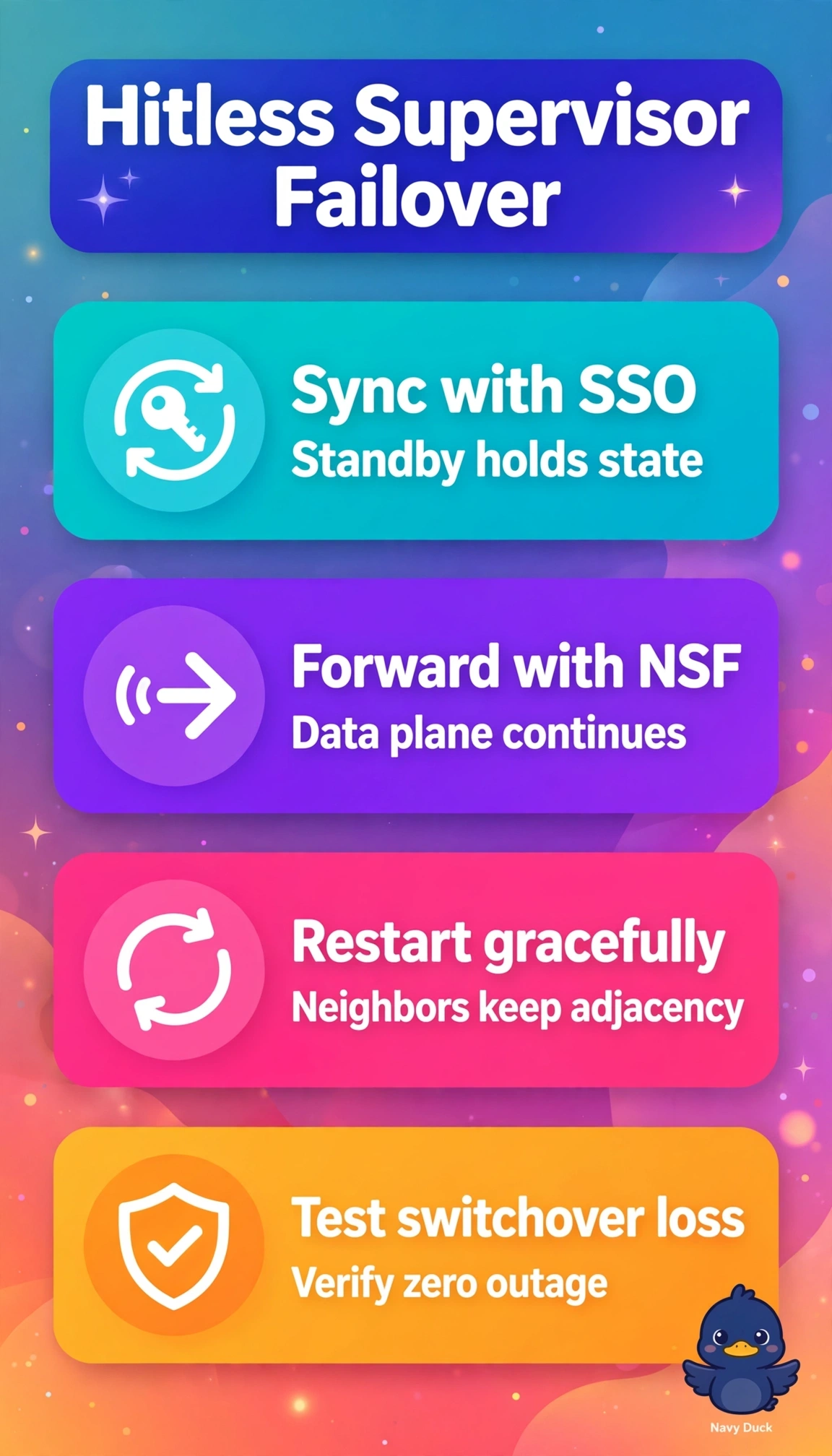
Short Explanation
You'll love how your core can swap supervisors without dropping a beat, like passing the baton mid-sprint without slowing down. With SSO paired with NSF and graceful restart, your forwarding and neighbor sessions stay alive while the backup takes over.
Full Explanation
The correct mechanism combines Stateful Switchover with Nonstop Forwarding and graceful restart because SSO continuously synchronizes configuration, Layer 2 state, and control-plane databases from the active to the standby supervisor while NSF maintains the forwarding information base in hardware during switchover, allowing graceful restart extensions to signal neighbors to hold adjacencies so peers do not declare the router dead and no reconvergence or multi-second outage occurs, which directly satisfies intact forwarding across failover. NSF with graceful restart alone without synchronizing supervisor state fails by concept because without SSO the standby lacks current protocol and system state to assume control hitlessly, so control-plane continuity cannot be guaranteed despite forwarding helpers. In-service software upgrade fails by concept because it is a planned maintenance vehicle for version changes during short windows that itself depends on underlying SSO and NSF, not a protection mechanism for unplanned supervisor failure with preserved adjacencies. A second chassis design with fast IGP convergence fails by concept because it provides node-level redundancy and capacity but still depends on IGP reconvergence and new neighbor relationships after a failure rather than preserving forwarding and adjacencies across an intra-chassis supervisor switchover. For exams, distinguish faster reconvergence from no reconvergence, as any stem requiring intact adjacencies points to stateful preservation rather than rapid rebuilding. In practice, confirm redundancy mode shows SSO, verify NSF and graceful-restart support on neighbors, and perform a supervised switchover test while monitoring traffic continuity and adjacency stability.