
A large campus is migrating distribution-to-access links to Layer 3 with ECMP, but OSPF timers take over a second to detect neighbor loss, causing voice drops during fiber cuts. The team needs sub-second detection without excessive hello overhead and seamless integration with routing reconvergence. Which failure detection design accelerates recovery in this routed access network?
Select an answer to reveal the explanation.
Short Explanation
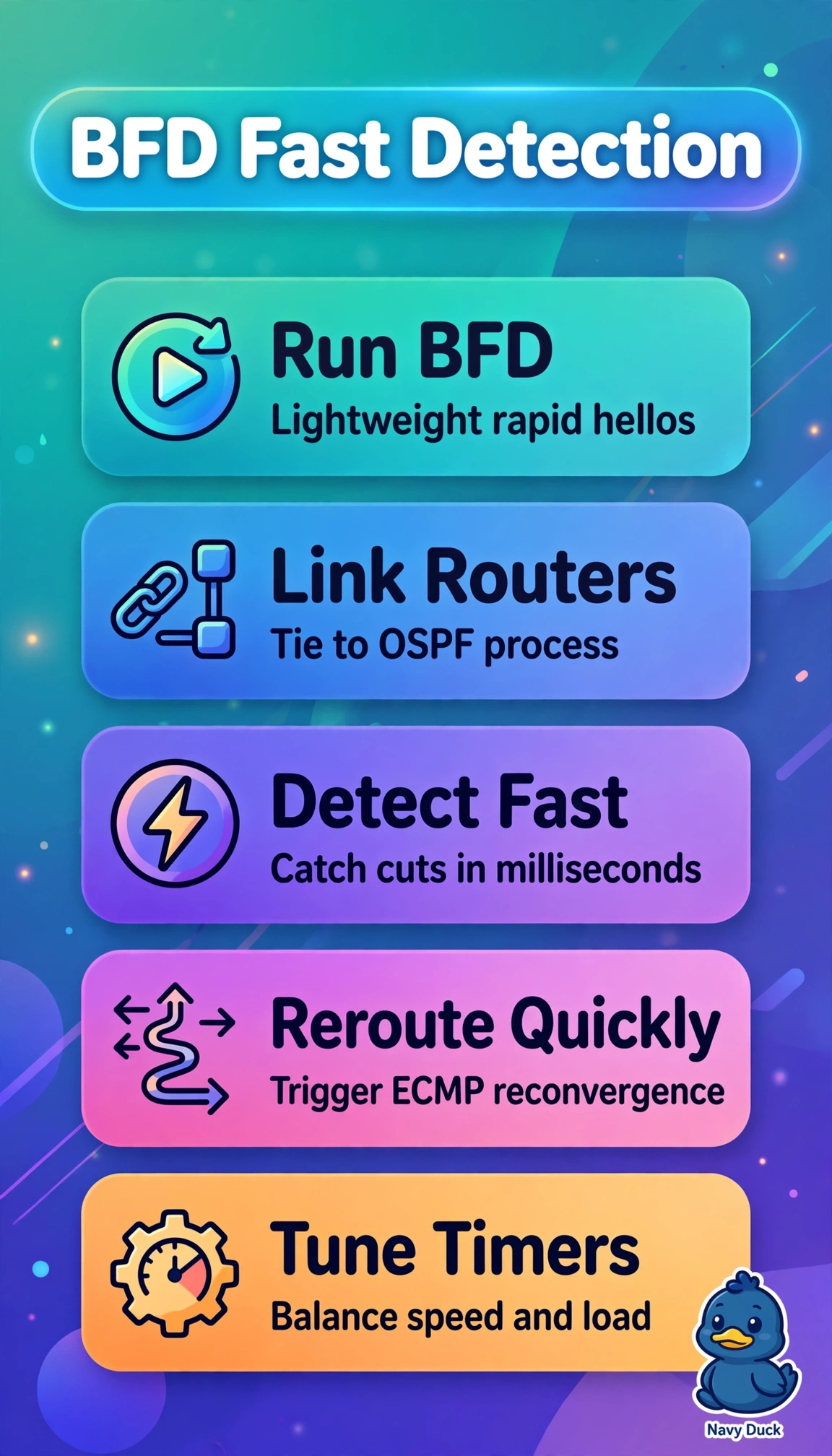
You're swapping a slow pulse check for a rapid heartbeat monitor. Lightweight BFD sessions spot a cut in milliseconds and tell routing to reroute fast.
Full Explanation
Bidirectional Forwarding Detection provides lightweight sub-second hello-based failure detection that integrates with routing protocols like OSPF, so link or path failures trigger rapid adjacency teardown and ECMP reconvergence without the overhead of very aggressive routing timers. Spanning-tree PortFast fails by concept because it applies to Layer 2 edge ports, not Layer 3 routed links, and does not detect forwarding failures. Increasing OSPF timers fails by concept because longer hellos slow detection further and relying solely on physical link-down misses soft failures. A first-hop redundancy protocol fails by concept because it protects host gateway availability rather than accelerating router-to-router failure detection and reconvergence. For the exam, remember BFD is tied to the routing process with negotiated timers, and validate timer consistency, echo support, and CPU impact.