
A national retailer runs one autonomous system across 30 WAN routers in a single IGP domain. iBGP full-mesh sessions are growing sharply, CPU is spiking during best-path churn, and the team must keep one externally visible ASN with minimal administrative split. Which BGP iBGP scaling design reduces sessions while preserving a single autonomous system?
Select an answer to reveal the explanation.
Short Explanation
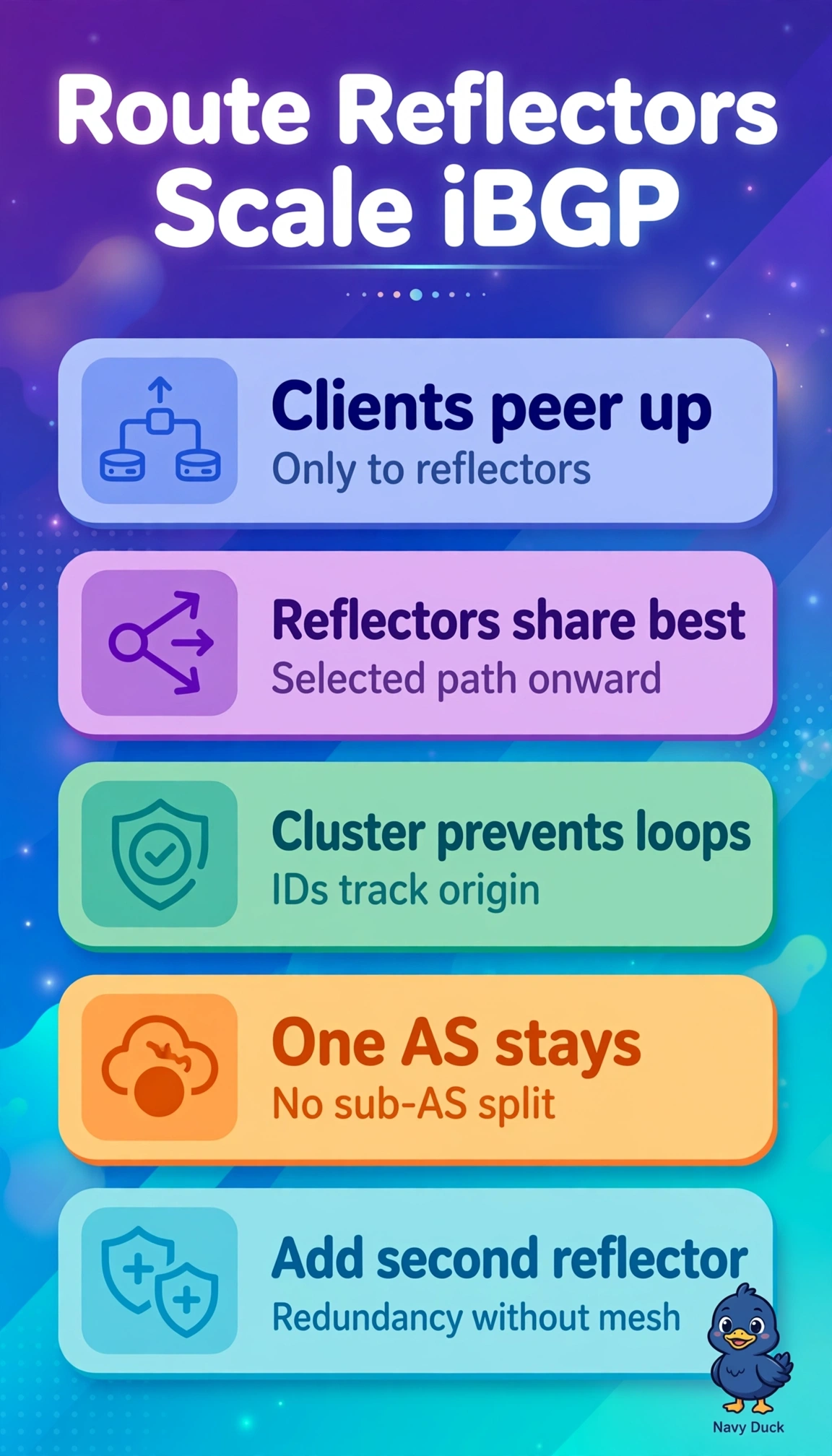
You keep things simpler when clients talk to just two helpers. Clustering gives you redundancy without splitting your AS or rebuilding the IGP, like having two dispatchers for one fleet.
Full Explanation
A redundant pair of route reflectors in a single cluster is correct because it collapses the n(n-1)/2 iBGP full-mesh requirement to client-to-reflector sessions only, sharply reducing TCP sessions, update replication, and best-path churn CPU on the 30 WAN routers while preserving one autonomous system, one IGP domain, and one externally visible ASN with minimal new policy boundaries. The confederation design is a legitimate large-scale technique that still advertises a single ASN externally and reduces mesh, but it creates multiple internal sub-ASs with their own AS numbers, peering rules, and policy administration, violating the stated minimal administrative split constraint. Retaining full-mesh iBGP with inbound filtering and IGP tuning is common operational practice to dampen churn and lower CPU, yet it leaves the underlying session scaling problem intact because every router must still maintain sessions to every other router. Migrating router groups into separate public autonomous systems peered with eBGP is standard for inter-organizational boundaries and does remove iBGP mesh, but it directly breaks the requirement to keep one unified, externally visible autonomous system. On exams, distinguish solutions that reduce sessions while keeping one AS from those that preserve a single external ASN but add internal AS boundaries. In practice, verify both reflectors share the cluster ID for redundancy, ensure clients peer only to reflectors, confirm IGP reachability to reflector loopbacks, and monitor reflector CPU, memory, and update load before scaling clients further.