
A hotel chain operates IPv4 for legacy property systems, IPv6 for new guest Wi-Fi, and needs to keep staff, guest, and building-automation traffic isolated while extending routes to an MPLS provider. Which BGP address family design should the designer adopt for multiprotocol and VPN isolation?
Select an answer to reveal the explanation.
Short Explanation
You’re sorting different kinds of traffic into labeled private boxes. The right address families keep each protocol and tenant in its own lane as routes cross the MPLS provider.
Full Explanation
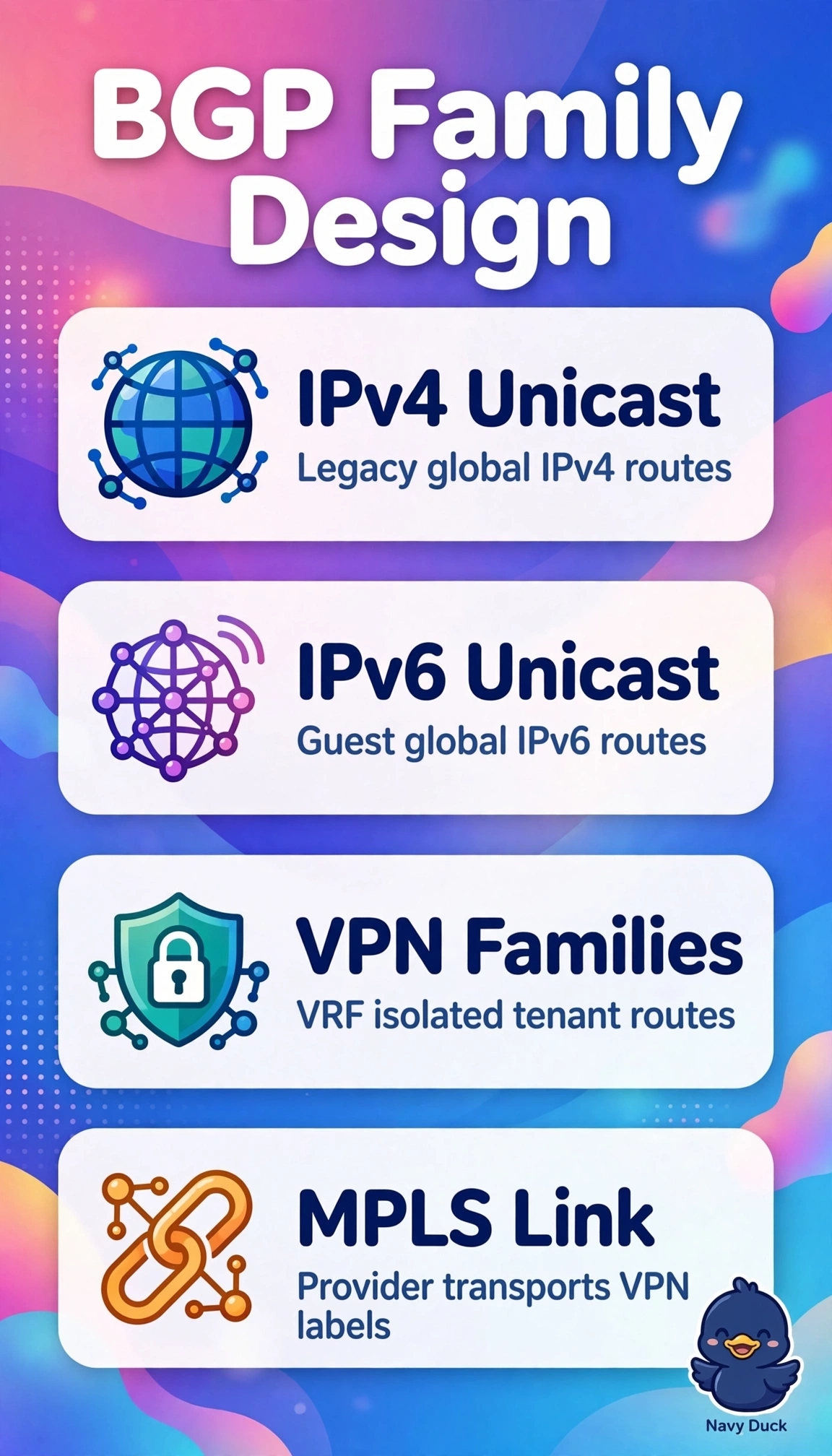
The design using IPv4 unicast for legacy property prefixes, IPv6 unicast for guest Wi-Fi, and VPNv4 plus VPNv6 for VRF-isolated staff, guest, and building-automation routes matches each protocol to its BGP family and preserves separation over MPLS. Route distinguishers and route targets support that VPN transport and tenant isolation. A design using IPv4 unicast, IPv6 unicast, and VPNv4 with VRFs but no VPNv6 lacks the VPN family needed to carry isolated IPv6 tenant prefixes across provider edges with their labels and extended communities; those routes cannot retain the required VPN isolation. A design using VRF-Lite locally without VPN signaling can separate traffic on a device, but cannot advertise tenant membership across the MPLS provider, so isolation does not extend through the provider handoff. A design using IPv6 unicast, VPNv4 and VPNv6, and NAT64 for legacy IPv4 systems relies on translation where native IPv4 reachability is needed; that can disrupt legacy peer connectivity and audit trails. Exam caveat: unicast families provide base reachability, while VPN families provide isolated transport, so isolation for both IP versions requires both VPNv4 and VPNv6. Practical check: verify each provider-edge VRF has the intended IPv4 and IPv6 prefixes, matching import and export targets, and no tenant prefixes leaking into global tables.