
A financial firm is redesigning management access for 150 branches where configuration backups cross the production WAN, auditors demand access during outages, and budget limits extra circuits. Which in-band versus out-of-band management trade-off best guides the design decision?
Select an answer to reveal the explanation.
Short Explanation
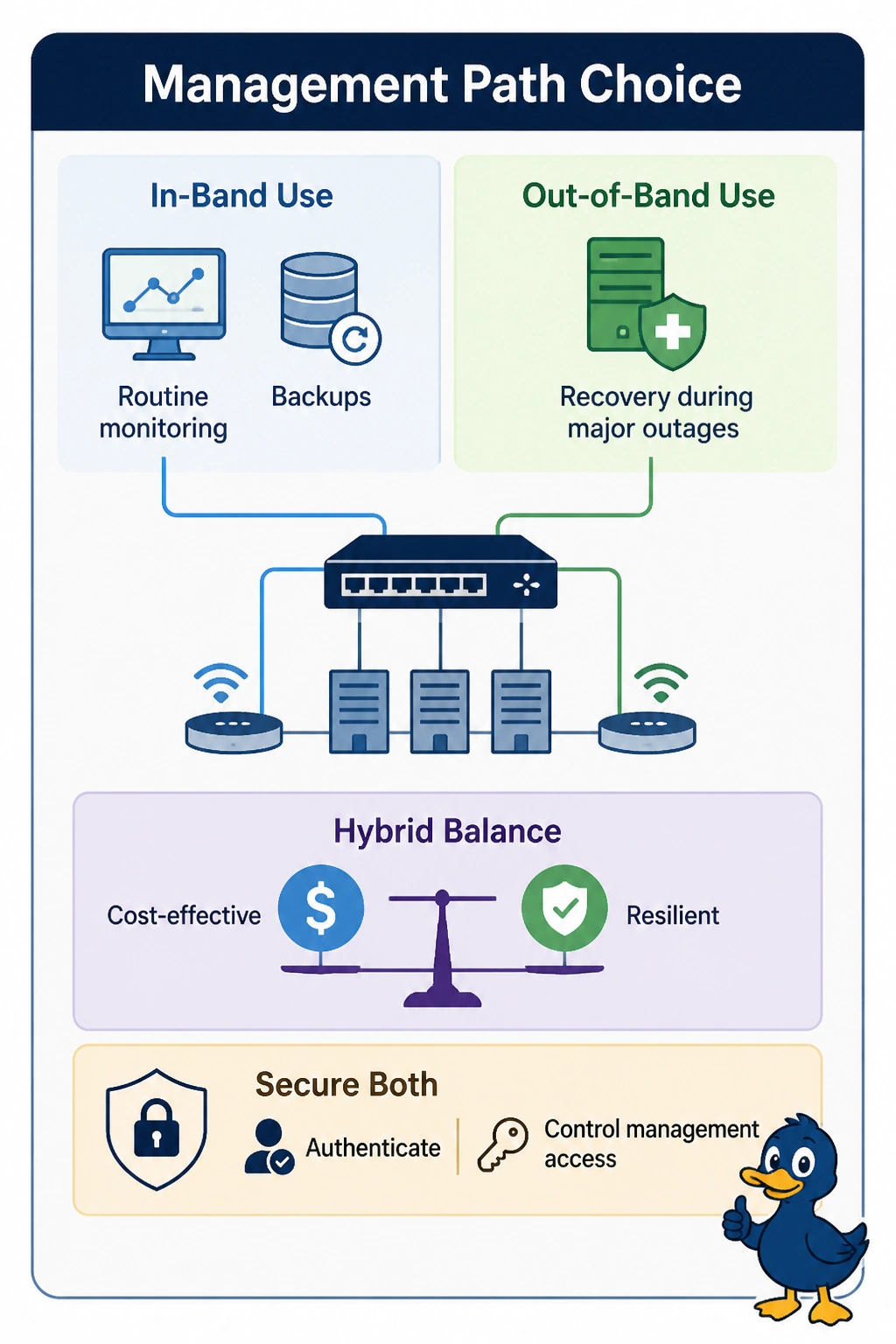
You cannot afford blindness in a crisis. Keep a spare key for emergencies and use the front door daily with resilience balanced against cost.
Full Explanation
The correct hybrid approach succeeds because it matches transport cost to criticality, using secured in-band paths for high-volume routine polling and configuration backups across 150 branches without extra circuits while reserving scarce out-of-band paths for auditor and administrator recovery when the production WAN fails. The centralized secured in-band design fails on availability because encrypted management VLANs provide confidentiality and segmentation but share fate with production, so an outage that isolates a branch also removes the very recovery access auditors require. The dedicated out-of-band design with separate cellular consoles to every site fails on economics because extending isolated transport for all monitoring and backups multiplies circuit, hardware, and operational costs beyond a budget that prohibits pervasive extra circuits. The hybrid that moves bulk backups onto dedicated out-of-band links fails on capacity efficiency because it consumes constrained recovery bandwidth with large scheduled transfers, raising cost and congesting the path needed for urgent access while underusing production capacity. An exam caveat is that secured does not equal survivable, so when outage access is explicit, focus on alternate reachability rather than encryption strength alone. A practical check is to simulate WAN loss at a pilot branch, verify routine monitoring degrades gracefully, confirm the out-of-band console still authenticates auditors with MFA and audit logging, and validate backup encryption and bandwidth limits on production.