
A manufacturer built an SD-Access fabric where roaming scanners keep their IP addresses while moving between warehouses, but large video flows must stay on efficient paths. The design must use the native SD-Access control and data planes and separate endpoint location from packet forwarding. Which LISP control plane and VXLAN data plane interaction best delivers mobility?
Select an answer to reveal the explanation.
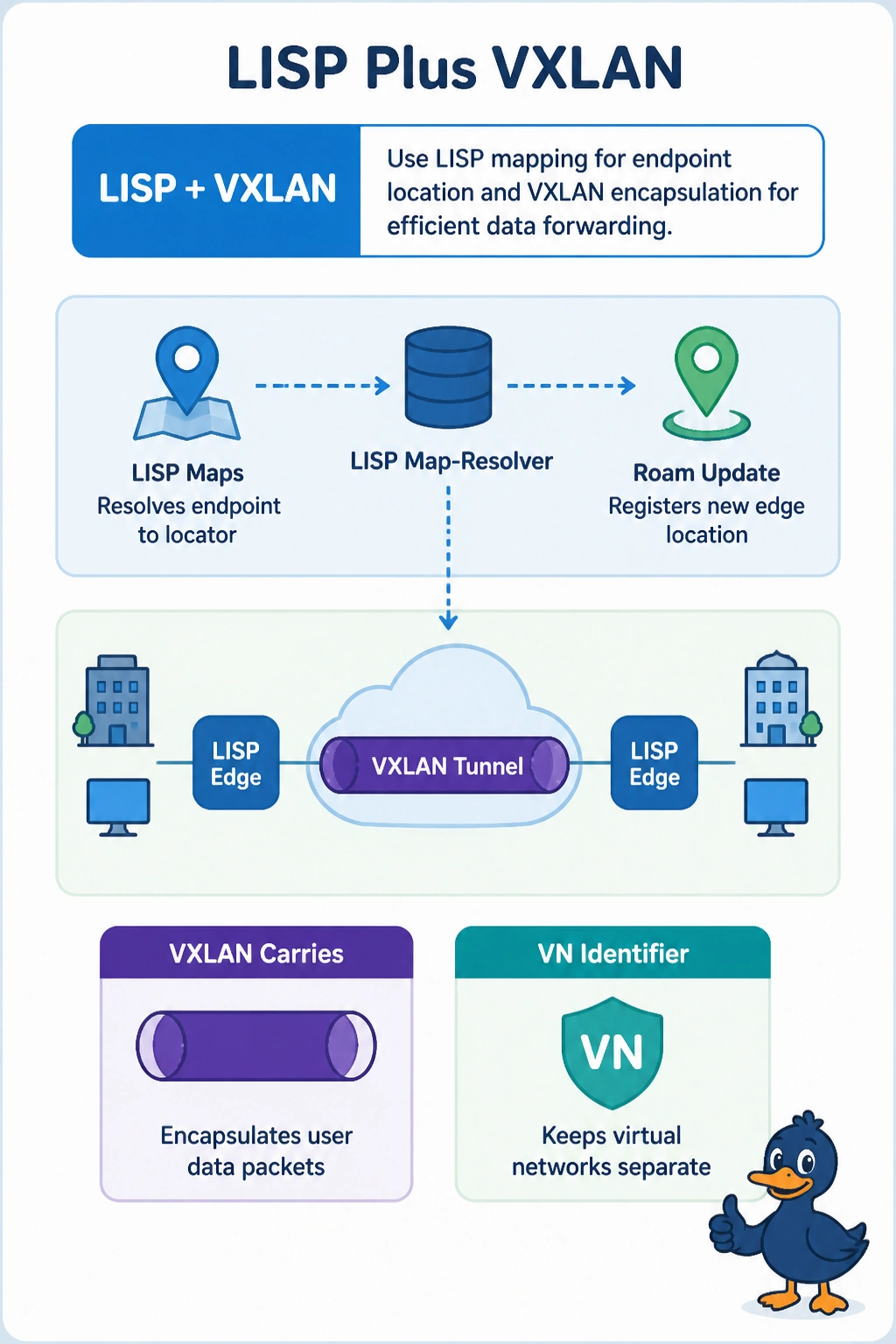
Short Explanation
You'll keep things smooth when your scanners roam since LISP mapping works like a phone book for endpoint locations. VXLAN encapsulation then does the delivery work so your big video flows stay on efficient paths.
Full Explanation
The correct design succeeds because LISP cleanly separates endpoint identity from routing location by maintaining EID-to-RLOC mappings, allowing scanners to retain their addresses while only locators change during roams, while VXLAN provides distributed high-throughput encapsulation between edge nodes over the underlay without path stretch for video. One centralized-border alternative is operationally sound for inspection and segmentation but violates the efficient-path requirement because backhauling large video flows to a border introduces tromboning, added latency and bottleneck risk contrary to direct edge forwarding. Another BGP EVPN alternative is widely deployed and does preserve addressing with efficient VXLAN forwarding, yet it fails the explicit separation mandate because EVPN couples reachability with the routing protocol rather than implementing a dedicated LISP mapping system distinct from forwarding. A further site-subnet alternative is a legitimate optimized routed pattern, but it breaks warehouse mobility because requiring a new local subnet address per site forces renewal and session reset for roaming scanners. As an exam caveat, distinguish SD-Access LISP mobility from EVPN host mobility and from traditional centralized anchoring by focusing on stem keywords about mapping versus forwarding. As a practical check, verify the same endpoint registers to different edge locators after a roam and that video between edges stays on the direct underlay path without traversing the border.