
A city government needs to connect five downtown offices in one bridged domain for legacy applications, plus a separate isolated point-to-point link for data-center replication between two sites. Carrier offerings list E-Line and E-LAN options. Which Metro Ethernet design should the designer select to satisfy both connectivity patterns?
Select an answer to reveal the explanation.
Short Explanation
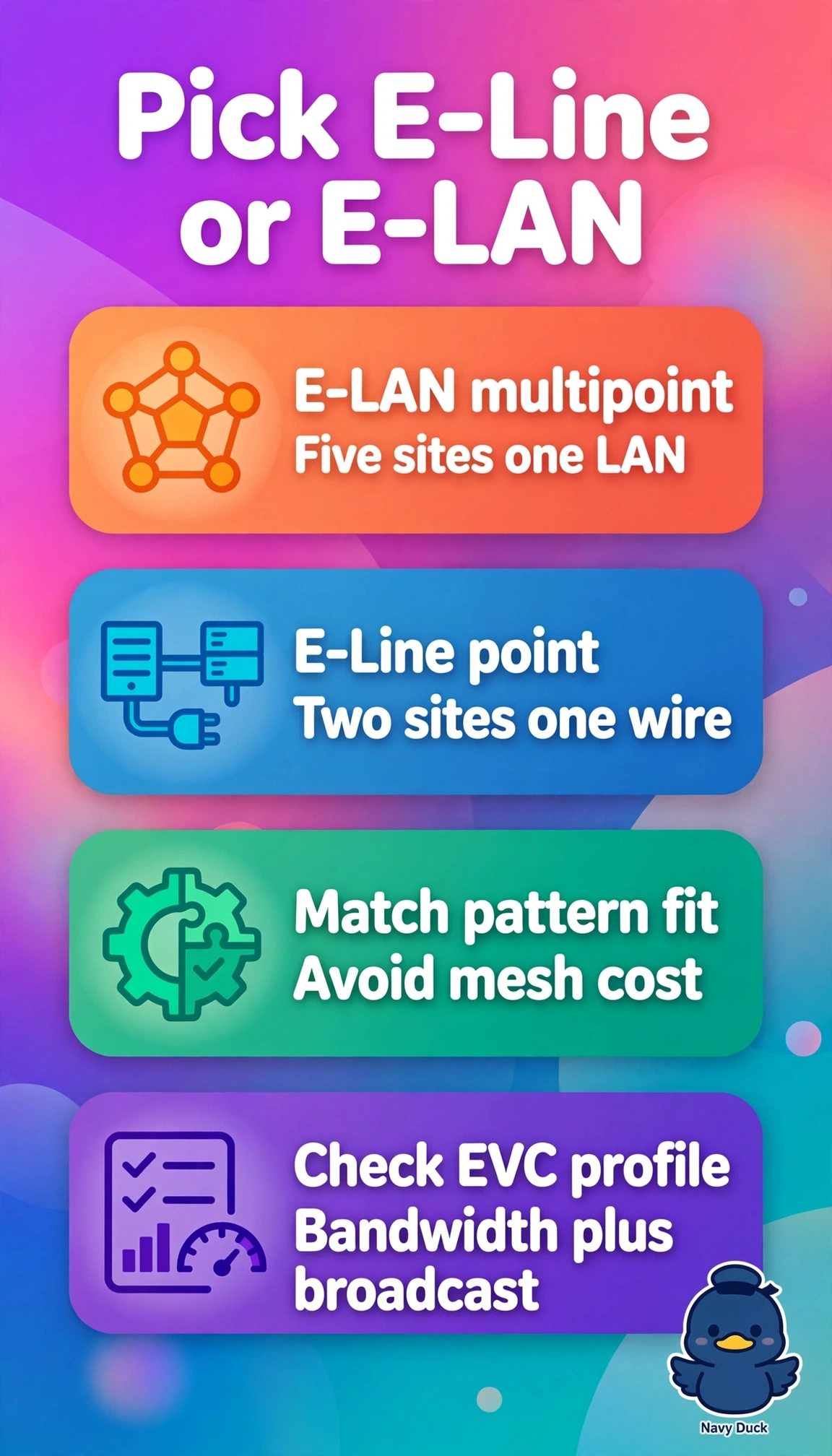
Matching service shape to traffic shape saves money and headaches here. Multipoint bridging fits the group while a private wire fits the pair, with multipoint guiding your pick.
Full Explanation
E-LAN provides multipoint-to-multipoint Ethernet service that emulates a bridged LAN across sites, ideal for five offices needing one broadcast domain, while E-Line provides point-to-point Ethernet virtual connection ideal for isolated low-latency replication between two endpoints. Reversing them forces replication onto a shared multipoint service and the five-site mesh onto a single point-to-point link, which cannot natively provide the required connectivity without extra overlays. Meshing E-Line circuits between every office to emulate multipoint creates N-squared circuit growth, higher cost, and complex provisioning compared with a single E-LAN instance. Using E-LAN only for replication and Internet routing for offices fails the bridged-domain requirement and introduces unpredictable performance for legacy protocols. Exam caveat: map E-Line to point-to-point and E-LAN to multipoint bridging. Practical check: confirm EVC topology, bandwidth profile, and broadcast handling per service instance.