
A national bank runs IS-IS across 80 routers with a stable core and many regional branches, needing loop-free hierarchy, summarized branch prefixes, and minimal link-state flooding to branches. Designers must choose router roles and adjacency types that enforce a two-tier boundary. Which IS-IS level design creates a stable and scalable hierarchy?
Select an answer to reveal the explanation.
Short Explanation
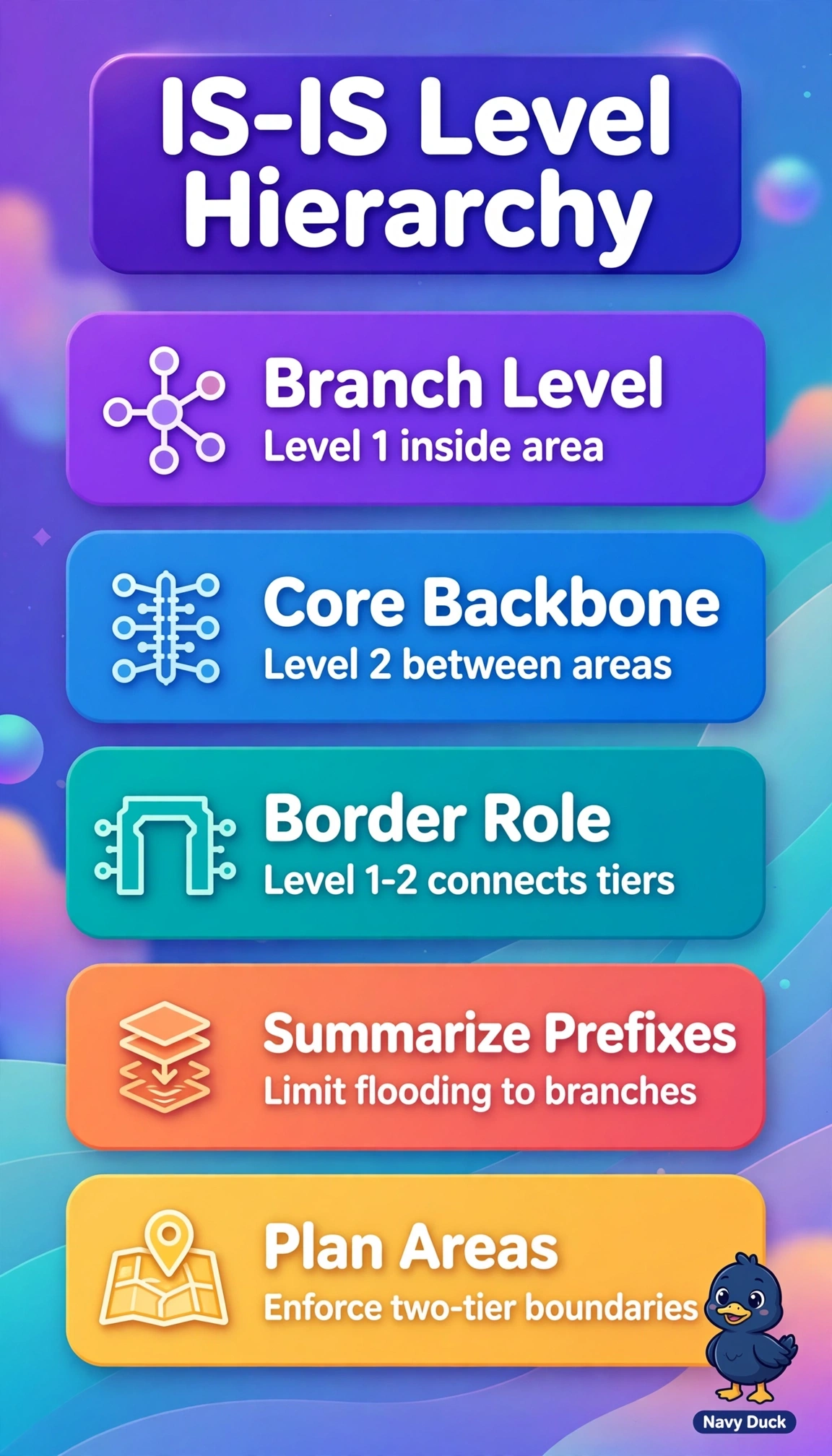
You're organizing branches under regional managers who report to headquarters. Placing the backbone at Level 2 keeps branch details summarized and flooding contained.
Full Explanation
IS-IS hierarchy uses Level 1 for intra-area routing within branches and Level 2 as the backbone between areas, with Level 1-2 routers providing controlled redistribution and summarization at boundaries, which limits flooding scope and supports stable growth. Making every router Level 1-2 fails by concept because it floods both levels everywhere, defeating hierarchy and increasing convergence load. Reversing roles with Level 1 core and Level 2 branches fails by concept because it misapplies the backbone function and prevents proper inter-area transit through the core. Using a single Level 2 area fails by concept because it removes the boundary that enables summarization and flooding containment for many branches. For the exam, remember Level 2 is the backbone and Level 1-2 does inter-area leaking, and check area addresses, adjacency formation, and summarization points.