
A manufacturer runs data centers with MPLS VPN and needs predictable performance to cloud workloads for ERP, plus rapid turn-up of new regions without new circuits. Architects must compare dedicated and virtual connectivity models. Which cloud connectivity option using direct and on-ramp constructs best addresses both needs?
Select an answer to reveal the explanation.
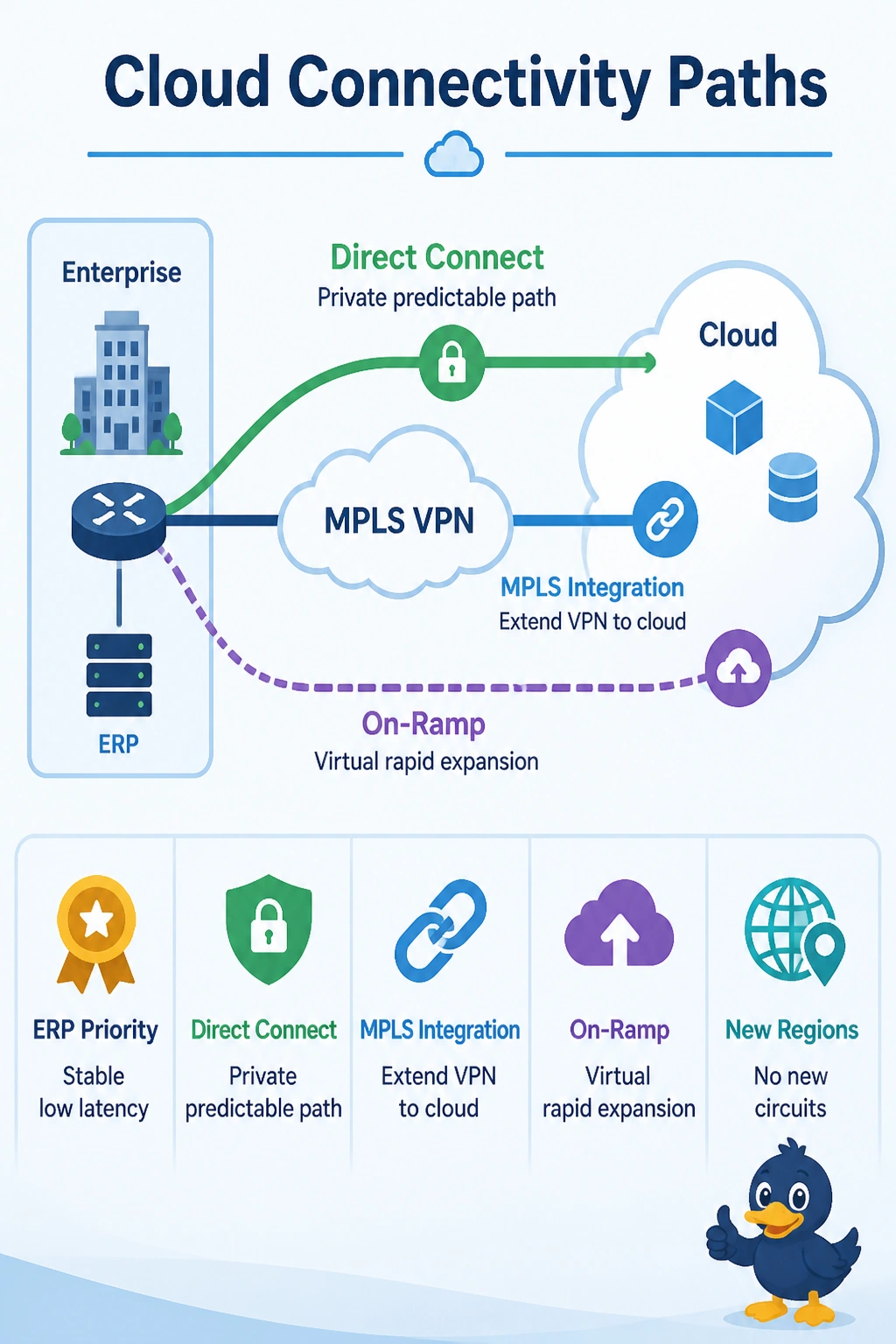
Short Explanation
You want steady ERP lanes plus fast new-region hookups. On-ramp extends your fabric to cloud without new wires. It's like keeping a private highway while adding express entrances.
Full Explanation
The correct pairing works because dedicated direct interconnect supplies SLA-backed private capacity with consistent latency and BGP integration to the existing MPLS VPN for ERP, while virtual cloud on-ramp instantiates hosted gateways and transit routing in new regions in software without ordering cross-connects, together satisfying predictability and rapid expansion. The per-region private-circuit approach preserves determinism but violates rapid turn-up without new circuits since each region still requires fiber delivery, authorization and provisioning lead time. The SD-WAN on-ramp over internet approach enables fast turn-up with dynamic path selection but violates predictable performance since broadband remains best-effort with congestion, jitter and no end-to-end SLA for transactional ERP. The exchange-hub with public SaaS peering approach keeps private ERP locally but violates predictable expansion since new-region ERP would ride SaaS-oriented public peering rather than private virtual interfaces, reintroducing variability and tromboning. Exam caveat is to lock on both paired keywords predictable and rapid without new circuits and separate dedicated private paths from virtual private on-ramps from public peering, as stems test whether virtual automatically means internet. Practical check is to map ERP throughput, latency budget and MPLS route import to provider presence, verify the on-ramp supports private interfaces with transitive routing, then replay ERP transactions measuring loss, latency and failover before cutover.