
A downtown headquarters has dual distribution switches with HSRP today, but failover tuning and dual control planes cause spanning-tree complexity. The refresh offers switch virtualization so the pair can operate as one logical node with one control plane. Which platform abstraction should the designer choose to simplify high availability and remove the FHRP need?
Select an answer to reveal the explanation.
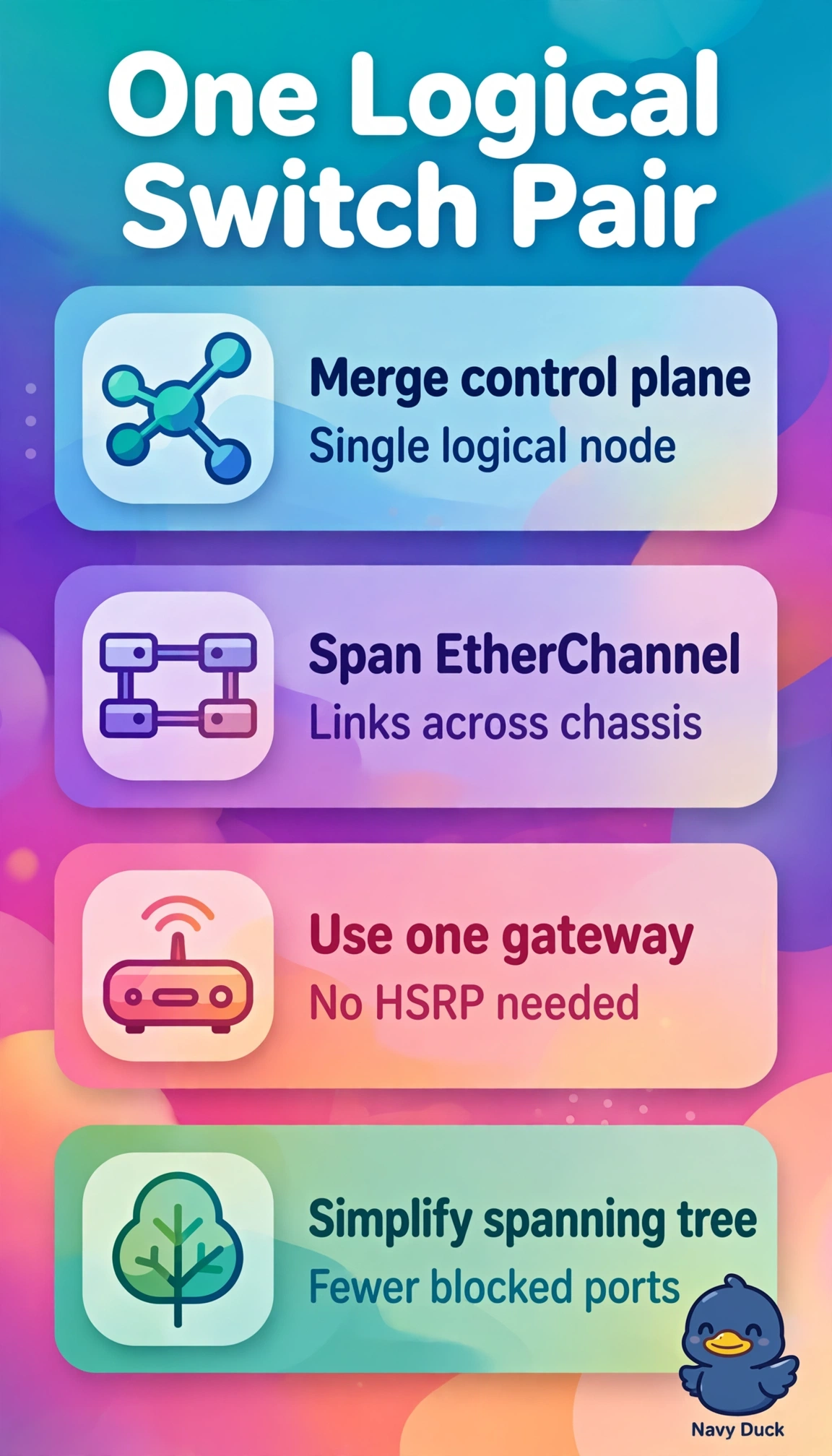
Short Explanation
Fewer brains can mean fewer arguments during failures. Merging the pair into one logical switch collapses protocols and gateway state, and virtualization is the shortcut you're choosing.
Full Explanation
Virtualizing the pair with StackWise or VSS merges two chassis into one logical switch with a single control plane and single management point, allowing multichassis EtherChannels that look like local bundles, collapsing spanning-tree adjacencies and removing the need for HSRP because only one gateway instance exists. NSF with SSO fails the consolidation requirement because it only preserves forwarding across a supervisor switchover within each independent switch, leaving two control planes, two configurations, HSRP peering, and interswitch spanning-tree to operate and tune. A vPC peer link fails the single-control-plane requirement because vPC provides loop-free multichassis aggregation from dual independent control planes that still need a gateway redundancy protocol and peer-link plus keepalive handling. Tuned HSRP timers with STP priorities fails the simplification goal because optimized hellos, preemption, and root placement only speed convergence of the existing two-node design while retaining FHRP and spanning-tree complexity. For exams, separate true single-control-plane virtualization from dual-control-plane multichassis LAG, and in practice verify model and code support, virtual-link redundancy, dual-active detection, and upgrade behavior before choosing the abstraction.