
A bank is planning native dual-stack on its campus and data center where most switches and firewalls already support IPv6. Operations worries about doubling troubleshooting load, security gaps, and inconsistent feature support. Which native dual-stack design consideration best addresses long-term operability?
Select an answer to reveal the explanation.
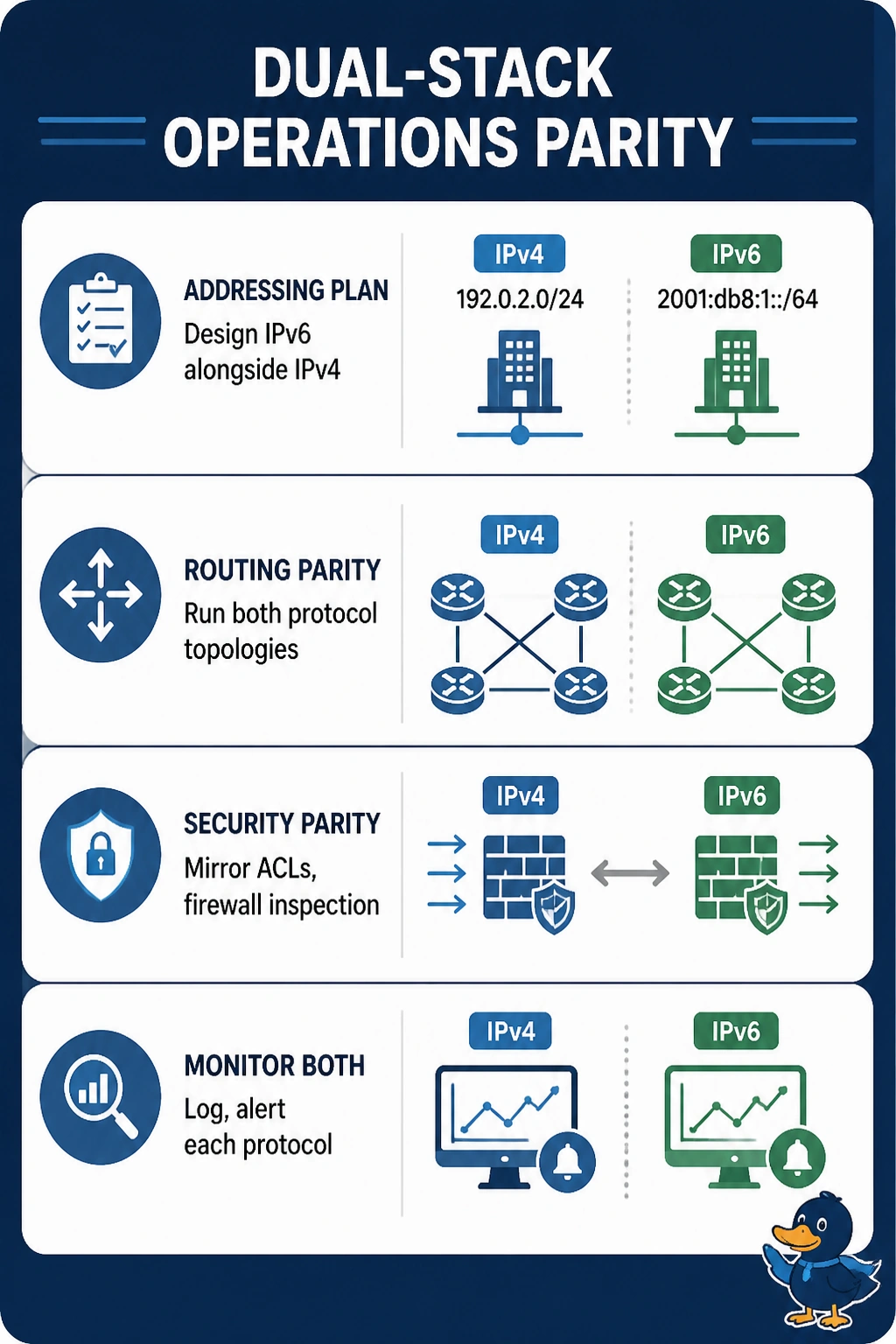
Short Explanation
Running two protocols means running two networks in parallel. Your win comes from matching parity so nothing slips through the cracks.
Full Explanation
The correct operations parity plan is right because native dual-stack does not merely add addresses or routes, it duplicates the entire operational surface that the bank already manages for IPv4, and long-term stability in a campus and data center with mostly ready hardware depends on extending identical processes for address management, routing policy, ACLs and firewall inspection, logging, SNMP and flow telemetry, and troubleshooting runbooks so staff do not face double load or blind spots. A structured hierarchical IPv6 addressing plan is standard and valuable for aggregation and growth, yet by concept it solves numbering and summarization rather than day-two operability and therefore leaves the stated worries about security gaps and monitoring inconsistency unaddressed. A validated hardware refresh to ensure consistent feature support is also common practice given uneven IPv6 support for QoS, multicast, or inspection, but it addresses capability readiness rather than process parity and does not itself unify how events are monitored or incidents are handled. A tuned OSPFv3 and BGP design for IPv6 path selection and convergence is essential for performance, yet it optimizes control-plane behavior while omitting the broader alignment of security controls and visibility that determines whether operations can support two protocols sustainably. For exam purposes, remember that questions asking for best long-term operability typically prioritize governance and parity over a single technical optimization, even when the single optimization looks complete. As a practical check, audit one IPv4 workflow end to end from provisioning to firewall rule to alert and confirm an equivalent documented IPv6 workflow exists before expanding dual-stack beyond pilot.