
A financial campus core with dual supervisors needs software upgrades and supervisor failures to occur without dropping BGP and OSPF adjacencies or interrupting trading traffic. The operations team requires continuous forwarding during control-plane switchover and peer cooperation for route recovery. Which high-availability mechanism enables hitless supervisor failover for routing protocols?
Select an answer to reveal the explanation.
Short Explanation
You're changing pilots without the plane dipping an inch. With stateful switchover plus cooperative restart, neighbors hold your routes while forwarding continues.
Full Explanation
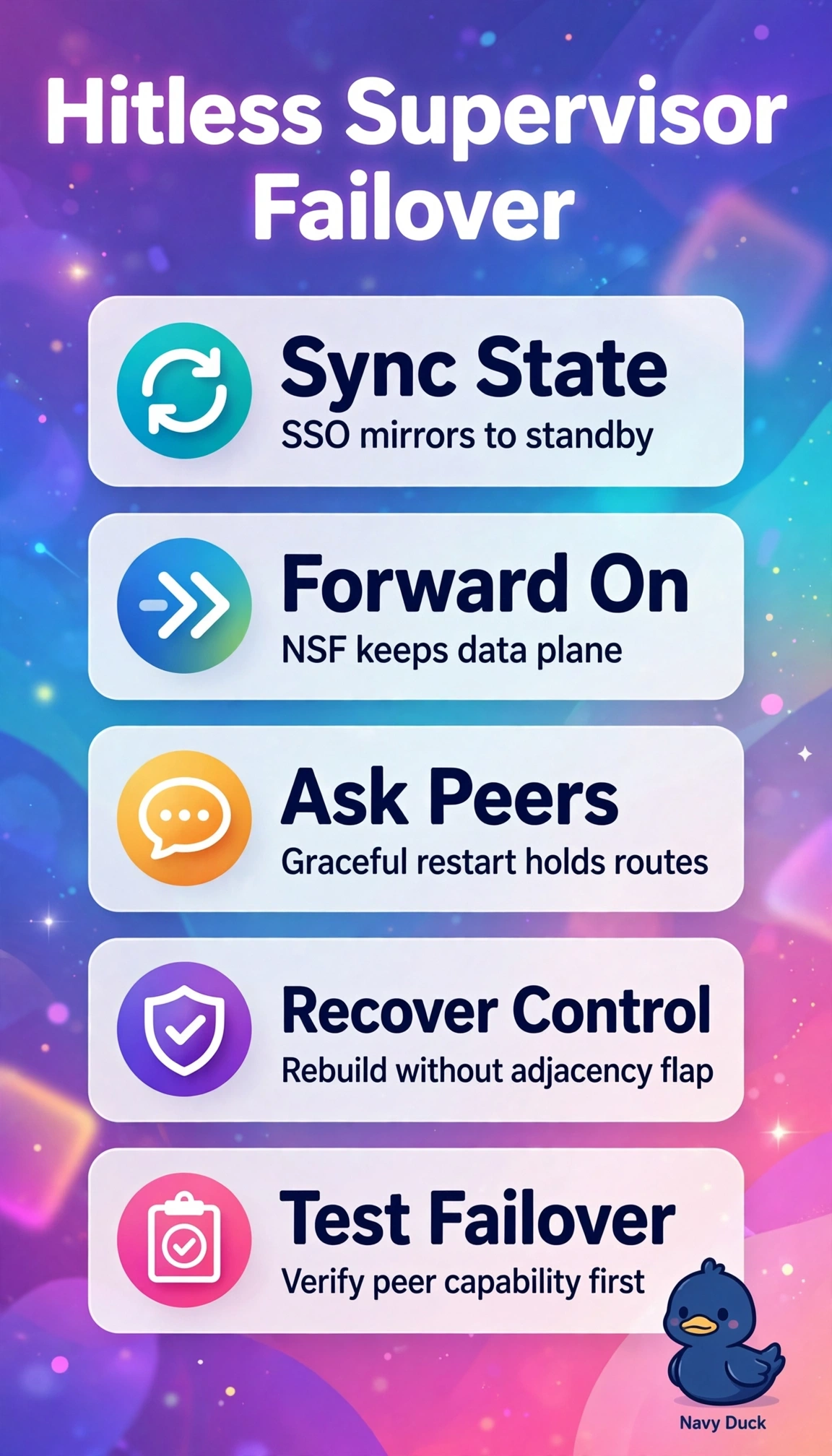
The correct mechanism combines SSO for supervisor redundancy with NSF and graceful restart for routing resiliency, so the standby supervisor assumes control with the forwarding plane intact while BGP and OSPF peers retain routes during control-plane recovery, preventing adjacency flaps and traffic loss across both upgrades and unexpected failures. The SSO-only approach is valid for stateful switchover and preserves forwarding tables momentarily, but without NSF and graceful-restart extensions the new active control plane must still rebuild neighbor state from scratch, so BGP and OSPF adjacencies drop despite continuous data-plane operation. The ISSU-based approach is a sound field practice for planned version changes because it sequences supervisor reloads while maintaining forwarding, yet it orchestrates only orderly upgrades and provides no protection when a supervisor fails unexpectedly, leaving half the stated resiliency requirement unmet. The OSPF-only NSF approach correctly uses standby forwarding continuity plus peer cooperation to achieve hitless recovery, but its scope covers only OSPF, so BGP sessions remain exposed to flap and reconvergence and the dual-protocol requirement for the campus core is not satisfied. A frequent exam caveat is conflating SSO which enables switchover readiness, NSF which preserves forwarding, graceful restart which enlists peers, NSR which avoids peer involvement, and ISSU which manages upgrades, with the deciding clues here being continuous forwarding plus explicit peer cooperation for both protocols and both failure types. A practical check is to confirm graceful-restart support on all BGP and OSPF neighbors, harmonize restart and stale-path timers with trading loss budgets, then validate with supervised switchover tests while monitoring adjacency stability and packet loss.