
A retail chain is adding 40 small stores and wants the provider to carry routing between sites so the small IT team avoids managing a full mesh of tunnels or a large enterprise routing domain. Overlapping private addresses are not required, but simple adds and provider-managed path selection matter. Which WAN service should the designer recommend to meet the routing ownership and scaling need?
Select an answer to reveal the explanation.
Short Explanation
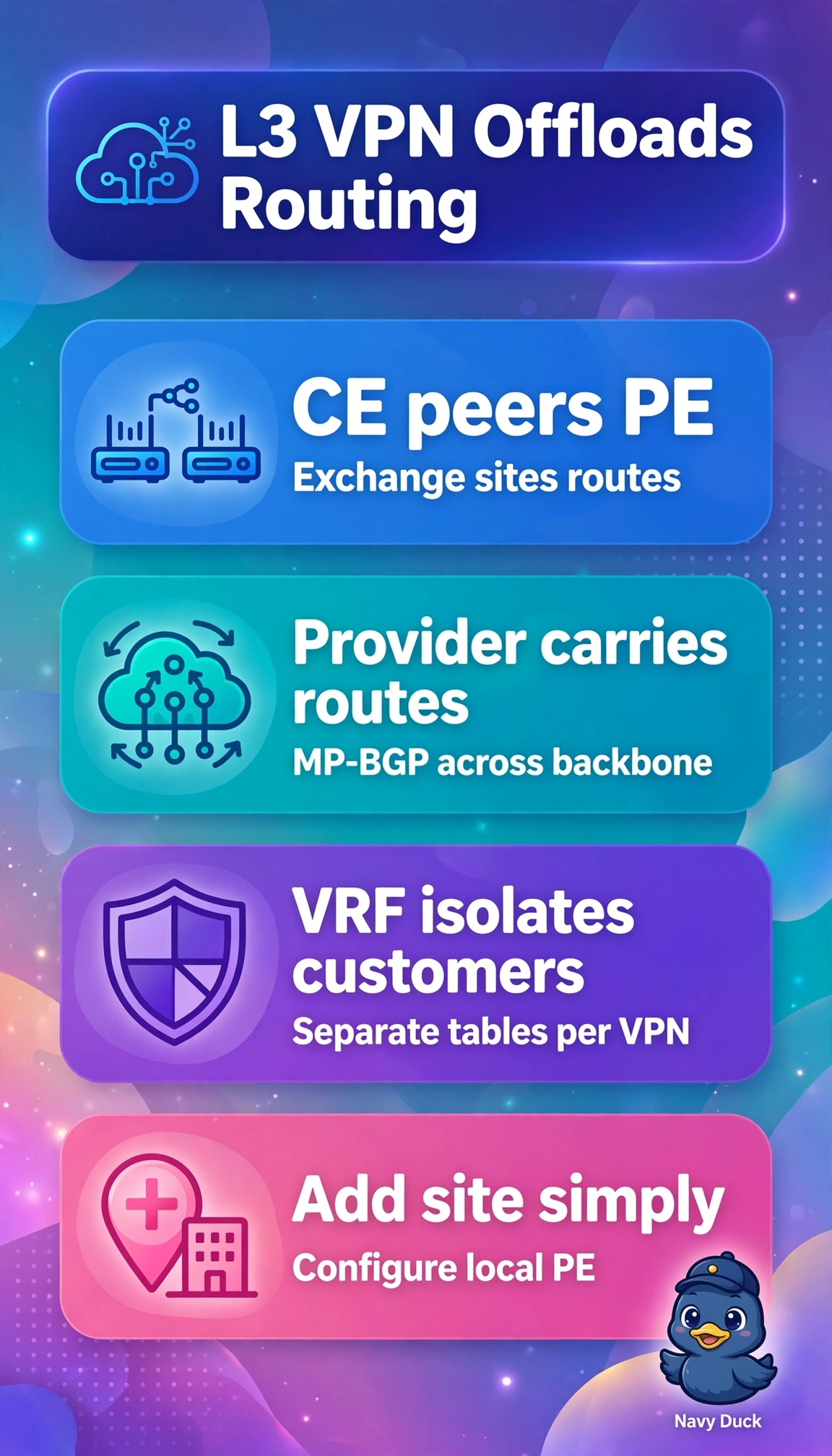
Offloading routing changes everything for a lean team. Provider-run Layer 3 VPNs act like a hired courier network handling directions for you, with VRF separation keeping customers apart.
Full Explanation
MPLS Layer 3 VPN places routing peering between customer edge and provider edge, with the provider carrying customer routes as VPN prefixes across its backbone and isolating customers in VRF tables, so adds require only a local PE configuration and enterprise routing stays simple. Layer 2 VPN to extend Ethernet while the enterprise controls all IP routing leaves all routing design, peering, and scaling with the enterprise, which increases operational burden and does not provide provider-managed path selection. Describing MPLS Layer 3 VPN as bridging frames confuses layers because Layer 3 VPN routes IP prefixes rather than switching customer Ethernet frames, so it misstates ownership and forwarding behavior. Layer 2 VPN with provider-managed VRF routing mixes models because VRF-aware routing is the hallmark of Layer 3 VPNs, not a transparent Layer 2 transport. Exam caveat: map routing ownership to Layer 3 VPN and transport transparency to Layer 2 VPN. Practical check: confirm CE-PE routing protocol, VRF route targets, and how a new site is provisioned.