
An enterprise OSPF backbone with 800 routers suffers CPU spikes during flapping of edge links, causing repeated full SPF runs and flooding of unstable LSAs. Stability must improve without hiding needed topology changes. Which OSPF scaling design using timers and suppression best stabilizes the network?
Select an answer to reveal the explanation.
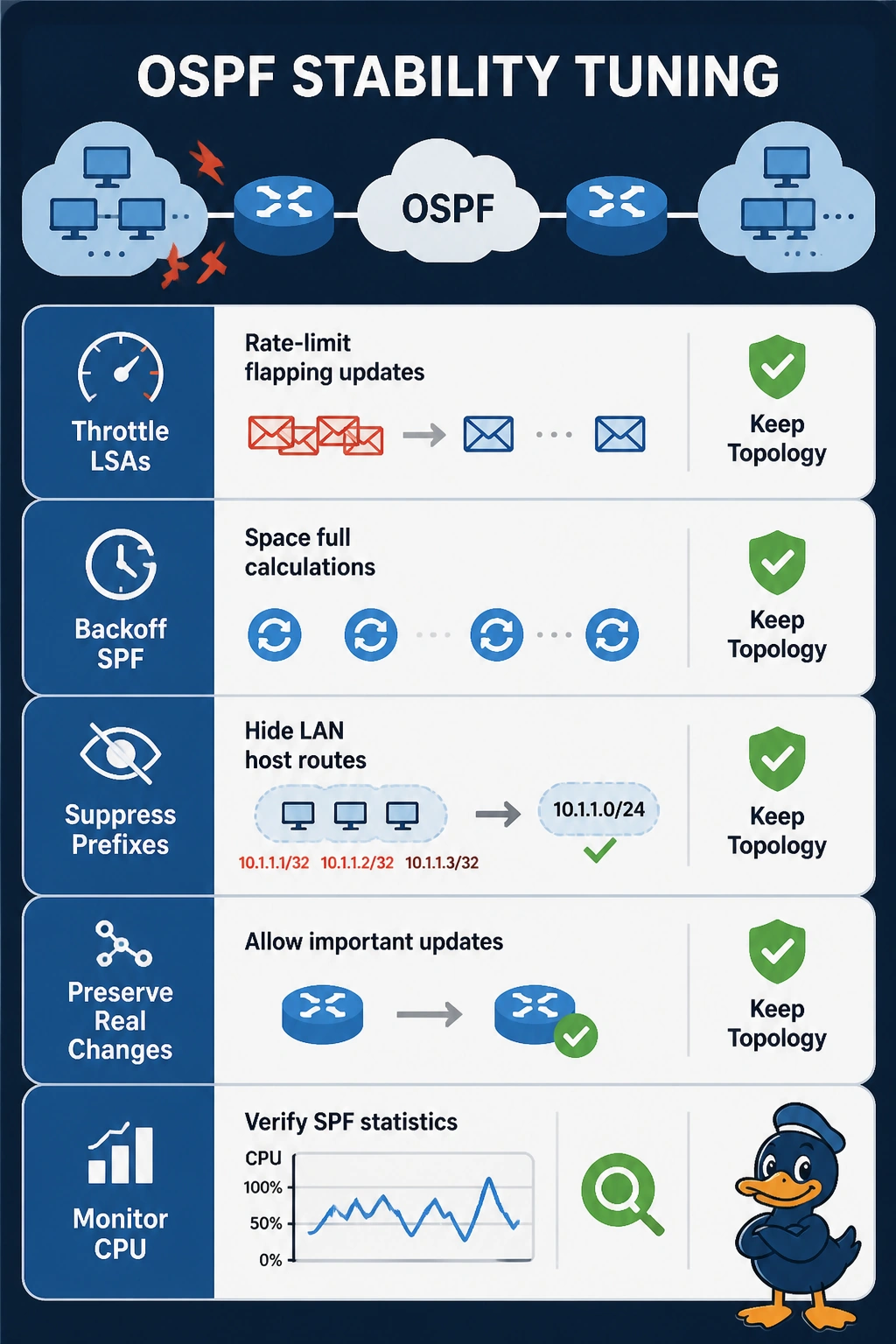
Short Explanation
You're adding shock absorbers so every pothole doesn't shake the whole bus. Tuned throttling spaces out the churn while prefix suppression quiets noisy LANs.
Full Explanation
The correct design succeeds because LSA generation throttling paces unstable edge LSAs with start-hold-maximum backoff, exponential SPF throttling batches repeated full runs while still allowing urgent changes through, and selective prefix suppression removes unstable LAN host prefixes from advertisement without withdrawing backbone reachability, together cutting CPU and flooding while preserving needed topology visibility. The incremental-SPF with tuned delays and totally stubby areas design fails by concept because incremental SPF and stub boundaries only shrink computation scope after a run is triggered and do not dampen origination rate, so flapping edge links still flood unstable LSAs and trigger frequent runs across the 800-router backbone. The LSA throttling with broad ABR summarization design fails by concept because coarse summarization trades visibility for quietness and hides needed topology changes where specific prefixes and failure location must remain visible for optimal routing and troubleshooting. The BFD with passive LAN interfaces and LSA pacing design fails by concept because accelerating detection without SPF backoff increases trigger frequency during flaps, and passive interfaces plus pacing alone cannot batch computation, so CPU spikes from repeated full SPF runs persist. Exam caveat is to distinguish stability mechanisms that add controlled delay and selective dampening from convergence mechanisms that add speed, since speed without backoff worsens flap-driven load. Practical check is to baseline show ip ospf statistics for SPF run count and throttle state with CPU history, then re-measure under induced flap while verifying suppressed versus required prefixes with ping and traceroute.