
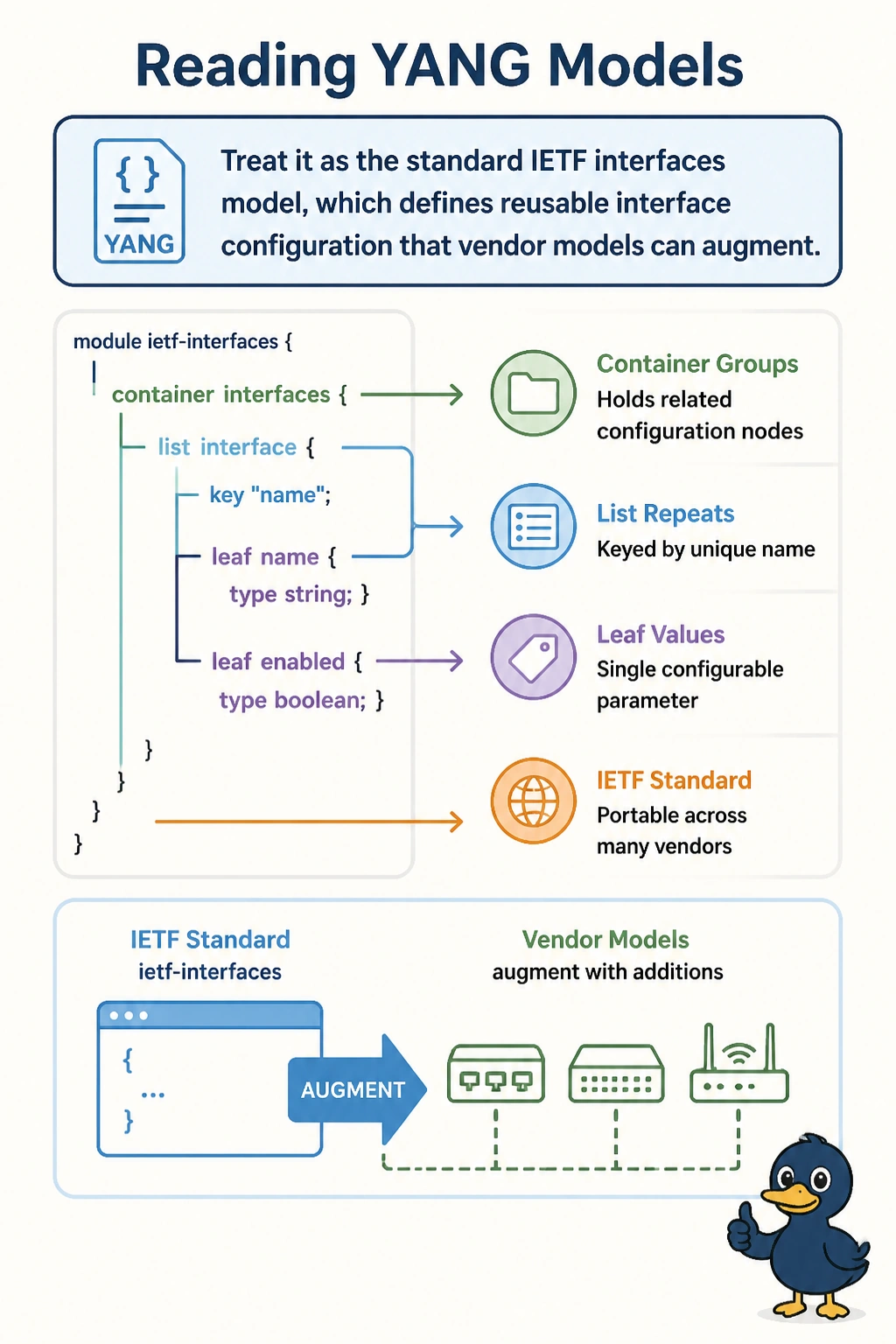
A network designer reviews a YANG module that shows a container interfaces with a list interface, leaf name as key, and leaf enabled as boolean. The team must automate multi-vendor campus switches without vendor extensions. Which interpretation of this YANG-based data model guides the correct tooling choice?
Select an answer to reveal the explanation.
Short Explanation
You are reading structure, not syntax trivia here. Containers group, lists repeat, and standardization lets your script speak to many vendors at once.
Full Explanation
The described container interfaces with list interface keyed by name and leaf enabled as boolean matches the standardized IETF interfaces model that defines reusable interface configuration intended to be implemented consistently and to serve as a base that vendor models can augment, which is why it guides correct tooling choice for multi-vendor campus automation without vendor extensions. The RESTCONF operational datastore query fails by datastore concept because it treats enabled as derived live status to read, while the structure describes intended administrative configuration in the running datastore to push, with operational state represented separately by leaves such as oper-status. The IETF system management model fails by module scope because DNS, hostname and clock belong to ietf-system rather than ietf-interfaces, so although it is standard and uses similar naming conventions it would direct automation at the wrong subtree and miss interface configuration entirely. The NETCONF candidate workflow fails by architectural layer because validation and commit describe protocol mechanics for safely applying any model, not the interpretation of what this specific model structure means for reusable tooling. Exam caveat: do not select a statement merely because it mentions multi-vendor consistency, boolean handling, or standard tooling, but verify whether the stem asks about model semantics versus protocol operation versus operational state. Practical check: inspect the module with pyang to confirm namespace and revision for ietf-interfaces, then compare RESTCONF running versus operational datastores and lab-test toggling enabled to confirm it controls intended admin state uniformly across switch operating systems.