
A two-building enterprise campus uses Cisco distribution switches as default gateways, and hosts in the same VLAN report one uplink idles while the other congests during peak backups. The manager requires active use of both gateways with automatic failover and prefers a Cisco-proprietary first-hop protocol. Which first-hop redundancy choice should the designer select to balance load and resilience?
Select an answer to reveal the explanation.
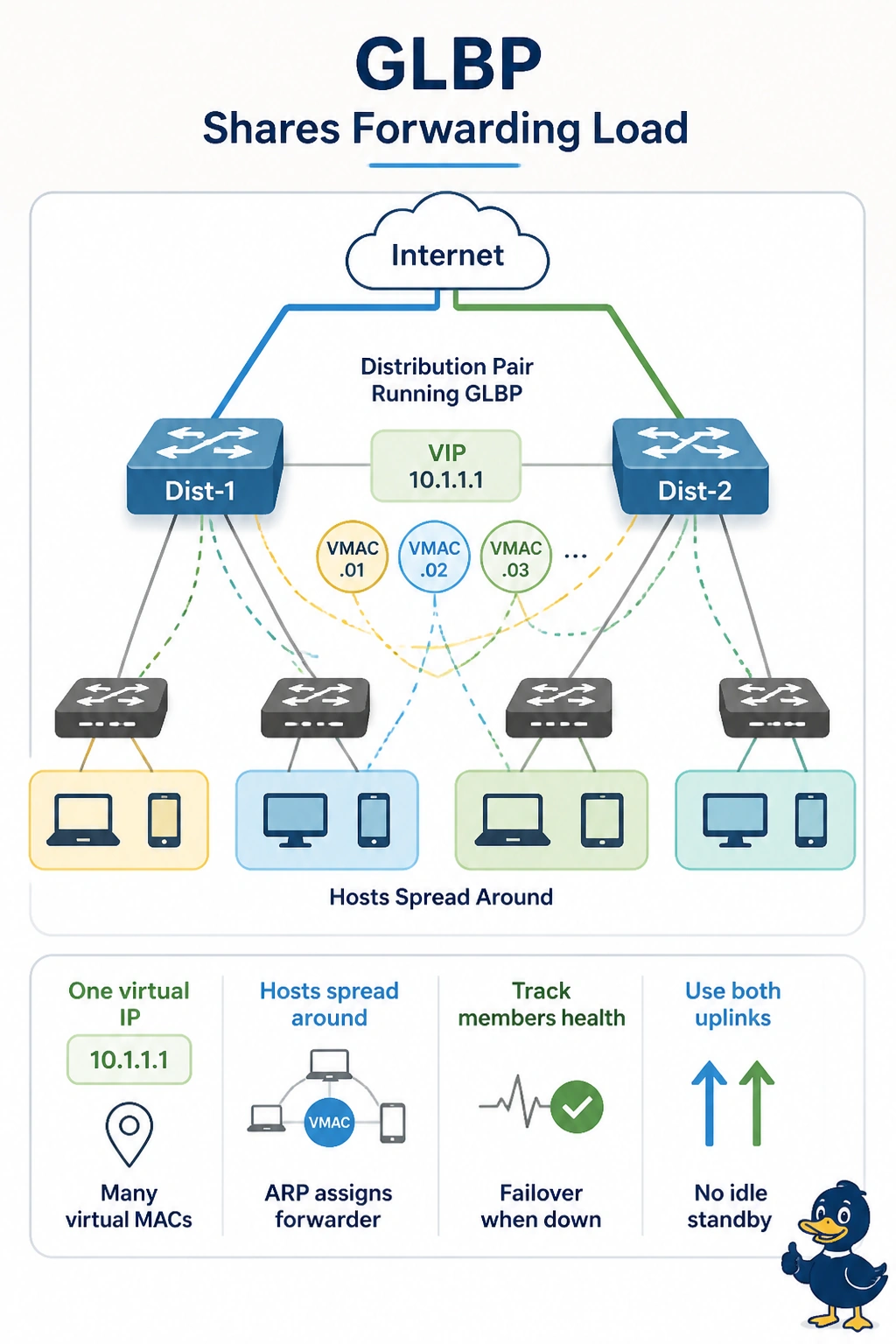
Short Explanation
You want both uplinks earning their keep instead of one napping. GLBP spreads hosts across forwarders while covering failures, making load-sharing your deciding clue.
Full Explanation
The requirement is active-active gateway forwarding within a VLAN, automatic failover, and a Cisco-proprietary protocol. GLBP meets it: its Active Virtual Gateway (AVG) assigns different virtual MAC addresses in ARP replies, allowing multiple Active Virtual Forwarders (AVFs) to forward simultaneously; priority-based takeover preserves service after failure. That addresses the idle-versus-congested uplinks during backups. HSRP with separate groups can distribute forwarding across VLANs and provide failover, but hosts in this single VLAN still use one active forwarder, so it does not resolve the stated imbalance. VRRP provides standards-based gateway redundancy and failover, and separate virtual gateways can share traffic, but it is not Cisco-proprietary and requires extra groups to approximate GLBP’s native per-host distribution. Layer 3 ECMP can use both access-to-distribution uplinks with fast convergence, but it is routed-path load sharing rather than first-hop gateway redundancy and requires a routed-access design and compatible host behavior. Exam caveat: distinguish HSRP multi-group distribution from GLBP’s round-robin, weighted, and host-dependent methods; GLBP combines per-host sharing and AVG-directed failover under one virtual IP. Practical check: verify AVG/AVF roles, virtual-MAC distribution, priorities, and backup throughput on each uplink before and after a forced failure.