
A large hospital runs IS-IS as the sole IGP across four areas with frequent maintenance windows and strict change control. Adjacencies must reject spoofed hellos and LSPs must survive brief link flaps without flooding churn. Which IS-IS authentication and stability tuning approach best meets these goals?
Select an answer to reveal the explanation.
Short Explanation
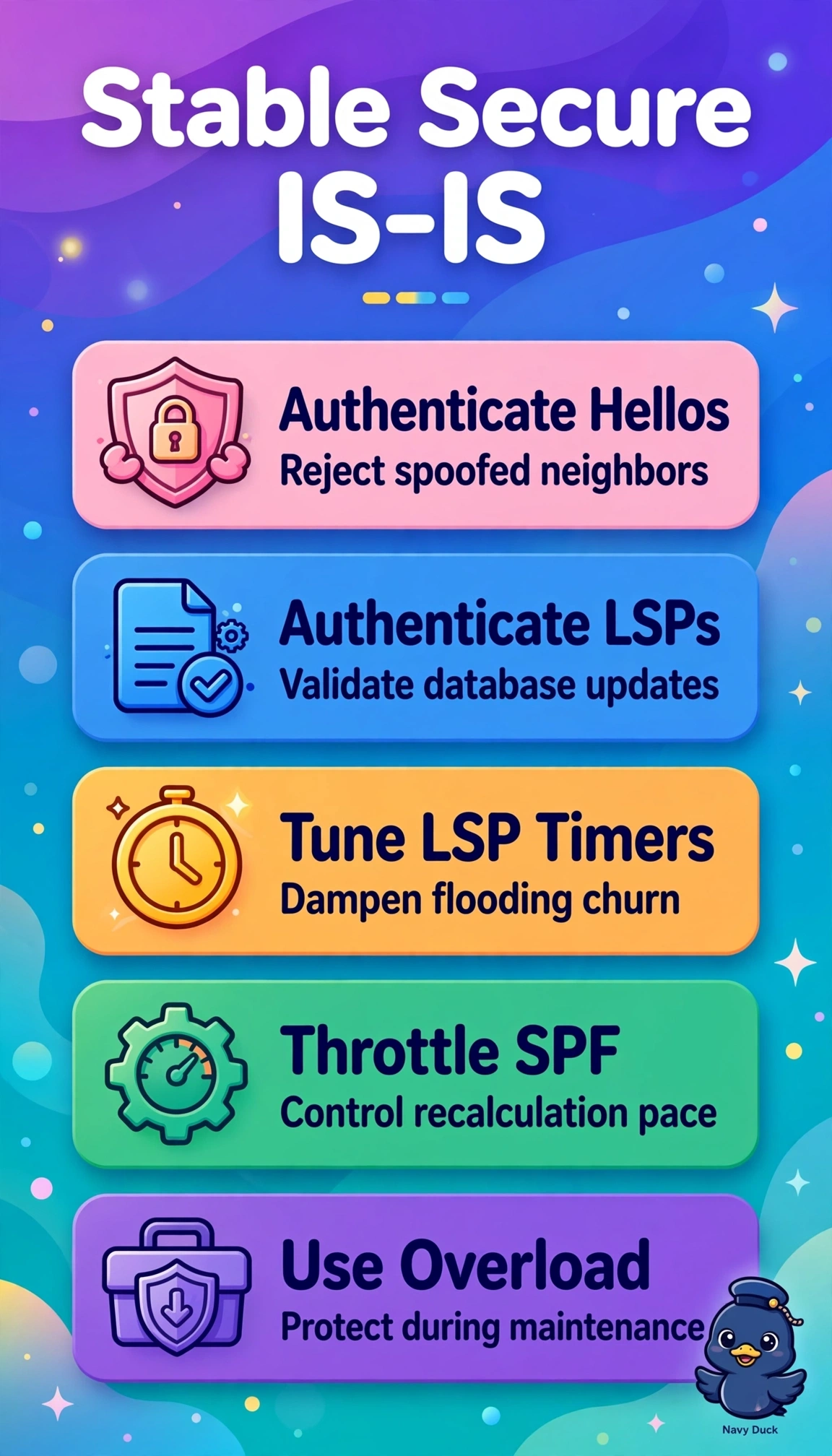
You're guarding a hospital network where flaps can't cause chaos. Authentication blocks spoofed hellos and LSPs while tuned timers calm flooding. It's like adding ID checks plus shock absorbers to your routing.
Full Explanation
The correct approach succeeds because it combines hello authentication to reject spoofed adjacencies with LSP authentication to protect the link-state database, plus tuned LSP generation and flooding timers to ride out brief flaps and overload control to isolate maintenance without churn across four areas. The choice with default timers and rapid flooding gets authentication right but fails stability by concept because untuned generation and aggressive flooding turn each brief flap into domain-wide churn, violating the core stability goal. The choice with hello authentication, tuned timers and overload-bit control gets adjacency security and stability right but fails database security by concept because without LSP authentication forged LSPs can still be accepted and flooded by authenticated neighbors. The choice confined to one flat Level-2 area gets authentication and timers right but fails hierarchy by concept because merging four areas into a single flooding domain expands LSP scope, removes summarization boundaries and undermines strict change control. As an exam caveat, hello and LSP authentication are separate functions with different scopes, so do not assume one implies the other and check whether timers versus overload-bit is being tested. As a practical check, confirm authenticated adjacencies, consistent databases, overload-bit during maintenance, and suppressed flooding during a controlled flap test.