
A logistics firm complains that file transfers and database sync over long-haul Internet paths suffer from slow start and packet-loss stalls, while real-time voice is already optimized elsewhere. The WAN architect proposes App-QoE TCP optimization on selected WAN Edges to improve throughput without changing applications. Which statement of TCP optimization benefits and traffic scope justifies this App-QoE proposal for this use case?
Select an answer to reveal the explanation.
Short Explanation
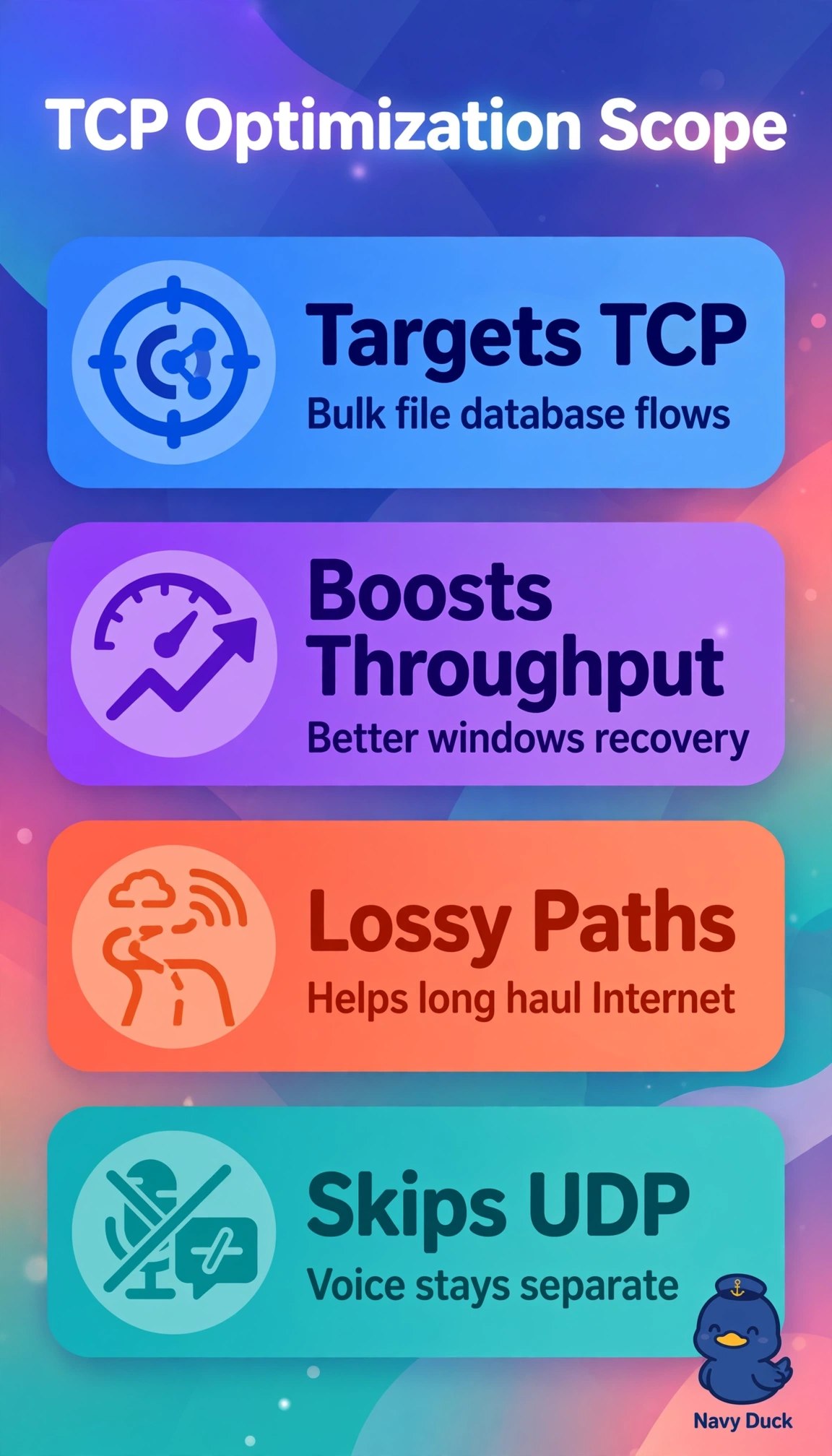
You’re targeting slow, loss-prone file transfers and database sync without changing applications or disturbing voice, so this is a strong fit. TCP optimization boosts bulk TCP throughput on those paths while leaving UDP voice out of scope.
Full Explanation
App-QoE TCP optimization deploys transparent WAN Edge proxies that use larger windows, window scaling, selective acknowledgment, and local retransmission to mask slow start and packet-loss stalls. That lifts file-transfer and database-sync throughput over long-haul, high-loss Internet paths without changing application code, while UDP real-time voice remains out of scope because it is already optimized elsewhere. Tuning application socket buffers is a real performance practice, but it requires host-level or code changes and therefore does not fit a network-side proposal that leaves applications unmodified. Improving both TCP bulk transfers and UDP voice quality over high-loss links describes a broader outcome, but this proposal is TCP-only; TCP proxy mechanics do not resolve UDP jitter and loss as FEC or queuing can. Accelerating TCP bulk transfers over low-loss private MPLS paths does not fit the stated path conditions: stable, low-loss transport rarely has the slow-start and loss-stall penalties that justify optimization here. On exams, distinguish generic WAN optimization from TCP-specific optimization, which excludes UDP. In practice, compare throughput and retransmission counters before and after enabling optimization on the selected WAN Edges, confirm voice queues remain untouched, and verify that no application update was required.