
A global enterprise adopts Multi-Region Fabric with 12 access regions in Americas, EMEA and APAC plus a high-capacity core backbone. Intercontinental spokes suffer suboptimal paths and excessive peering. Which hierarchical design correctly uses regions, border routers, and path selection for scalable inter-region routing?
Select an answer to reveal the explanation.
Short Explanation
You're moving from tangled backroads to hub-and-highway routing. Border routers stitch access regions to the core backbone.
Full Explanation
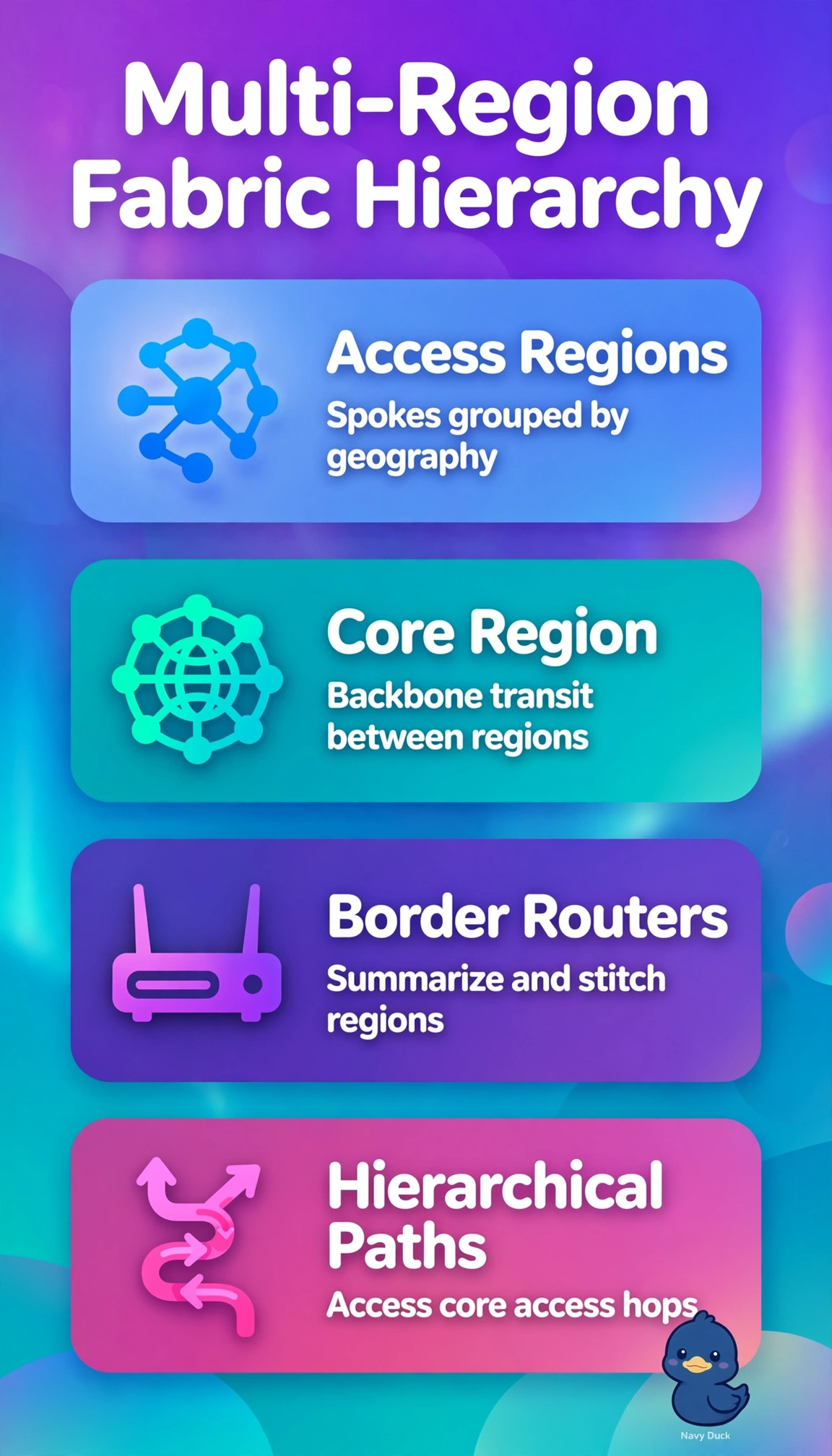
The correct design works because it preserves full hierarchy at global scale: spokes stay contained in access regions for summarization and fault isolation, the high-capacity core provides shared inter-regional transit to avoid n-squared peering, and border routers enforce hierarchical advertisement with centrally guided path selection for optimal intercontinental forwarding. The localized-exit variant is common for hot-potato egress and satisfies regions plus core transit, yet it fails by concept because independent per-region exit decisions lack end-to-end visibility of latency, cost and backbone capacity, so the stated suboptimal intercontinental paths persist. The direct-peering mesh variant is standard in small fabrics and preserves regions plus border-router control, yet it fails by concept because without the core as transit, regions must maintain extensive peering adjacencies, reintroducing the excessive peering and churn that is unsustainable as the number of regions grows. The direct-to-core variant reflects centralized-backbone simplicity and preserves transit plus optimized selection, yet it fails by concept because attaching spokes past access regions collapses hierarchy, flooding the core with spoke routes and losing summarization, isolation and independent scaling. Exam caveat: any mention of core or border routers alone does not earn credit unless regions, core transit, and hierarchical global path selection appear together. Practical check: confirm access-region attachment, border-router summaries, and that intercontinental traceroutes traverse core border hops on globally computed optimal exits.