
A financial firm must send branch Internet traffic to a Secure Internet Gateway provider requiring scalable onboarding, with active-standby resilience if a provider site fails and no per-tunnel manual reconfiguration. Branches run dual transports. Which branch-to-SIG connectivity design meets these needs?
Select an answer to reveal the explanation.
Short Explanation
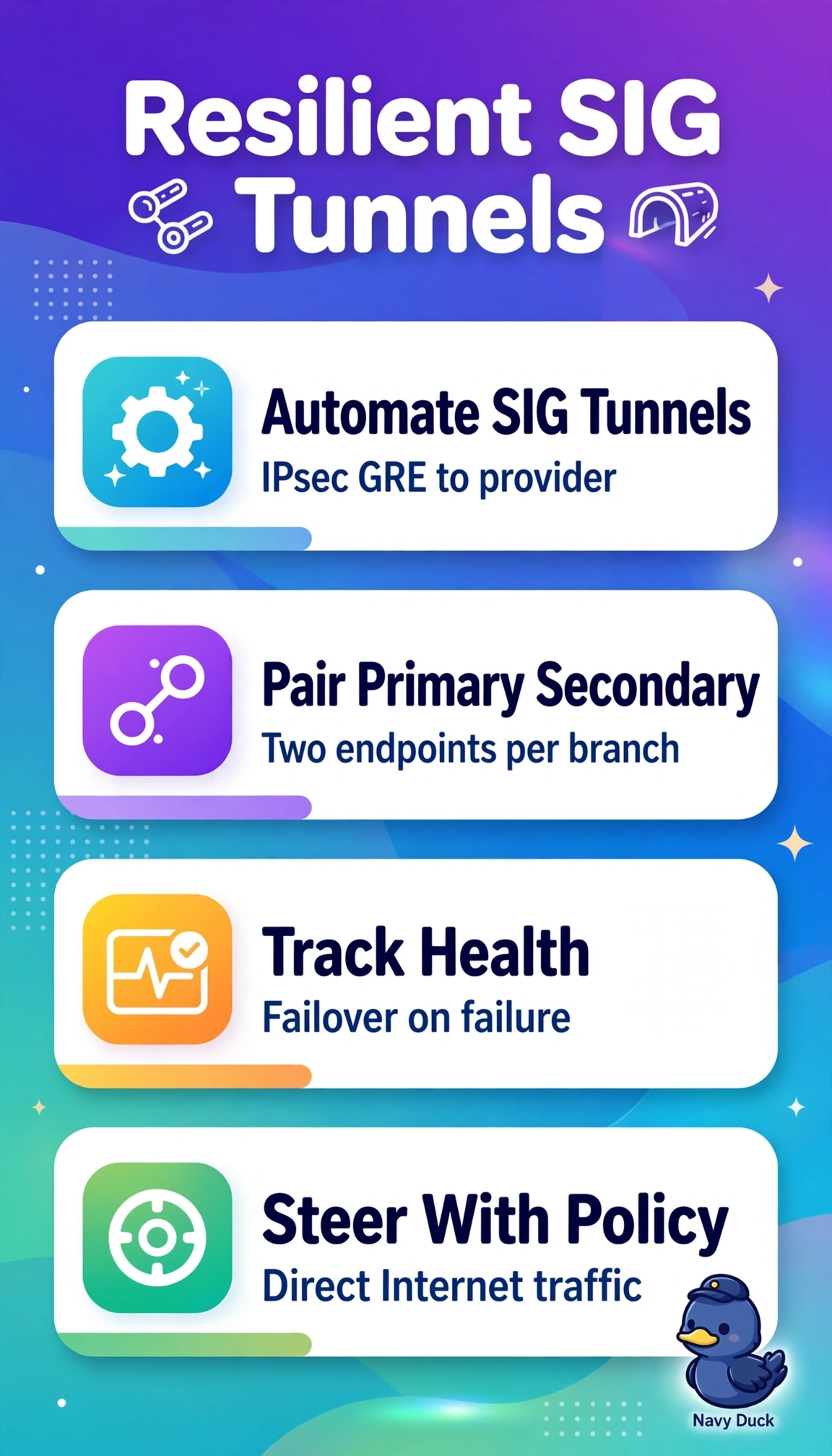
You need safe Internet exits that survive a provider outage without extra work. Use paired tunnels with SIG redundancy and health tracking for automatic switchover. It's like having two guarded exits with signs that flip if one closes.
Full Explanation
The correct design succeeds because automated tunnel creation enables scalable onboarding without per-tunnel configuration while defined primary and secondary endpoints with tracking provide active-standby resilience that shifts traffic automatically if the provider site fails across dual transports. The manual static-routed design offers dual-site reachability and uses both transports yet breaks automation since every branch needs hand-built parameters and manual updates for key or endpoint changes, increasing deployment time and error risk. The primary-only automated design scales and survives local link loss but fails provider redundancy because a single site outage removes inspection for all branches despite healthy transports. The single-transport automated dual-site design preserves automation and provider diversity but violates dual-transport use since one carrier fault or last-mile cut isolates the branch even when both SIGs are healthy. As an exam caveat, separate link failover from site failover because dual transports alone do not meet an active-standby SIG requirement without two tracked provider endpoints. For practical validation, confirm zero-touch tunnel instantiation from templates, simulate primary SIG failure to observe automatic promotion of standby without manual intervention, and shut each transport to prove continued protected egress.