
A global enterprise with 500 sites across Americas, EMEA and APAC suffers suboptimal tromboning when all traffic transits one hub, and needs hierarchical routing with regional isolation. Planners propose Multi-Region Fabric with access and core roles. Which hierarchical path selection design meets the isolation requirement?
Select an answer to reveal the explanation.
Short Explanation
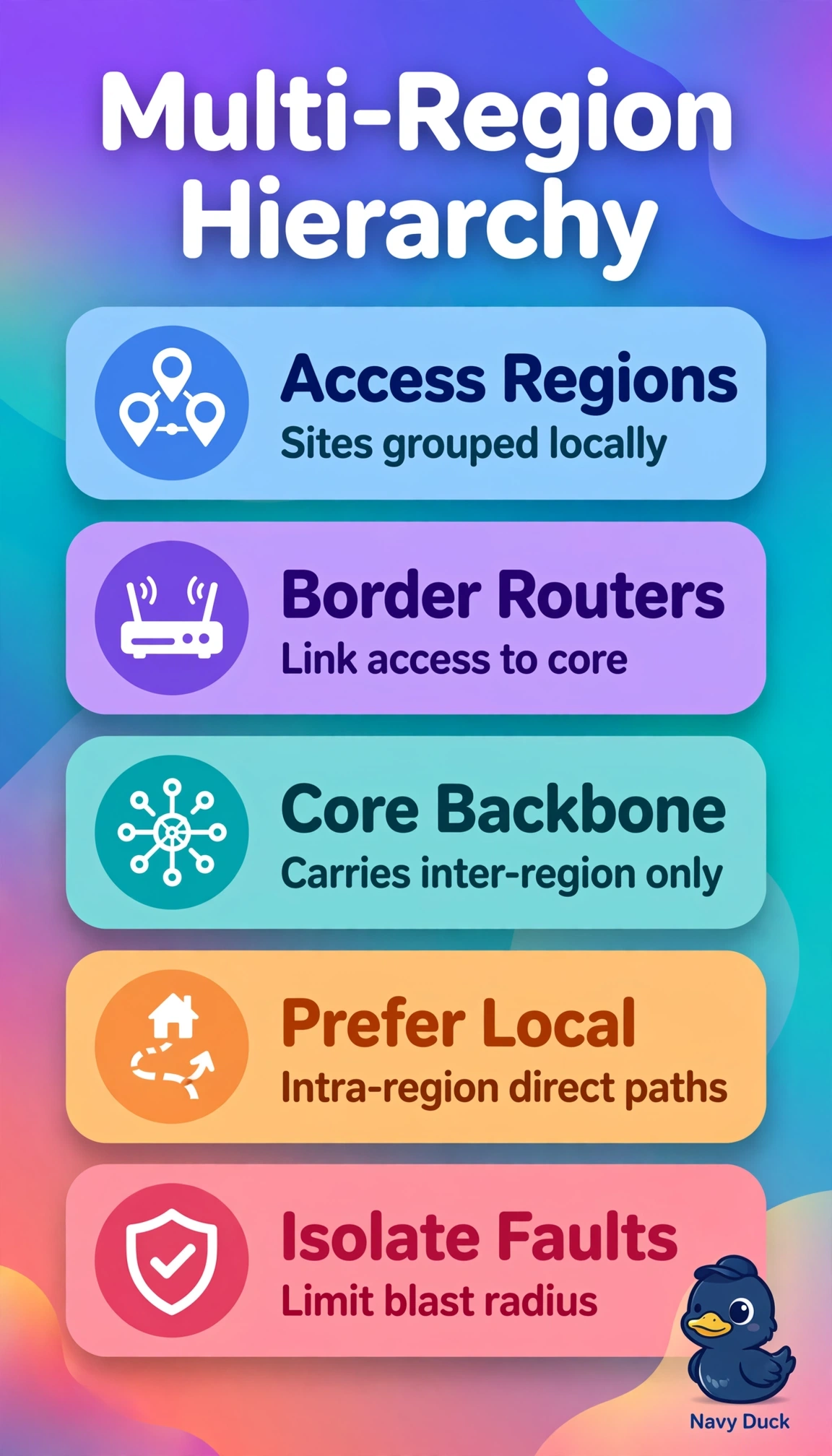
You’ll keep traffic closer to home by grouping sites into regions and letting border routers connect access to the core. Think of local roads for nearby errands and the highway for longer trips: regional isolation keeps intra-region paths preferred while the core handles inter-region traffic.
Full Explanation
Assigning sites to geographic access regions across the Americas, EMEA and APAC, with border routers linking access to core and intra-region paths preferred before core transit, meets the requirement. Local traffic stays local for regional isolation, while inter-region traffic can use the core; this avoids sending all traffic through one hub and supports a scalable hierarchy. Routing all traffic through core transit for centralized inspection retains regions and the access-to-core hierarchy, but reintroduces tromboning and sends intra-region traffic away from local paths. Putting all sites in one access region while preferring local paths before core transit keeps the path preference but removes geographic regional isolation and creates an oversized fault and policy domain for a global enterprise. Peering access regions directly to one another and avoiding core transit may reduce hops, but removes the core role and undermines hierarchical control and inter-region policy enforcement. For the exam, distinguish regional hierarchy from VPN segmentation or centralized management: neither alone provides distinct access regions interconnected by a core. In practice, verify region IDs and access versus border roles on each router, then inspect routing tables and traceroutes to confirm same-region flows avoid core nodes and cross-region flows transit the core as intended.